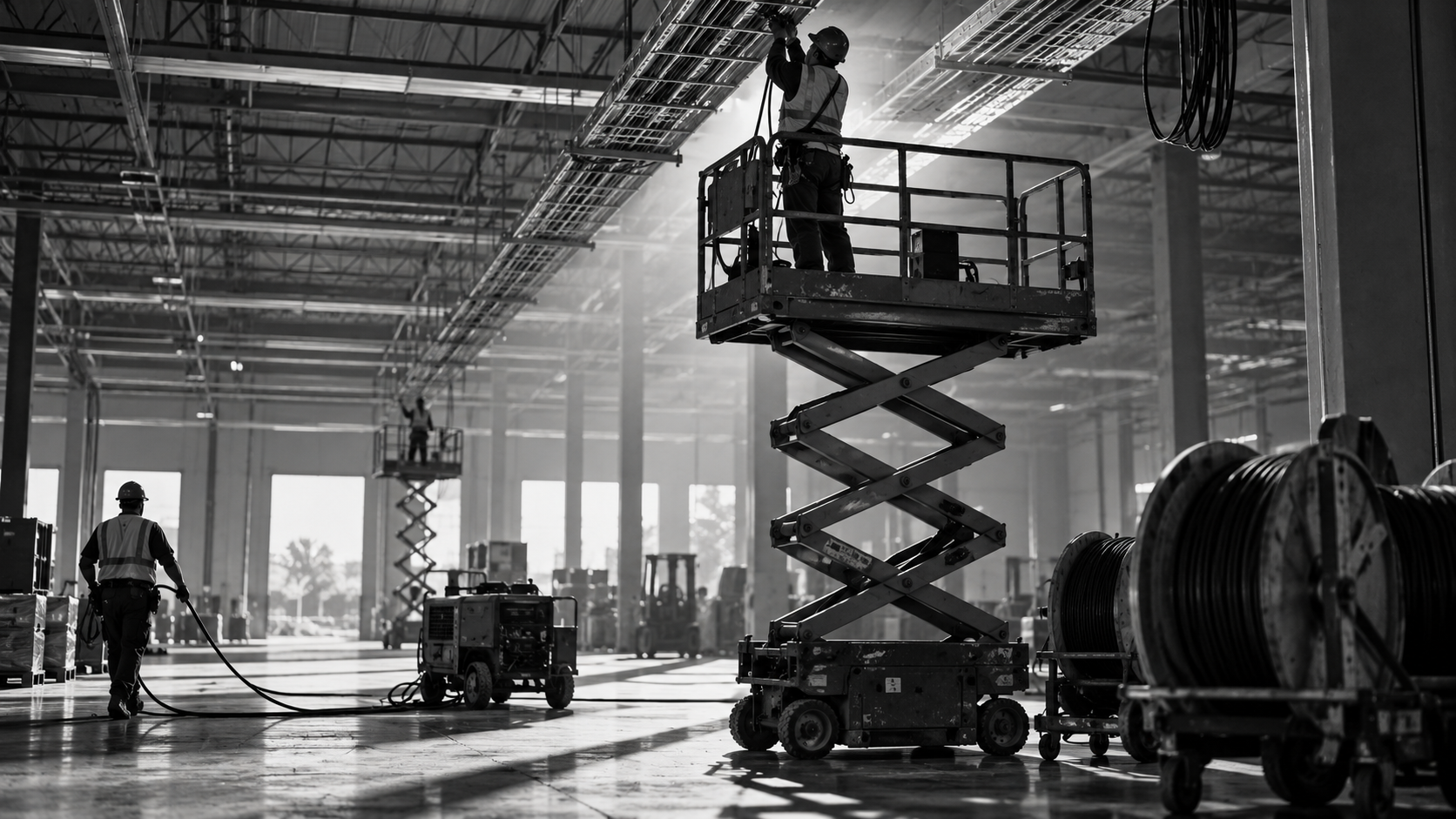
"Learn how to choose the right warehouse network cabling equipment in 2026. Discover tips for selecting scissor lifts, cable pullers, and installation tools."
Related reading: Choosing the Right Scissor Lift for 35-Foot Ceilings (2026), How to Rent the Right Warehouse Network Cabling Equipment, and Best Lifts for Finished Concrete Floors: Rental Guide 2026.


Get the latest GoDizel content delivered straight to your inbox
Don't get stuck in the 32-foot trap. Learn why a 35-foot ceiling requires a 40-foot scissor lift for safety and reach in 2026. Expert guide to lift sizing.
Learn how to rent the right equipment for warehouse network cabling in 2026. Discover how to choose the best scissor lifts and cable pullers for your project.
Warehouse network cabling equipment rental starts with one measurement that contractors often underestimate: ceiling height. Before you search for a lift on Dizel or anywhere else, pull out your laser measurer and record the maximum height of every cable tray run, conduit pathway, and junction point in the facility. That single number drives every access equipment decision that follows.
Use these criteria to select the right aerial work platform for your network cable installation:
Match lift class to ceiling height. A [compact electric scissor lift for data cabling](https://www.godizel.com/product/electric-scissor-lift-13-14-50b7) handles runs up to 13–14 feet, while mid-range ceiling heights typically require a [20-foot platform](https://www.godizel.com/product/20-electric-scissor-lift-b5ee). Ceilings above 22 feet demand a 26-ft model.
Verify slab load ratings. Confirm floor load capacity before staging any electric scissor lift. Exceeding rated capacity risks permanent slab damage and site shutdowns.
Require non-marking tires. Specify non-marking tires in your rental agreement to protect finished concrete or epoxy-coated warehouse floors.
Account for NEC clearance. NEC standards mandate a 12-inch minimum access space above cable tray installations — factor that into your working height calculation before you confirm the lift spec.
Budget for duration. The national average cost for renting a scissor lift runs approximately $223 per day, and weekly rentals typically deliver a 55% daily savings — a meaningful line item on any warehouse cabling project that spans multiple days.
With access heights confirmed and your lift class locked in, the next decision is the pulling and handling equipment that moves network cable efficiently across long backbone runs.
Once your lift spec is confirmed — whether that's a compact unit for lower runs or a battery-powered platform reaching 33' for high-bay backbone pathways — the equipment should shift to what actually moves the cable.
Here's what a complete pulling and handling kit looks like for a warehouse network cabling project:
Rent an industrial cable puller rental rated at 6,000 lbs minimum. Long backbone runs in a cable warehouse environment generate significant tension. A 6,000-lb electric puller handles heavy conduit pulls without overstressing the cable jacket or violating TIA-568.2-D handling requirements for balanced twisted-pair cabling.
Add a cable blower for conduit runs to interior modular offices. Warehouses frequently include internal modular buildings. A cable blower uses compressed air to float the cable through conduit — dramatically faster than hand-pulling and far less likely to introduce bend-radius violations.
Pair a cable feeder at the source end. Feeders control pay-out speed and prevent the reel from free-spinning, which protects the jacket and keeps tension consistent across the entire run.
Include a cable lasher for overhead messenger wire applications. Where cable runs along messenger wire rather than through conduit, a lasher wraps the cable uniformly — maintaining proper tension and staying compliant with NEC Article 300 support requirements.
With your pulling kit confirmed, every drop still needs to be verified before close-out — which brings us to testing and certification.
With your pulling and handling equipment confirmed, the final rental category contractors most often skip — and later regret — is verification gear. Every drop you run needs to be tested before you hand the GC a close-out package, and the stakes are high: 57% of new cabling installations fail first-pass certification, according to BICSI data. That's not a rounding error — it's a project delay waiting to happen.
Here's how to build testing into your rental plan before you ever pull cable:
Rent a DSX-series cable analyzer rated for the cable category you're installing. This class of tester certifies RJ45 drops against TIA-568.2-D performance limits and generates the pass/fail reports your GC actually needs at project close-out.
Confirm the tester firmware is current for current standards before it ships to your job site. An out-of-date calibration profile can produce passing results that fail third-party verification — the exact outcome you should rent proper equipment to avoid.
Test every drop individually. Spot-checking a sample run is one of the most common patterns behind that 57% failure rate. Full-coverage testing, especially in long industrial cable runs across high-bay spans, catches marginal pairs that a spot check misses.
Document results immediately after each test session. Export the reports directly from the analyzer to a shared drive so the GC has a timestamped certification record — no scrambling at final walkthrough.
If you need to reposition the tester between cable tray runs at height, pair it with a compact battery-powered platform to keep your tech mobile without compromising safety. With your full equipment list locked — access, pulling gear, and testing tools — the next step is sourcing all of it efficiently through a digital marketplace.
With your access, pulling, and testing equipment all specified, the final step is actually booking it — efficiently, without the back-and-forth that eats into mobilization time. A digital marketplace like Dizel lets you search by equipment capacity and job-site location simultaneously, so you're not sifting through listings that can't reach your site within your schedule.
Here's how to run through the procurement process without surprises at invoice time:
Search by capacity and location first. Filter by the lift height and cable puller tension rating you confirmed in earlier steps. If you're still asking "what size scissor lift for warehouse cabling is right for my job?" — start with your max working height plus the required safety clearance, then match that to available units nearest your site to cut delivery costs.
Review all-in pricing before you commit. Expand each listing to confirm delivery, fuel, and damage protection fees are visible upfront. Hidden fees are where rental budgets break down — you should see a complete cost before checkout, not after.
Bundle equipment in a single transaction. Add your scissor lift, cable puller, and any additional handling gear to one order where the platform allows. A single purchase order simplifies your project accounting and reduces the coordination overhead of managing multiple vendor contacts.
Align delivery scheduling to your crew's mobilization date. Confirm the low-voltage subcontractor's start date first, then schedule delivery for the morning prior. Equipment sitting idle on-site for two days is real money — rent run periods should be tight and intentional.
Handled this way, procurement becomes a decision you make once and document cleanly — not a recurring distraction. That cleaner process sets up your close-out package for success, which is exactly where the final section pulls everything together.
Running network cable through a warehouse isn't a task you can improvise on-site. Every decision — from lift class to cable tray installation tools to certification gear — compounds into either a clean close-out or a costly rework. Here's how to lock in the right approach before mobilization:
Prioritize weekly rental terms for scissor lifts. Daily rates add up fast on multi-day backbone runs. Weekly rates typically deliver significant savings — a line item that's easy to justify when ceiling heights require consistent elevated access throughout the project.
Verify the 12-inch NEC clearance before any tray goes up. This is one of the most common warehouse installation failures. Confirm clearances during your site walk, not after the crew is already on the lift.
Rent certification-grade testers for every run. Don't assume pulls are clean. The failure rate for new cabling in industrial installs is high enough that skipping verification isn't a calculated risk — it's a liability.
Use a centralized digital marketplace to rent all equipment in one pass. Coordinating across multiple vendors introduces scheduling gaps, hidden fees, and wasted mobilization time. A single platform search eliminates that friction entirely.
Handled correctly, your warehouse equipment strategy becomes a competitive advantage — faster scheduling, tighter budgets, and a close-out package the GC can sign off without pushback. Dizel gives you the search depth to execute that strategy from one place.
Warehouse network cabling equipment rental starts with one measurement that contractors often underestimate: ceiling height.
Match lift class to ceiling height.
Rent an industrial cable puller rental rated at 6,000 lbs minimum.
With your pulling kit confirmed, every drop still needs to be verified before close-out — which brings us to testing and certification.
With your pulling and handling equipment confirmed, the final rental category contractors most often skip — and later regret — is verification gear.


