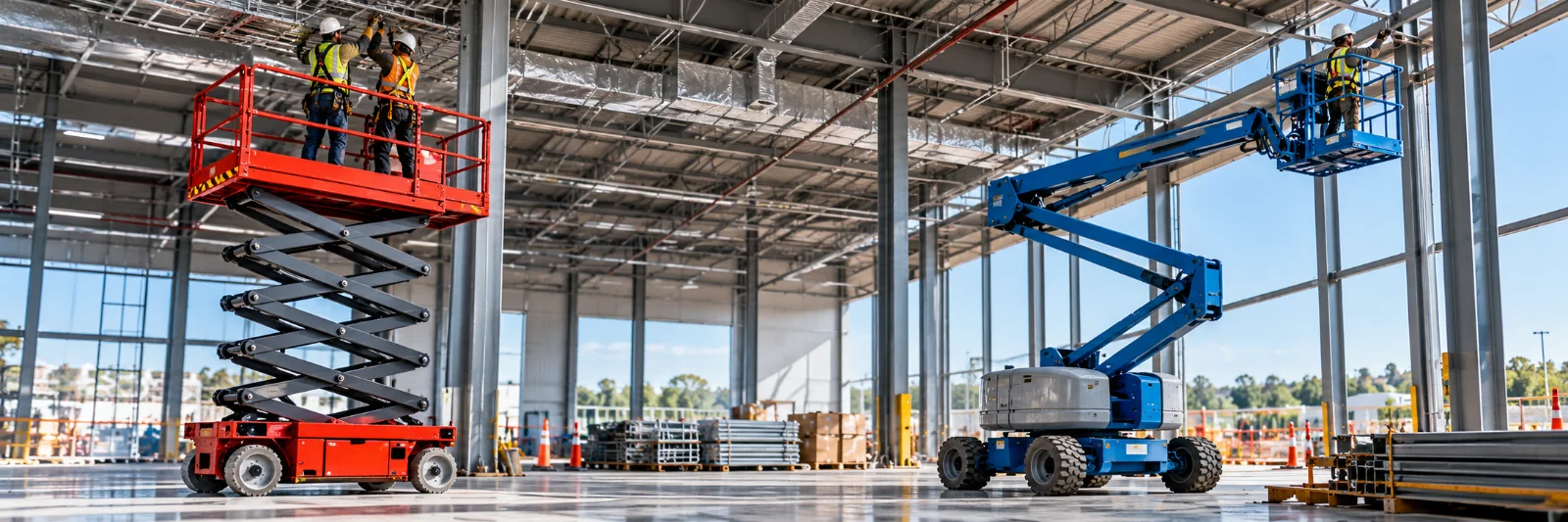
"Struggling to choose between a scissor lift and a boom lift? Learn the key differences to pick the perfect aerial lift for your 2026 construction project."
Related reading: How to Rent the Right Lift for Warehouse Security Camera Installation, How to Streamline Equipment Procurement for Multiple Job Sites Without Managing Separate Rental Agreements, and How to Rent Storm Cleanup Equipment After a Hurricane in 2026.


Get the latest GoDizel content delivered straight to your inbox
Learn how to rent the right lift for warehouse security camera installation in 2026. Compare scissor and boom lifts to meet OSHA safety requirements.
Learn how to consolidate equipment procurement across multiple job sites. Stop managing separate rental agreements and optimize your fleet management today.
The wrong lift on site doesn't just slow a crew down — it forces a mid-project swap, a second delivery fee, and a day of lost production. Most of those mistakes trace back to one misunderstanding: treating height as the only variable that matters.
A scissor lift is a Mobile Elevating Work Platform (MEWP) that raises a guarded platform straight up on a crossed-brace mechanism, moving only vertically from its footprint. That constraint is the whole story. The platform rises directly above the chassis and nowhere else, which means the machine has to be positioned squarely beneath the work. If a column, a stack of material, or a mechanical unit sits between the wheels and the target, the lift can't solve it.
What you get in exchange is capacity. Scissor platforms are wide and long, holding two or three workers plus pipe, conduit, drywall, or fixtures without crowding. Extension decks slide forward to add roughly three to five feet of reach over a small obstruction — enough to clear a wall base or a curb, not enough to clear a structure.
That profile makes a scissor lift for construction the default on interior work: HVAC rough-in, ceiling grid, sprinkler heads, lighting, and anything repetitive across a flat finished slab.
A boom lift answers the question a scissor lift can't: what if you can't park directly under the work? The machine mounts a platform on a hydraulic arm extending from a rotating turntable, so the basket travels up, out, and around obstructions while the chassis stays put. That horizontal envelope — not the maximum height — is the reason to rent one.
Two configurations dominate specification sheets:
Telescopic (straight) booms — a single extending arm delivering maximum horizontal distance in a straight line. Best for open sites, steel erection, and spans across excavations or landscaping.
Articulating booms — multiple jointed sections that fold and bend around corners. An articulated boom lift reaches up and over roof edges, piping, and parked equipment; this is why an articulating boom lift for construction wins on congested or retrofit sites.
Tail swing is the factor that gets overlooked. As the turntable rotates, the counterweight sweeps behind the chassis, and on non-zero-tail-swing models that arc can pin a worker against a wall, vehicle, or barricade. Boom work demands a cleared radius, not just a cleared pad.
The risk profile follows the complexity. Self-propelled boom lifts (3b) were involved in 26% of fatal and major incidents in 2025, which is an argument for machine-specific operator training rather than general MEWP familiarity.
Lift Type | Fall Protection Required | Primary Risk |
|---|---|---|
Scissor lift | Guardrail system; harness generally not mandated when rails are intact and in place | Tipover on slope, soft ground, or debris |
Boom lift (telescopic or articulating) | Full-body harness with lanyard attached to the manufacturer's anchor point | Ejection from basket; crushing from tail swing |
This is the compliance distinction crews most often get backwards. Under OSHA 29 CFR 1926.453, a boom-supported platform requires a body belt or harness with a lanyard attached to the boom or basket — no exceptions for short duration. A scissor lift is treated differently because its guardrail system is the fall protection, so harness use is a site-policy decision rather than a blanket federal mandate. Writing "harness always required" into a job hazard analysis for scissor work isn't conservative; it creates a tether that can complicate egress.
The risks diverge the same way. Boom baskets can catapult an unrestrained operator when the arm contacts structure or the chassis drops into a void. Scissor lifts fail by going over. Tipovers account for 56-59% of scissor-lift fall incidents, and fatal overturns involving MEWPs increased by 50% between 2021 and 2023 — which is why ground condition verification belongs in the rental decision, not the morning huddle. ANSI/SAIA A92 classification language should match what's on the order.
Run these four questions before anyone books a machine. The answers settle the lift boom vs scissor debate faster than a spec sheet comparison.
Is the work directly overhead, or at an angle? If the crew can stand beneath the target with clear floor around it, a scissor lift does the job with less setup. If the approach is lateral — over a roof edge, across a mechanical pad, past a structural column — only a boom reaches it.
What is the combined weight of workers, tools, and materials? Add the people, the material staged on the deck, and the tools. Scissor platforms typically carry more total weight than a boom basket, so heavy-material tasks like glazing or ductwork favor them. If the number approaches the rated capacity, size up rather than making two trips.
Is the terrain finished concrete or rough, uneven soil? Slab-on-grade and polished floors suit standard slab scissors. Grade changes, gravel, or compacted fill call for rough-terrain tires and outriggers.
Are there overhead obstructions? Map power lines, rafters, pipe racks, and joists first. Obstructions dictate stowed height, boom articulation, and minimum approach distance to energized conductors.
Power source and tire package decide where a machine can legally and physically work. Getting this wrong is the most common cause of a rejected delivery.
Battery-electric drives produce no exhaust and little noise, making them the only practical option inside occupied buildings, hospitals, and finished retail space. Non-marking tires protect sealed concrete, terrazzo, and epoxy coatings from the black scuffing that standard rubber leaves behind. Check floor loading before a machine goes on an elevated deck — point loads from a compact scissor are manageable, but a boom lift carries a heavier chassis to counterbalance the extended arm, and that mass concentrates through four wheels.
Diesel power delivers the torque needed to climb grade, cross compacted fill, and run full shifts without a charge cycle. Rough-terrain tires with aggressive tread, four-wheel drive, and oscillating axles keep the chassis level on uneven ground. Outriggers extend the effective footprint, which means the staging area has to be larger than the machine itself.
Terrain mismatch carries real consequences: IPAF recorded 100 reported fatalities involving powered access equipment globally in 2024.
Aerial lift selection 2026 comes down to four decisions a project manager can make from the plan set.
Choose a scissor lift when the work sits directly overhead, the ground is flat and stable, and the platform needs to hold multiple workers plus material. Vertical-only travel is a limitation on complex sites and an efficiency gain on open ones.
Choose a boom lift when you must reach over, around, or past an obstruction, need height a scissor can't deliver, or are working across uneven terrain. The horizontal envelope is what you're paying for.
Verify floor load limits in writing before any boom lift goes indoors or onto an elevated slab. Confirm the machine's operating weight against the structural engineer's rating, not against what fit last time.
Confirm operator certification matches the machine class. Familiarity with a scissor lift does not qualify an operator on a self-propelled boom; the controls, the tail swing, and the fall protection obligations are different.
The reach envelope — the actual geometry of vertical versus horizontal movement the task demands — determines which one you need. Height alone never does.
Knowing which machine you need is the easy half. The hard half is finding one available, on your dates, at a price you can defend to the owner — without spending an afternoon on hold with four rental yards.
Dizel puts scissor and boom lift availability from multiple yards in one search, so procurement teams can compare a 26-foot electric slab scissor against a 45-foot articulating boom side by side instead of sequentially. Pricing shows up as all-in: rental rate, delivery, and pickup together, which removes the invoice surprise that shows up two weeks after the machine leaves your site.
Specification filters handle the details that determine whether a delivery gets accepted — non-marking tires, articulating jib, rough-terrain package, zero tail swing. AI-driven search support lets a project manager describe the constraint in plain terms and get back machines that actually meet it, rather than scrolling a generic category page.
Rental yards keep control of their own pricing, and contractors stop guessing at market rates. Search your equipment on the Dizel marketplace, compare what's actually available near your site, and lock in 2026 pricing before your crew is standing around waiting on a machine.

