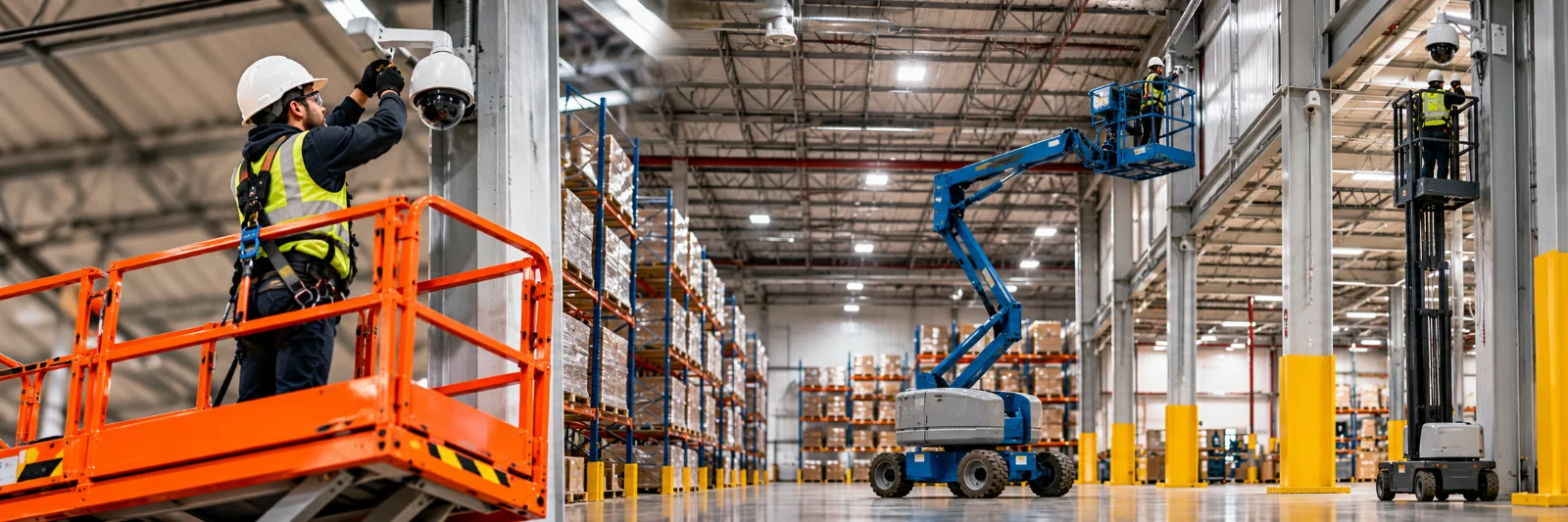
"Learn how to rent the right lift for warehouse security camera installation in 2026. Compare scissor and boom lifts to meet OSHA safety requirements."
Related reading: Choosing Between a Scissor Lift and a Boom Lift for Your 2026 Project, How to Streamline Equipment Procurement for Multiple Job Sites Without Managing Separate Rental Agreements, and How to Rent Storm Cleanup Equipment After a Hurricane in 2026.


Get the latest GoDizel content delivered straight to your inbox
Struggling to choose between a scissor lift and a boom lift? Learn the key differences to pick the perfect aerial lift for your 2026 construction project.
Learn how to consolidate equipment procurement across multiple job sites. Stop managing separate rental agreements and optimize your fleet management today.
Measure the exact mounting point before you price a single machine. Pull a laser measurement from the finished floor to the ceiling joist, racking upright, or wall bracket where each camera lands. Record the tallest mounting point on the job — that number drives the entire rental decision.
Then convert that measurement into a lift spec:
Measured mounting height — floor to the camera bracket, not floor to ceiling deck.
Add working clearance — a technician standing on the platform reaches roughly 6 feet above it, so working height equals platform height plus 6 feet.
Subtract obstructions — HVAC ducts, sprinkler mains, and high-bay fixtures reduce usable vertical travel at the exact spot you need it.
Confirm the result against available models — order platform height, not working height, or you'll rent two sizes too large.
In industrial and warehouse settings, the ideal height for security cameras is between 10 and 12 feet to provide a broader view while deterring tampering. That means most of this work is handled by a compact electric unit. The average national rental cost for a scissor lift is $223 per day, with compact 19-foot electric units starting as low as $56 per day — so oversizing is pure margin loss.
The scissor lift vs boom lift for cameras question comes down to one thing: whether anything sits between the lift's wheels and the mounting point.
Lift Type | Best Use Case | Movement Style |
|---|---|---|
Electric scissor lift | Straight vertical access in open bays and narrow aisles | Vertical only, platform rises directly above the chassis |
Articulating boom lift | Mounting over racking, conveyor lines, or fixed equipment | Vertical plus horizontal reach with an articulating "knuckle" joint |
Vertical mast lift | Single-tech camera work in tight dock areas | Vertical only, smallest footprint |
Pick a scissor lift when the camera bracket sits directly above floor you can drive on. Measure your narrowest aisle — including pallet overhang, not just the rack frame — and compare it against the machine's stowed width and turning radius. A 30-inch scissor fits aisles that stop a 48-inch unit cold.
Pick an articulating boom when racking, a conveyor run, or stored inventory blocks the floor beneath the mounting point. The knuckle lets the platform clear the obstruction and come back in over it.
Confirm non-marking tires on whichever unit you book. Standard black rubber will streak sealed and epoxy-coated warehouse floors, and the tenant will bill you for the restoration.
Run this checklist before the rental is confirmed. Every item is a condition of the booking, not a field adjustment.
Electric power source only. Battery-electric drive is the requirement for enclosed warehouse work — it eliminates exhaust in a space with no mechanical ventilation designed for it.
No internal combustion units indoors. Diesel and gas lifts generate carbon monoxide that accumulates fast in a closed envelope. Never accept an IC machine as a substitute when your electric unit is unavailable — reschedule instead.
Trained and authorized operators. OSHA warehouse lift requirements 2026 still hinge on documented aerial lift training for every person who operates the platform. Collect certification cards before mobilization.
Fall protection anchor points. Boom lift work requires a full-body harness tied to the manufacturer's designated anchor. Scissor lifts rely on the guardrail system, so confirm the chains and gates function.
Pre-shift inspection record. Brakes, controls, emergency lowering, and tire condition documented before the first lift.
The stakes justify the paperwork: 20% of fatal warehouse accidents are falls from platforms. Proper lift selection and enforced compliance are what keep a camera install from becoming a recordable.
Renting electric manlifts for warehouses doesn't require a morning of phone tag. Run the procurement digitally:
Enter your job site ZIP and dates to pull live availability from rental yards actually serving that market.
Filter by platform height, power source, and width using the specs you calculated in Steps 1 and 2.
Compare all-in pricing across providers — confirm delivery, pickup, and damage protection are included in the quoted number before you commit.
Check the machine's maintenance and inspection status with the yard. There were 1,380 aerial lift injuries recorded between 2011 and 2014, and equipment condition is the variable you control at booking.
Schedule delivery for the day before installation so the crew starts at 7 a.m. instead of waiting in the parking lot.
Book through checkout to lock member pricing and manage extensions, swaps, and the return from one interface.
Price transparency is the point. When the rate you see is the rate you're invoiced, you can bid the camera install with a real equipment line item instead of a padded guess — and you stop absorbing fees nobody disclosed on the phone.
Here's the complete framework for how to rent a lift for security cameras in a warehouse, condensed to what you need at the bid table:
Add 6 feet to platform height to get working height. Order on platform height — that's the spec rental yards list.
Target the 10-to-12-foot mounting band. A 19-foot compact electric unit covers the overwhelming majority of warehouse camera work.
Electric power is non-negotiable indoors. No IC engines in an enclosed building, no exceptions, no substitutions.
Scissor lifts for open aisles, articulating booms for reaching over racking and conveyors. Measure your narrowest aisle before you choose.
Non-marking tires and documented operator training protect the floor and your OSHA record simultaneously.
Get the warehouse camera installation lift right the first time and the job runs one day instead of three. Get it wrong and you're paying redelivery on a second machine while your electrician stands idle.
See the Real Rental Price Before You Make a Single Call. Run your specs through Dizel and book the unit that matches the building.

