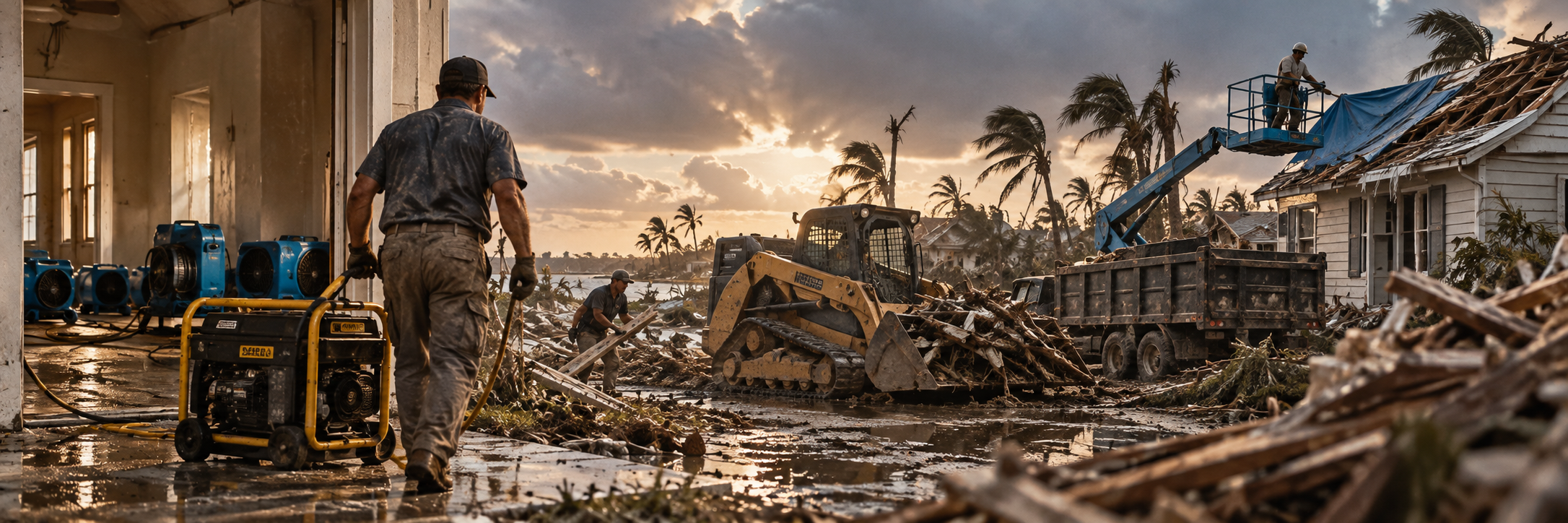
"Learn how to rent storm cleanup equipment effectively in 2026. Follow our guide to secure essential restoration tools and prevent long-term property damage."
Related reading: How to Rent and Set a Commercial Generator in 5 Steps, Rent vs. Buy a Skid Steer: Is Ownership Worth It for 10 Uses a Year in 2026?, and How to Rent the Right Trencher for a 24-Inch Deep Trench.


Get the latest GoDizel content delivered straight to your inbox
Learn how to rent and set a commercial generator for your site. Follow our 5-step guide to calculating loads, choosing equipment, and ensuring safe power.
Should you rent or buy a skid steer for 10 uses a year? We break down the maintenance costs and ownership math to help you make the right choice in 2026.
The first 48 hours after landfall decide whether a structure dries out or becomes a gut job. Mold colonizes wet drywall fast, so interior stabilization outranks yard debris every time. Demand for emergency restoration equipment rental spikes the moment a storm clears — Hurricane Helene caused $78.7 billion in damages in 2024, and the Red Cross committed $42.9 million for relief by late 2024, an influx of resources that competes directly for the same local drying inventory you need.
Having owned and operated a restoration company for many years, this was something I saw firsthand after major water losses and storms. The first priority was always stopping the damage from getting worse and getting the drying process moving. After a large event, equipment availability could disappear incredibly fast because every restoration contractor in the area was looking for the same dehumidifiers, air movers, and generators at the same time.
Reserve high-capacity dehumidifiers and air movers sized to the building envelope, not the room count.
Rent portable or industrial-grade generators to power drying equipment before grid restoration.
Deploy moisture meters and record a baseline reading for hidden dampness in drywall cavities and subfloors.
Run drying fans continuously until meter readings confirm safe moisture levels, logging hours daily.
Skip the moisture meters and you have no proof the structure dried. Start your hour logs immediately — FEMA’s reimbursement rate for a 2023 pickup truck used in disaster work is $15.29 per hour, and undocumented hours don’t get paid.
One thing restoration taught me is that documentation can feel like overkill while you’re doing it, but you almost never regret having too much of it. Moisture readings, photos, equipment logs, delivery tickets, and daily notes become incredibly important when someone asks you weeks or months later to prove what happened on the job.
Storm-saturated soil won’t hold a ladder foot, and tarping a roof takes both hands. Aerial access is the safest line item in your storm damage restoration equipment package, and it moves crews faster than any ladder setup.
After a storm, speed matters, but trying to save time with the wrong equipment usually does the opposite. I saw this plenty of times in restoration. A crew trying to make a ladder or the wrong piece of equipment work can lose hours and create a safety issue in the process. Having the right access equipment on site lets the crew focus on the work instead of figuring out how to reach it.
Rent a towable boom lift in the 30- to 50-foot range to give crews a stable platform for two-handed tarping and shrink-wrap work.
Tow the unit into position on firm ground, extend and pin all outriggers, and confirm level before elevating.
Clear gutters, valleys, and rooflines of limb debris early — trapped material backs up drainage and drives water into the structure you just started drying.
Verify every operator holds current OSHA aerial platform certification before the first lift cycle.
Safety warning: Wind conditions stay unstable for days after hurricane passage. Check the manufacturer’s maximum wind speed rating for the platform and shut down aerial work when gusts exceed it. More guidance on towable lift selection is worth reviewing before you spec the fleet.
Once interior drying is running and metered, shift crews to site-wide clearing and scale your hurricane cleanup equipment rental accordingly.
This is also where sequencing starts to matter. From my years running a restoration company, I would much rather have equipment arriving when the crew is actually ready to use it than have expensive machines sitting on rent waiting for another phase of the job to finish. After a storm, it is easy to fall into the trap of trying to secure everything at once because you’re worried it won’t be available later.
Skid steers and compact track loaders (CTLs) — the default choice for residential lots, tight commercial sites, and soft ground where wheeled machines sink.
Excavators — for heavy lifting, downed structural members, root balls, and obstructions no loader will move.
Grapple buckets — mount them on the CTL for tree limbs and brush; a standard bucket wastes passes on material a grapple picks clean in one.
Dump trailers and haul trucks — sized to the volume you’re generating, not the volume you hope for.
Coordinate machine arrival with the municipal debris pickup schedule. Staging material curbside before pickup begins means handling it twice, and double-handling is the fastest way to burn reimbursable hours on nothing.
Attachments are another small detail that can make a huge difference. I’ve seen plenty of situations where the machine itself was capable of doing the work, but the wrong attachment turned what should have been a straightforward cleanup into a slow process. On storm work especially, the goal isn’t just getting a machine. It’s getting the right setup for what the crew is actually moving.
Hurricane Helene caused $78.7 billion in damages in 2024 — a figure that tells you exactly how thin regional machine inventory gets when a major storm lands.
Procurement and paperwork run in parallel. A machine you can’t document is a machine you paid for twice.
This part hits home for me because I spent years dealing with the operational side of restoration. When a major event hits, your project managers already have more going on than they can reasonably keep up with. Crews, customers, insurance companies, subcontractors, drying equipment, schedules, documentation, and new losses are all competing for their attention. Equipment procurement becomes another job on top of the actual job.
Search a digital marketplace for real-time availability instead of working a call list of yards; storm cleanup equipment rental inventory turns over hourly, and phone tag loses you the asset.
Confirm all-in pricing before signing — delivery, pickup, damage protection, environmental fees. Post-storm invoice surprises are the norm when rates are quoted verbally.
Log machine hours by task, separating debris removal from structural repair work. Mixed logs stall claims.
Photograph equipment on site with date stamps, and keep signed delivery tickets with the hour meter reading at drop-off and return.
FEMA’s Public Assistance Program reimburses equipment by the hour against published rates — the rate for a 2023 pickup truck used in disaster work is $15.29 per hour. Hours you didn’t record are hours you can’t claim.
Standardize this documentation format across every disaster cleanup equipment rental your firm places, so multi-zone operations file identically.
This is actually part of what eventually led me to build Dizel. I lived the equipment procurement problem as a contractor. When you’re trying to run jobs, having someone spend hours calling rental companies asking what they have, what it costs, and whether they can deliver it is a terrible use of their time. I knew there had to be a better way to search the market.
Key takeaways:
Stabilize first. Dehumidifiers, air movers, and generators are the only priority in the first 48 hours.
Work safe at height. Towable boom lifts replace ladders for every roof-level task on saturated ground.
Scale third. CTLs, excavators, and grapple buckets move in once interior moisture readings are trending down.
Document continuously. Task-level hour logs and all-in rental contracts protect your reimbursement position.
Procure early. Check GoDizel for real rental prices and live availability before regional inventory bottoms out.
Scarcity is the defining condition of post-storm procurement. The Red Cross committed $42.9 million for relief by late 2024, and that kind of resource surge pulls every available machine within a day’s haul into the affected zone. Contractors who rent storm cleanup equipment in sequence — drying gear, then aerial access, then earthmoving — secure the scarce assets while competitors are still dialing yards.
After years in restoration, that sequence makes a lot of sense to me. Storm response can feel chaotic because everything seems urgent at the same time. But the best operations I saw were the ones that could prioritize what actually needed to happen next. Protect the structure. Get it drying. Make the property safely accessible. Then bring in the equipment needed to scale the cleanup.
That experience is also a big part of why I built Dizel. Contractors shouldn’t have to work through a call list every time they need a machine. Search what you need, compare the available options, understand the price, and get back to running the job.
Sequence the fleet, log the hours, and the recovery schedule holds.

