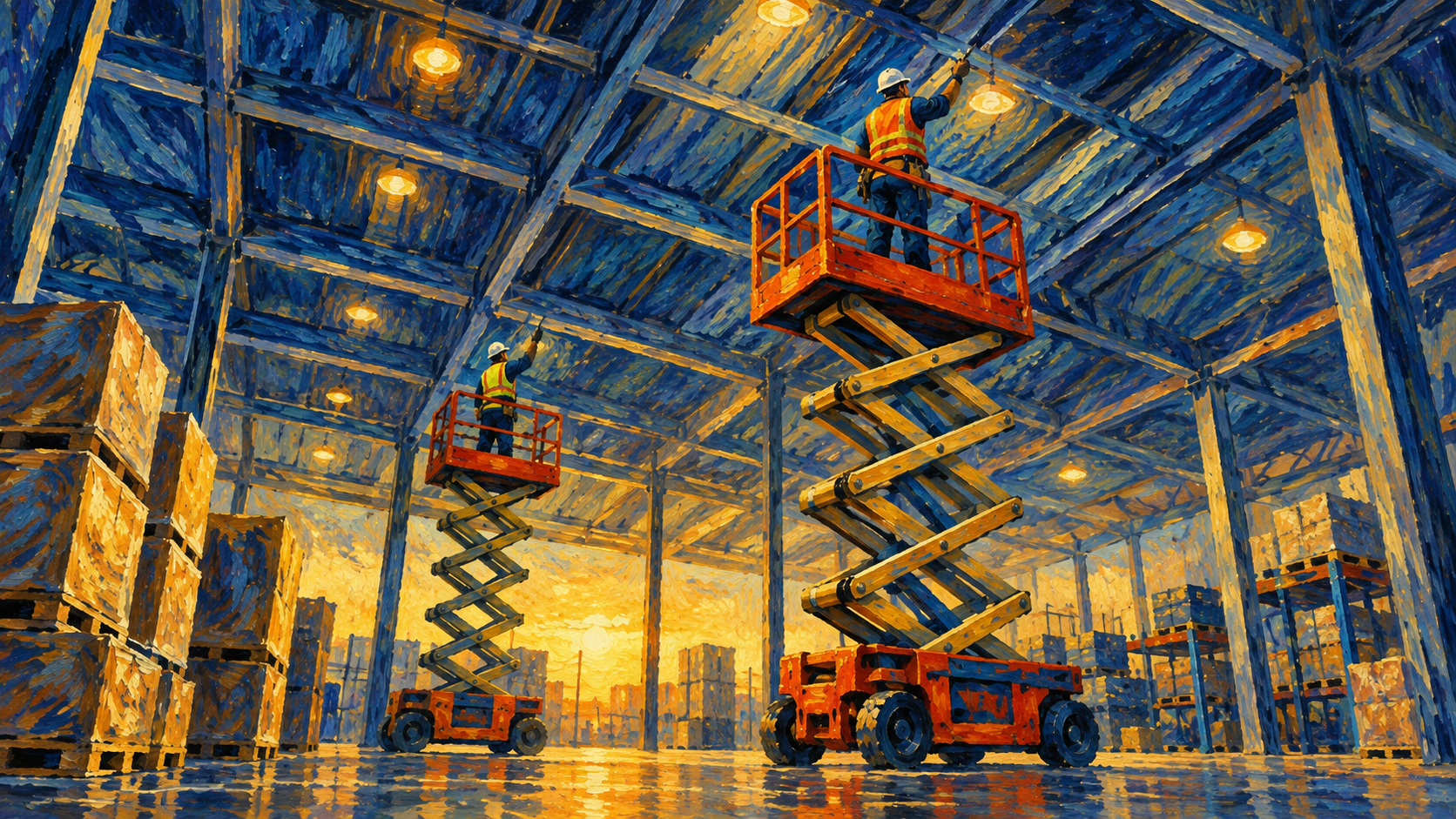
"Don't get stuck in the 32-foot trap. Learn why a 35-foot ceiling requires a 40-foot scissor lift for safety and reach in 2026. Expert guide to lift sizing."
Related reading: How to Rent the Right Equipment for Warehouse Cabling 2026, How to Rent the Right Warehouse Network Cabling Equipment, and Best Lifts for Finished Concrete Floors: Rental Guide 2026.


Get the latest GoDizel content delivered straight to your inbox
Learn how to choose the right warehouse network cabling equipment in 2026. Discover tips for selecting scissor lifts, cable pullers, and installation tools.
Learn how to rent the right equipment for warehouse network cabling in 2026. Discover how to choose the best scissor lifts and cable pullers for your project.
Renting the wrong scissor lift size for a 35-foot ceiling doesn't just slow the job down — it creates a safety liability that no project manager can afford to explain after the fact.
Platform height is the number most GCs look at first, and it's also where the most expensive misunderstanding in aerial work begins. That rating describes the elevation of the basket floor — not where a worker's hands actually reach. Add six feet for average standing reach, and you arrive at working height: the only measurement that determines whether your crew can actually perform the task in front of them.
Run that math against a 32-foot scissor lift and the problem becomes immediately clear. A 32-foot platform puts working height at roughly 38 feet — which sounds like enough clearance for a 35-foot rafter. But that calculation assumes a fully extended machine on a perfectly level surface, with a worker centered in the basket and the work directly overhead. In practice, crews end up stretched to their limit, necks craned, arms extended — a posture that kills precision and compounds fatigue across a full shift. (Compare that strain against what's required for lighter, shorter-reach tasks, and the ergonomic gap becomes obvious.)
A 40-foot scissor lift changes that equation entirely. It positions the platform at a height that puts rafter-level work at roughly waist to chest height — a stable, controlled working position. That distinction is why 40-foot machines have become the practical standard for interior warehouse work in 2026. The next question, though, isn't just about height — it's about which machine physically fits the floor you're working on.
A 32-foot scissor lift at a 35-foot ceiling isn't a workable solution — it's a liability dressed up as a rental option.
The 32-foot lift is common in rental fleets precisely because it covers a wide range of commercial interiors. But understanding the difference between reach height and platform height exposes the problem fast. A machine rated at 32 feet platform height delivers a maximum working height of roughly 38–39 feet — which sounds like enough headroom until you factor in that crews spend the entire shift at full extension. Arms overhead, body braced, no margin for adjustment. That's not a working position; it's a sustained physical strain that compounds across a full eight-hour day.
The 40-foot machine resets that equation at a structural level. With the platform positioned around 40 feet, rafter-level work on a 35-foot ceiling lands at approximately chest or waist height for most workers. Precision tasks — fixture installation, conduit runs, fire suppression work — require exactly that kind of stable, controlled positioning. For a direct look at what the shorter-reach version of this machine offers by comparison, the platform height ceiling tells the whole story.
Worker fatigue isn't just a comfort issue — it's a precision issue. Overhead reaching accelerates error rates on detailed work and increases the risk of dropped tools or misaligned components. In practice, crews on undersized lifts slow down significantly in the final hours of a shift, which pushes project timelines and adds real cost.
Current current safety guidance increasingly favors positioning workers within a comfortable reach arc rather than at maximum extension. Choosing the 40-foot lift isn't oversizing the job — it's speccing it correctly. And once you've settled on the right platform height, the next variable that determines whether that lift actually works in your building is its footprint on the floor.
Once you've confirmed that a 40-foot machine is the right platform height for a 35-foot ceiling, the next question determines whether that machine can actually do the job: does it fit your warehouse floor?
Base width is the dimension that rental conversations almost never cover upfront — and it's the one that causes the most friction on delivery day. Standard electric scissor lifts are typically 46 to 48 inches wide, a footprint engineered to provide the lateral stability that higher extensions demand. At 35 feet of elevation, even minor sway becomes a real concern, and that wider stance is what keeps the platform locked and steady during rafter-level work. Narrow models, by contrast, measure 30 to 32 inches wide — purpose-built to pass through a standard 36-inch commercial door without modification.
That dimension trade-off sits at the heart of every 32 ft vs 40 ft scissor lift for warehouse decision. The narrow lift solves an access problem; the wide lift solves a stability problem. In most active warehouses, you need to solve both. A 30-to-32-inch unit might clear the loading dock door cleanly, but operators frequently report increased platform movement at full extension — a sensation that slows precise work and raises legitimate safety flags.
In practice, the most reliable approach before committing to a wide-base 40-footer is a straightforward aisle audit. Measure your narrowest pinch points — racking end caps, column clearances, and any permanent infrastructure that breaks the open floor. A 46-to-48-inch machine needs consistent aisle width well above that figure to maneuver safely, and a single overlooked column can strand the equipment mid-job. And that's just the floor geometry. What sits beneath the surface — concrete load ratings, power source access, and tire requirements — adds another layer of variables that every GC needs to account for before the truck backs up to the dock.
When contractors ask what size lift for 35-foot rafters, the platform height answer is straightforward — but the site-readiness variables underneath that answer are where projects quietly fall apart.
Floor Load is the first variable that deserves serious attention before a 40-foot machine rolls off the truck. Electric scissor lifts in this class typically weigh between 12,000 and 15,000 pounds before you factor in crew and materials. That concentrated load, transferred through four relatively small footpads, can exceed the per-square-foot rating of older warehouse slabs — particularly near dock aprons or sections of floor that have been patched or resurfaced. Pull the facility's concrete load documentation before you commit to a machine, not after.
Turning Radius is the second figure that gets skipped in rental conversations and then becomes an urgent problem at 6:00 a.m. on day one. A 40-foot electric scissor lift typically requires a turning radius well above 80 inches to maneuver safely between standard racking bays. If your aisle geometry is tight, that machine may technically fit the aisle but be unable to reposition between work zones without a full exit and re-entry sequence — burning time on every move.
Power Source isn't really a decision inside a finished warehouse — it's a foregone conclusion. Electric is the only practical choice for 35-foot interior work. Propane and dual-fuel machines introduce exhaust accumulation at elevation, create ventilation obligations, and conflict with most facility operating agreements. For lower-level access needs in adjacent areas, a compact electric option handles the light work without adding a second fuel source to the job.
Non-Marking Tires round out the site-readiness checklist and are increasingly non-negotiable in current facility contracts. Distribution centers and third-party logistics operations routinely specify non-marking rubber as a condition of equipment access — a requirement that rental yards don't always volunteer upfront. Confirm tire spec before the delivery is scheduled. Getting this wrong means the machine sits at the dock while you renegotiate with the facility manager. And beyond these site-readiness details, there's a broader cost picture worth understanding — because a single wrong rental decision doesn't just cost time, it compounds into re-delivery fees, project delays, and conversations no GC wants to have.
Renting the wrong lift for a 35-foot ceiling doesn't just slow the job — it triggers a chain of costs that compound before the crew drinks their first coffee.
The scenario plays out more often than it should. A GC calls around to local rental yards, asks how high can a scissor lift go, gets a confident answer of "32 feet," and schedules delivery. The machine arrives, the crew gets it into position, and within the first hour it's obvious the platform height isn't enough. At that point, you're not just facing a productivity problem — you're looking at a re-swap: the original machine goes back on a truck, a replacement gets sourced and delivered, and every hour in between is dead time on the clock.
"We lost most of a day's labor waiting on the right machine. The delivery fee hit twice, and neither was in the original budget."
That's the friction hiding inside the "just call around" approach. When you're working down a list of rental yards, you're not selecting the right spec — you're selecting from whatever happens to be available that day. The result is a tendency to rationalize undersized equipment as close enough, which is exactly how 32-foot lifts end up on jobs that need 40 feet.
"Nobody told me the quote didn't include fuel surcharges or the damage waiver until the invoice showed up."
Pricing transparency is the other pressure point. High-reach equipment — anything in the 40-foot range — carries delivery fees, protection plans, and sometimes environmental surcharges that don't surface until the paperwork is in front of you. Knowing the all-in cost before you commit isn't a luxury; it's basic project math. Real-time availability platforms let you compare specs and total pricing side by side before a single call is made, which cuts the guesswork and the invoice surprises. That shift — from reactive phone calls to informed decisions — is what keeps re-swap scenarios off your job site. And it's a good place to start building a quick pre-delivery checklist, which is exactly what the next section covers.
For a 35-foot warehouse ceiling, the right equipment decision comes down to four variables — and getting any one of them wrong costs more than the rental itself.
The previous sections have covered the physics, the floor constraints, and the compounding costs of a wrong call. What follows distills that into a clean pre-delivery framework you can work through before the truck ever leaves the yard.
Working height = Platform height + 6 feet. A 40-foot platform gives you roughly 46 feet of working height — enough to operate comfortably at 35 feet without maxing out your reach or your crew's stamina.
Default to the 40-foot machine. For 35-foot rafters, a 32-foot lift isn't a backup plan — it's a liability. Select the 40-footer and adjust from there only if the site genuinely can't accommodate it.
Audit aisle widths before you confirm the base spec. A standard 46-to-48-inch base handles most warehouse floors. If your pinch points won't clear it, a narrow-base unit in the 32-inch range becomes the conversation — not before.
Pull the floor load rating. Electric 40-foot machines are heavier than they look. Confirm the slab can handle the static load before the delivery is scheduled, not after it arrives.
And once those four boxes are checked, the final step is finding the right machine at the right price without working through six phone calls. That's where the procurement conversation picks up next.
The right scissor lift for a 35-foot warehouse ceiling isn't a phone-call guessing game — it's a spec decision you can lock in before the crew shows up.
The rental industry has shifted meaningfully toward transparent, searchable procurement. In 2026, waiting on hold to confirm platform height and base width availability is the old way. Platforms like Dizel let you filter by working height, base width, power source, and tire type in a single session — so you're comparing machines on spec, not on whatever the yard happens to have on the lot that morning.
The all-in pricing visibility matters just as much as the spec filters. Delivery fees, protection plans, and environmental surcharges have a way of surfacing at the worst possible moment — usually when the paperwork is already in front of you. Seeing the complete cost picture before the machine leaves the yard isn't a convenience; it's how you protect a project budget that has no room for re-swap fees and second deliveries.
And that's ultimately what this comes down to. A 3-foot height gap between a 32-foot platform and a 40-foot machine looks minor on paper. In practice, it's the difference between a crew that can work efficiently at a safe, controlled height and one that's overreaching at maximum extension — a safety liability that no six-figure contract can absorb. Don't let an underspecced rental be the reason a project stalls. Confirm the right machine, confirm the all-in cost, and move.

