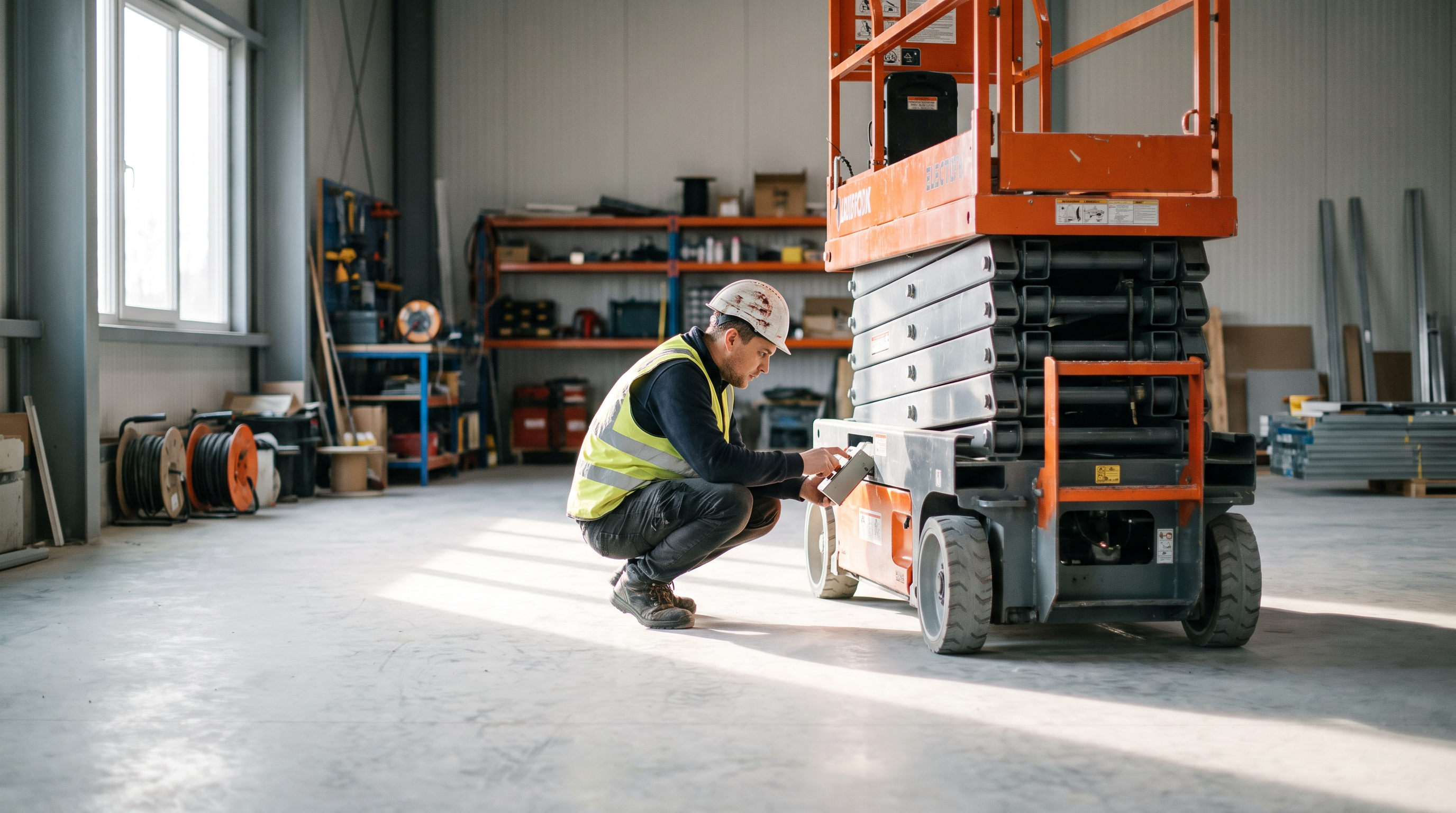
"Need a lift that won't mark finished concrete floors? Discover why electric scissor lifts with non-marking tires are the top choice for indoor projects."
Related reading: How to Choose the Best Lift for Warehouse Data Cabling, Choosing the Right Scissor Lift for 35-Foot Ceilings (2026), and How to Rent the Right Equipment for Warehouse Cabling 2026.


Get the latest GoDizel content delivered straight to your inbox
Need to install data cabling? Follow our 5-step guide to choosing the right electric scissor lift for your warehouse network wiring project in 2026.
Don't get stuck in the 32-foot trap. Learn why a 35-foot ceiling requires a 40-foot scissor lift for safety and reach in 2026. Expert guide to lift sizing.
The right answer to "what lift can I rent that will not mark finished concrete floors" is straightforward: an electric scissor lift.
Electric scissor lifts run on battery power, which means no exhaust soot to stain surfaces and no hydraulic fluid leaks that can permanently damage polished or sealed concrete. That's a critical distinction on any interior job site where floor condition matters — whether it's a freshly poured warehouse slab, a retail buildout, or a hospital corridor.
The market has largely aligned around this reality. Electric engine types now hold a 68.7% revenue share of the scissor lift market, driven specifically by demand for indoor, finished-floor applications. If you need to work without risking surface damage, the industry has already made its choice.
On platforms like Dizel, you can browse options such as a compact unit built for tight interior spaces or step up to a larger electric platform when the job demands more reach. Understanding what makes a tire "non-marking" is crucial for protecting finished floors.
Non-marking tires for aerial lifts are made without carbon black — the additive that gives standard rubber its dark color and, unfortunately, its tendency to scuff finished concrete.
Color: Light gray or white, rather than traditional black
Compound: Carbon-black-free rubber that transfers no pigment under load or rotation
Construction: Solid (flat-free) rather than pneumatic, so there's no risk of a blowout depositing rubber across a polished slab
Surface contact: Engineered for smooth, sealed, or epoxy-coated floors — not outdoor terrain
The difference matters when renting equipment for interior work. A standard black tire can leave streaks that are expensive to sand or resurface out of finished concrete. Non-marking tires eliminate that risk at the source. And because narrow units built for smooth slabs are designed specifically around this tire type, floor protection is built into the equipment — not an afterthought.
It's worth knowing that approximately 90–95% of North American slab scissor lift units enter rental fleets already fitted with non-marking tires, so the odds are in your favor — but always confirm the spec before you book. If you need more reach on a sensitive floor, that's where boom lift options come into the picture.
When you need high-reach access on a sensitive surface, not every boom lift will do — the safest options for indoor concrete floors are electric atrium lifts and spider lifts, both engineered specifically around floor protection.
Atrium lifts: Compact, electric-powered, and built with a low footprint for tall interior spaces like atriums, museums, and airports. They pair naturally with non-marking tires and produce zero emissions.
Spider lifts: Track-mounted or wheeled, distributing load across multiple points. Useful on concrete floors where conventional booms would concentrate too much weight in one spot.
Pounds per square inch (PSI) matters here. Boom lifts apply significantly higher pounds per square inch to a floor than a scissor lift does — which means you need a floor load calculation before you commit to a unit. If the numbers work out and your reach requirement is modest, an electric unit sized for narrow runs on smooth slabs is often the smarter rent-that-avoids-damage choice for concrete floors versus a full boom.
One caveat: any telescopic boom brought indoors must be fitted with non-marking tires — this specification isn't assumed, so confirm it in writing. Choosing the right equipment is only part of the equation; how you operate it on the day matters just as much.
Knowing how to prevent floor damage when renting a lift comes down to three actions you take before the machine ever moves: verify the spec, inspect the tires, and protect the floor's highest-stress zones.
Verify tire type in writing. Before delivery, confirm the rental agreement explicitly states "non-marking tires." A verbal assurance isn't sufficient — if the paperwork states "rubber tires," request clarification on the specification.
Inspect tires at intake. Even a lift that will not mark floors under normal use can scratch finished concrete if debris is embedded in the tread. Walk around the unit and check for embedded rocks, screws, or grit before you move it an inch.
Protect high-traffic turning zones. Turns concentrate load and friction in one spot. Lay Masonite sheets or specialized floor mats anywhere the lift will pivot or repeatedly track the same path.
In practice, most surface damage on finished slabs happens at the start of a job — not because the wrong lift was chosen, but because intake steps were skipped. Those three checks take under ten minutes and can save thousands in floor remediation costs.
For most contractors doing indoor work on finished concrete, renting a non-marking lift will not just protect the floor — it'll protect the budget too.
Buying a specialized electric scissor lift with non-marking tires means taking on capital expenditure, storage, maintenance, and annual inspections. For project-specific use, that calculation rarely works out. Renting transfers all those costs to the rental provider, allowing you to pay only for the days you need the machine.
It's also worth noting that approximately 90–95% of North American slab scissor lift units sit in rental fleets — that's the industry signaling where the value lands. Understanding what are non-marking tires on a scissor lift matters when you're buying, but when you're renting, that spec is already built into the fleet. Rent based on the job requirements, not the inventory.
The safest rental options that will not mark finished concrete floors are electric scissor lifts and atrium lifts fitted with non-marking tires — both eliminate the carbon black compound that causes dark streaking on polished or coated slabs. Spider lifts are a strong alternative when the job requires irregular terrain or tight maneuvering around obstacles. Confirming the tire spec in writing before delivery is non-negotiable regardless of which unit you choose.
Non-marking tires are manufactured without carbon black, the additive that gives standard rubber its dark pigment. On finished or sealed concrete, standard tires leave rubber transfer marks that are difficult — and expensive — to remove. Non-marking compounds provide the same load-bearing performance without the residue, which is why they're the baseline requirement for any indoor aerial lift rental on a protected surface.
Indoor aerial lift rental requirements in 2026 are governed by ANSI/SAIA A92 standards and OSHA 1926.502 fall protection criteria, neither of which explicitly mandates non-marking tires by name. However, property owners and general contractors routinely write floor protection into their site-specific safety plans, making non-marking tires a de facto requirement on most commercial interior projects. Don't assume the rental unit arrives compliant — request written confirmation of the tire spec before the machine is loaded onto the truck.
Standard rubber tires leave black transfer marks at every contact point, and those marks intensify at turning zones where friction is highest. Beyond cosmetic damage, debris embedded in tread can scratch sealed or polished surfaces. Remediation costs vary by floor type, but on high-end epoxy or polished concrete, repairs can run into thousands of dollars — a cost that is typically borne by the contractor, not the rental provider. Between 2011 and 2014, 1,380 workers were injured while operating an aerial or scissor lift — floor condition and surface-appropriate equipment selection are part of the same risk-management conversation.
For project-specific indoor work, renting consistently outperforms buying on a total-cost basis. Ownership means capital outlay, storage, maintenance schedules, and annual inspections — none of which generate revenue between jobs. Renting transfers those costs to the provider and limits your exposure to the exact days you need the machine on site. The rental model is also where the industry keeps its most current, spec-compliant inventory, so you're more likely to get a properly configured unit without having to source tires separately or retrofit older equipment.

