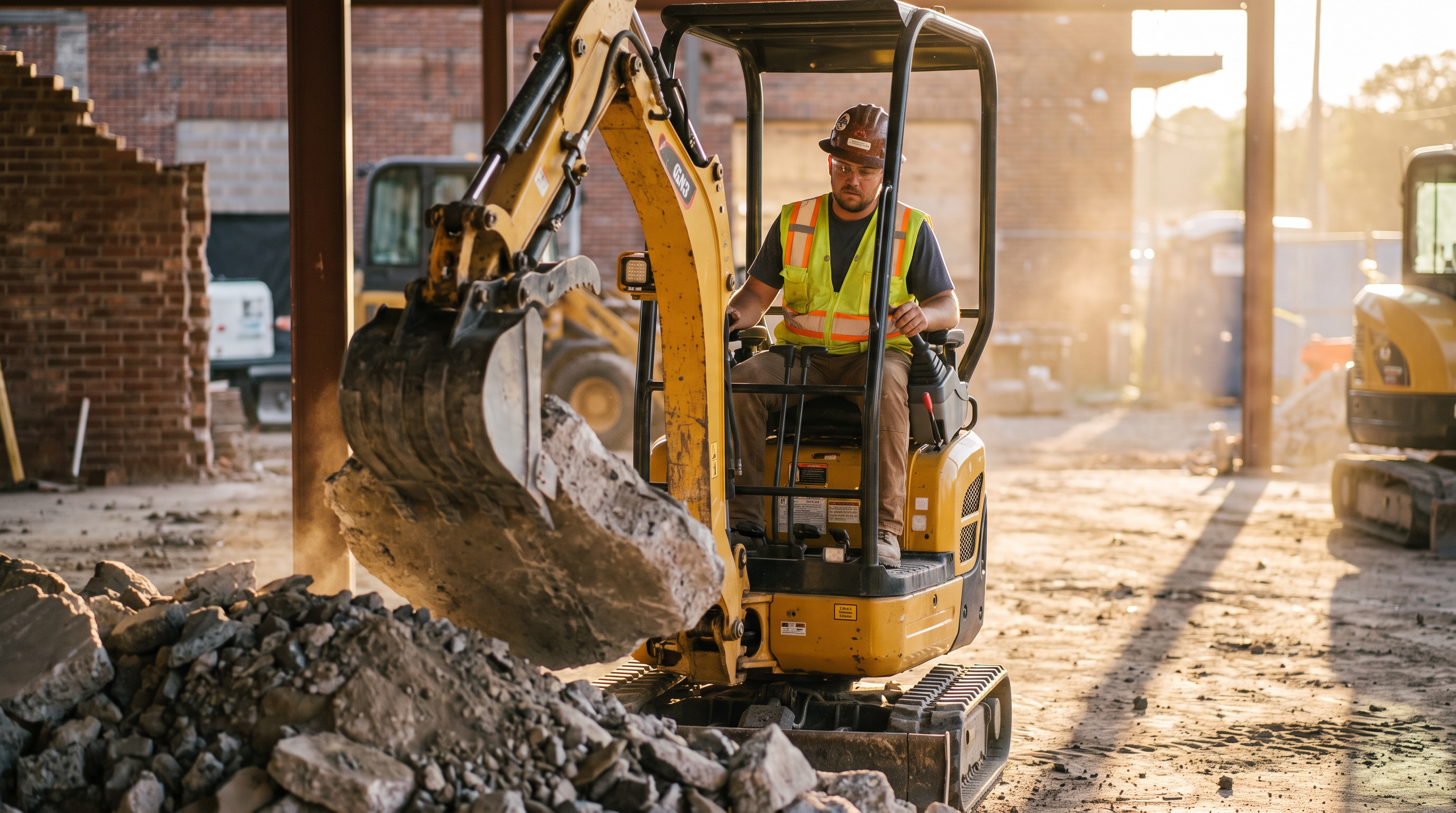
"Struggling with site clearing delays? Discover why precision concrete demolition is the critical bottleneck and how to optimize your removal process for success"
Related reading: How to Streamline Equipment Procurement for Multiple Job Sites Without Managing Separate Rental Agreements, How to Rent Storm Cleanup Equipment After a Hurricane in 2026, and How to Rent and Set a Commercial Generator in 5 Steps.


Get the latest GoDizel content delivered straight to your inbox
Learn how to consolidate equipment procurement across multiple job sites. Stop managing separate rental agreements and optimize your fleet management today.
Learn how to rent storm cleanup equipment effectively in 2026. Follow our guide to secure essential restoration tools and prevent long-term property damage.
Concrete demolition isn't a single task on a project checklist — it's the critical bottleneck that determines whether the rest of your site work runs on schedule or bleeds cost.
Concrete and bricks commanded a 60.42% share of the global construction and demolition waste management market in 2025. That figure alone tells you something important: the majority of what comes off a cleared site is hardscape material, and how efficiently you handle it shapes every phase that follows. Poor sequencing, wrong equipment, or underestimating material volume doesn't just slow down demolition — it backs up excavation, grading, and utility work simultaneously.
Government investment is amplifying the pressure. The U.S. demolition and wrecking market is projected to reach $13.8 billion by 2032, driven largely by infrastructure spending cycles that are creating more teardown and rebuild work across the country. More projects in the pipeline means more competition for equipment, tighter site timelines, and less margin for error on job sequencing.
That's why "breaking stuff" is a dangerous oversimplification. Demolition is really about managing site flow — controlling where debris goes, how fast it moves, and what the ground looks like when the next crew arrives. Right-sizing your equipment to the material you're actually cutting and cracking is where that control begins. And the choice between methods matters far more than most site plans account for — which is exactly what we'll get into next.
Choosing the wrong demolition method doesn't just slow you down — it can erase the profit margin on an entire site clearing phase before the first truck rolls in.
Concrete removal contractors know this better than anyone. The gap between manual and mechanical demolition isn't a matter of preference; it's a matter of economics and physics. A crew with jackhammers can handle isolated patches, curb sections, or tight spots where machinery simply can't maneuver. But once you're dealing with full slabs, reinforced footings, or anything over a few hundred square feet, manual methods become a liability — slower, costlier, and harder on your crew.
Manual demolition makes sense only at the margins — small-scale removal, detail work near utilities, or spaces with zero equipment access. The tipping point arrives quickly: labor hours stack up faster than most site managers anticipate, and the ROI flips decisively toward mechanical methods once square footage climbs past a modest threshold.
Hydraulic breaking with excavators is the clear industry standard for slab removal at scale. As industry practice confirms, mechanical demolition using hydraulic attachments is the go-to approach for breaking and removing slabs during site prep — combining speed, force, and operator safety in ways manual tools can't match. A compact machine with the right reach can work efficiently even in constrained footprints.
Chemical and thermal methods exist — expansive grout, flame cutting, wire sawing — but they serve niche applications. In practice, they're slower, costlier to mobilize, and rarely the right call for standard site clearing timelines.
Site managers consistently favor hydraulic attachments not just for raw speed, but because they reduce the number of workers in the strike zone, keep debris consolidation manageable, and integrate cleanly into the broader excavation workflow. That efficiency has a dollar value — and understanding exactly what it costs to unlock it is where the real planning begins.
The sticker price on a rental unit is rarely what you actually pay — and in site clearing, that gap between quoted rate and total landed cost is where project budgets quietly fall apart.
Most GCs focus on the daily or weekly rental rate when evaluating equipment. That's understandable, but it's an incomplete picture. By the time you factor in delivery and pickup fees, fuel surcharges, environmental levies, and the insurance riders that many yards require for demolition-class equipment, the real cost can run 20–40% higher than the base quote.
Consider what actually drives total cost on a concrete removal job:
Delivery and pickup fees — often $150–$400 per mobilization, billed separately from the rental rate
Fuel surcharges — variable, but frequently tacked on for hydraulic breakers and excavators running full shifts
Insurance and damage waivers — required by most rental yards for heavy attachments; can add 10–15% to the daily rate
Operator hours vs. machine hours — a 1,000 sq. ft. slab removal typically runs 6–10 machine hours, but labor cost often doubles or triples that figure depending on haul distance and debris sorting requirements
Idle time and scheduling gaps — equipment sitting on-site between phases still accrues rental charges
Traditional yard quotes often obscure these line items, presenting a clean day rate that fragments into surcharges once the contract arrives. Marketplace-based rental platforms, by contrast, make it easier to compare total-cost scenarios across multiple providers before you commit — which is especially valuable when you're sourcing something like a compact excavator for tight clearance work where both the unit spec and the all-in price need to align with your site conditions.
Total Landed Cost — the sum of rental rate, fees, fuel, insurance, and labor burden — is the only number that matters when you're pricing a concrete demolition scope.
Getting that number right upfront is what separates a profitable site clearing phase from one that quietly erodes your margin. And the equipment selection itself plays directly into that equation — which brings us to the question of how to match machine size to the actual demands of your job site.
Over-specifying equipment is one of the most common — and costly — mistakes specialized trades make during precision concrete demolition, and it's one that concrete demolition companies rarely discuss openly.
Over-specification creates two immediate problems on tight sites: congestion that slows every other crew working around you, and fuel burn that quietly erodes your margin. Bringing a full-size excavator onto a site where a mini would do the job doesn't signal competence — it signals poor planning.
Mini vs. micro excavators are where the real decision lives for most electricians and framers doing precision trenching. A mini excavator in the 3,000–4,000 lb class handles the majority of utility trenching and perimeter footing work efficiently, while a micro (under 2,000 lbs) earns its place when you're working inside an existing structure or navigating a tight urban lot. The rule of thumb is straightforward: match the machine's footprint to the work zone, not to the scope of the whole project.
Zero tail swing is the feature that changes the math in urban demolition environments. When the rear of the machine stays within its track width during a full rotation, you eliminate the clearance buffer you'd otherwise need to keep adjacent trades, parked trucks, and existing structures out of harm's way. That translates directly into a smaller effective work zone — and faster cycle times.
Vacuum excavation trailers add another layer of precision that blunt machinery can't match. When you're clearing near active utilities, hydro-vac removes material around conduit and pipe without the risk of a strike that would shut the site down entirely. In practice, pairing a mini excavator with a vacuum trailer is the combination that keeps utility-adjacent work moving on schedule.
Getting the equipment spec right protects your schedule and your budget — but it also shapes how safely your crew can operate. That's a conversation worth having before the first tool hits the slab.