"Learn how to rent and set a commercial generator for your site. Follow our 5-step guide to calculating loads, choosing equipment, and ensuring safe power."
Related reading: How to Rent Storm Cleanup Equipment After a Hurricane in 2026, Rent vs. Buy a Skid Steer: Is Ownership Worth It for 10 Uses a Year in 2026?, and How to Rent the Right Trencher for a 24-Inch Deep Trench.


Get the latest GoDizel content delivered straight to your inbox
Learn how to rent storm cleanup equipment effectively in 2026. Follow our guide to secure essential restoration tools and prevent long-term property damage.
Should you rent or buy a skid steer for 10 uses a year? We break down the maintenance costs and ownership math to help you make the right choice in 2026.
Before you contact a supplier, settle two numbers: the electrical load the unit has to carry and the physical envelope it has to fit through. Determine the equipment needed to move and set a commercial generator. That answer changes entirely based on frame size, and frame size comes from the load calculation — not from a guess. Size the unit to total connected kW plus starting surge, then confirm voltage and configuration, typically 480V three-phase for commercial buildings.
Walk the route and the pad before delivery:
Total kW demand, including motor inrush, and the required voltage and phase configuration
Gate widths, overhead clearance, and turning radius for a flatbed and tractor
Crane setup area and swing radius, including overhead power lines and adjacent structures
Concrete pad or soil bearing capacity checked against the generator's wet weight with fuel and coolant
Setback distances from windows, doors, and fresh-air intakes
Confirm placement against NFPA 110 for emergency and standby power systems before the unit leaves the yard. A compliant clearance drawing prevents a second mobilization when the inspector arrives.
The power unit is one line item on the ticket. The support fleet is what actually gets it onto the pad. Build the industrial generator rental around the tonnage on the spec sheet, not the footprint.
Match a rough-terrain forklift or telehandler to the generator's wet weight, with capacity remaining at the reach and height you'll actually use.
Book a flatbed or step-deck for generator transport, sized for the enclosure length and rated for the load.
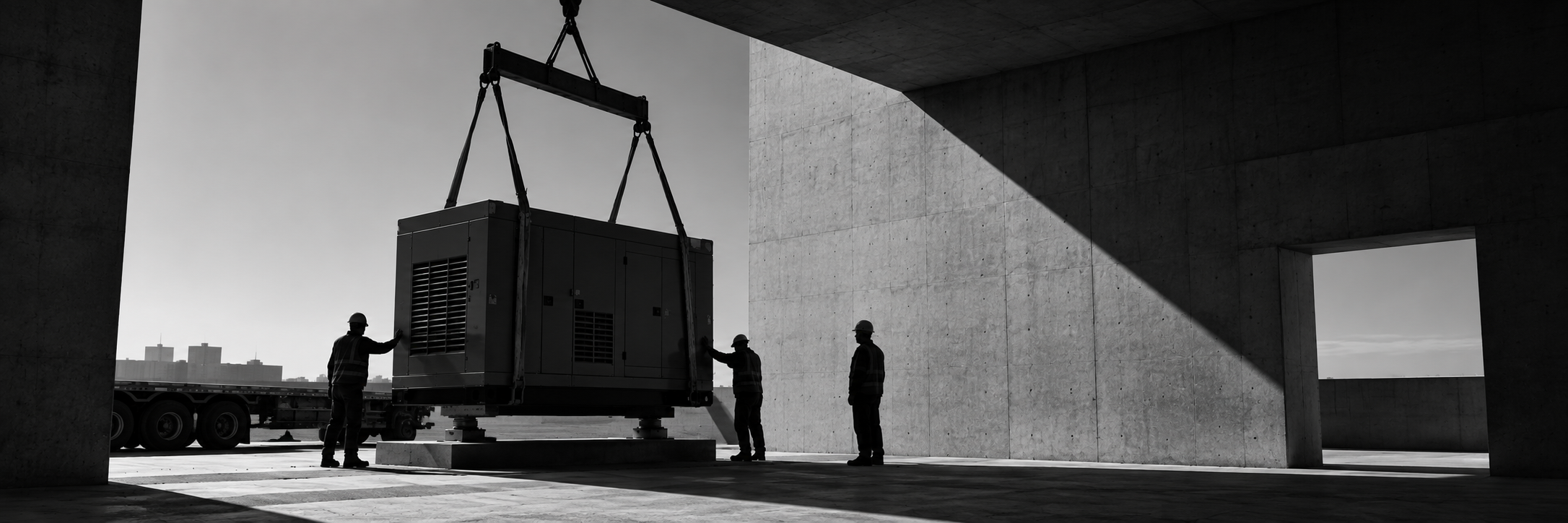
Rent a spreader bar. Slings choked around a skid pull inward and crush thin-gauge enclosure panels and radiator housings — the spreader keeps the lifting legs vertical and the load path clean.
Verify that every sling, shackle, and shortening hook meets ASME B30.9, and reject any synthetic sling without a legible tag.
Stage cribbing, steel plate, and machine skates for the final few feet when the crane can't reach the pad.
Rigging failures are not a paperwork problem. OSHA recorded 5,283 fatal work injuries in the United States in 2023. Use Dizel to compare live pricing and availability on forklifts, trailers, and rigging from multiple suppliers in one search.
Set the unit on vibration isolation before it touches concrete. Spring mounts or bonded neoprene pads under the skid rails keep engine harmonics out of the building structure and cut transmitted noise — critical when the pad shares a wall with occupied space. Then level the frame in both axes before you torque anything down. An out-of-level engine starves bearings on one side, traps air in the coolant circuit, and prevents the oil pan from draining fully at service intervals.
Keep these on the truck:
A high-accuracy machinist's spirit level for rail-to-rail checks across the skid
A laser tracker or rotary laser with a receiver for long-span pad verification
Shim stock and grout plates for correcting pad variation without stressing the frame
Set exhaust discharge downwind of the building and clear of every fresh-air intake, louver, and operable window. Carbon monoxide accumulation is the failure mode that kills people: portable generators were associated with 1,332 CO-related deaths from 2004 through 2021. Orientation is a life-safety decision, not a convenience one.
Work the connection sequence in order. Skipping the load test is how a rental unit fails at 2 a.m. with the building on it.
Ensure the unit is locked out and the main breaker is open before connecting any cables.
Install grounding and bonding conductors per local code and NFPA requirements, then verify continuity with a meter — rather than by sight.
Terminate temporary power cables at the cam-lock panel following the manufacturer's phase rotation, and confirm rotation with a phase sequence tester before energizing any three-phase motor load.
Connect a rented load bank and run the unit to full rated capacity, holding steps long enough to verify coolant temperature, oil pressure, and voltage regulation under load.
Review the test for wet stacking, frequency droop, and exhaust temperature, and address any issues before transferring building load.
Transfer load through the transfer switch, then document startup parameters — oil pressure, coolant temperature, frequency, and voltage at each leg — on the commissioning sheet.
That documented baseline is your defense on damage claims at return. It also gives the next shift a reference point when readings drift.
Commercial generator installation succeeds or fails on the support equipment nobody budgets for. Line up the spreader bar, the isolation pads, the laser level, and the load bank on the same purchase order as the power unit, and the first lift becomes a two-hour job instead of a two-day problem. Order all commercial generator installation equipment from a single temporary power equipment rental source to ensure aligned delivery windows.
Key Takeaways
Always lift with a spreader bar. Choked slings crush enclosure panels and radiator cores, and that damage lands on your rental invoice.
Set the unit on vibration isolation every time, to protect the building structure and control noise at the property line.
Source forklifts, flatbeds, rigging, and load banks through Dizel in a single search so you get real pricing up front and no invoice drama at return.
Hold the job to NFPA 110 for placement and testing, and ASME B30.9 for every sling and shackle on site.

