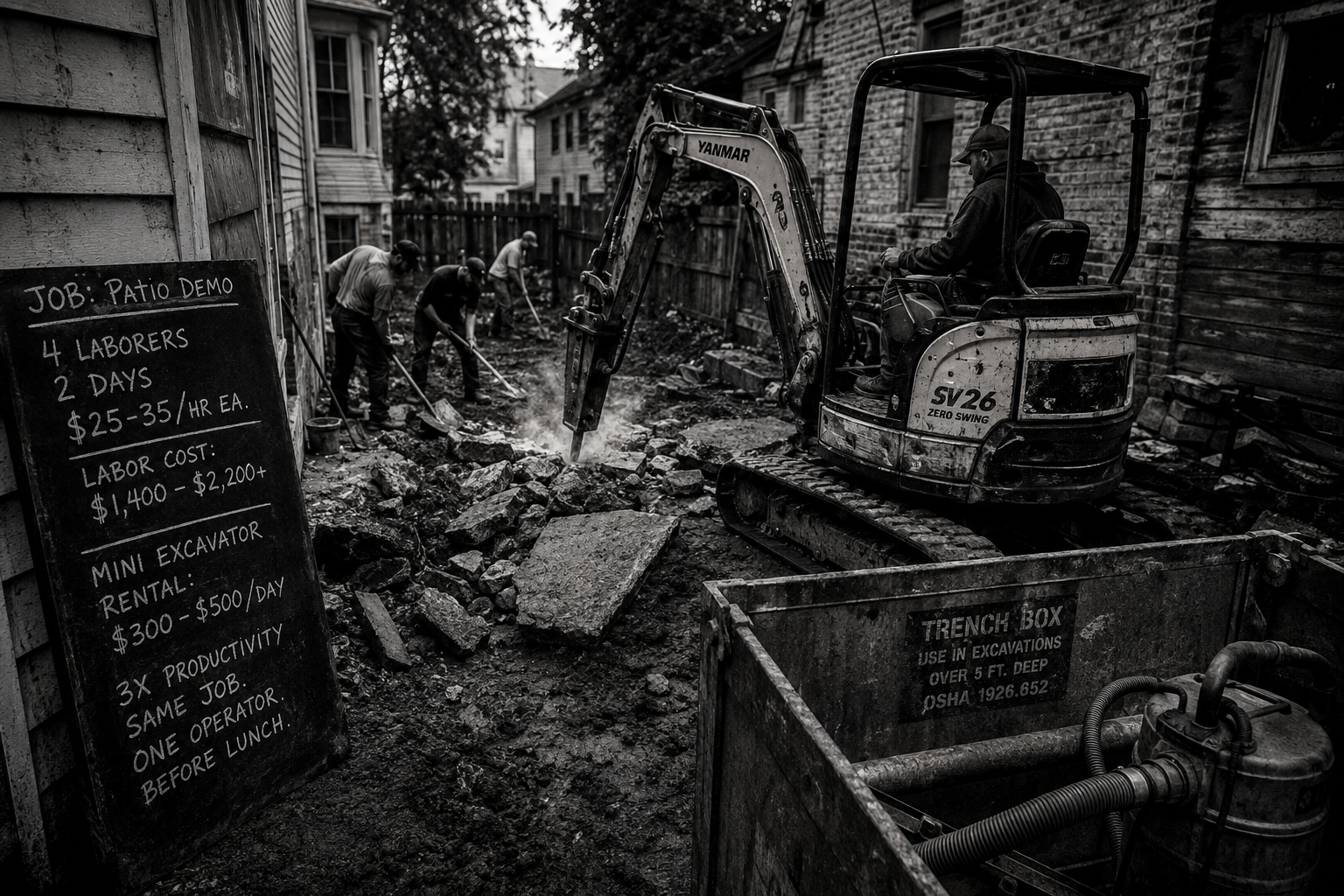
"Stop overspending on labor. Discover how a mini excavator rental boosts productivity, lowers costs, and outperforms a manual crew on residential demo projects."
Related reading: How to Streamline Equipment Procurement for Multiple Job Sites Without Managing Separate Rental Agreements, How to Rent Storm Cleanup Equipment After a Hurricane in 2026, and How to Rent and Set a Commercial Generator in 5 Steps.


Get the latest GoDizel content delivered straight to your inbox
Learn how to consolidate equipment procurement across multiple job sites. Stop managing separate rental agreements and optimize your fleet management today.
Learn how to rent storm cleanup equipment effectively in 2026. Follow our guide to secure essential restoration tools and prevent long-term property damage.
Bringing four workers to a residential demolition job looks like a plan — until you run the actual numbers.
Labor costs for a demo crew add up fast. At $25–$35 per hour per worker, a four-person crew running two full days on a straightforward task like tearing out a concrete patio or clearing a foundation approaches $1,400–$2,200 in wages alone — before you factor in supervision time, workers' comp, and the inefficiency of hand tools on material that wasn't designed to move by hand.
Mini excavator rental cost, by contrast, typically runs $300–$500 per day for a compact unit in the 1–6 ton class. That's the sticker price — but the more useful figure is Total Landed Cost: the all-in number that includes delivery, fuel, the operator's time, and the productivity multiplier a machine brings over manual labor. When you stack that against four workers moving the same cubic yardage with shovels and demo hammers, the machine wins on nearly every residential site.
The efficiency sweet spot for residential demo sits right here. A compact excavator can move soil, break concrete, and load debris in a single workflow — collapsing three manual tasks into one. What typically happens is a crew that took two days to complete a job gets replaced by a single operator finishing before lunch.
And the way contractors source that equipment is changing too. The old process — calling yards, waiting on hold, hoping a unit is available — is giving way to digital procurement platforms where you can compare specs, check availability, and book without the friction. The sections ahead get into the specifics of which machine fits which site constraint, starting with the tightest job conditions you'll face.
Choosing the wrong excavator footprint on a tight residential site doesn't just slow you down — it can damage the very structure you're trying to protect.
That's where machine geometry becomes as important as raw digging power. On residential demo jobs, you're often working within inches of a standing wall, a neighbor's fence, or a utility line. Sending in a full-size machine — or even an oversized mini — creates congestion that eats into the productivity gains you calculated in the last section.
Zero Tail Swing is the first feature worth understanding. A standard excavator swings its counterweight well beyond the width of its tracks when rotating, which is fine on an open site but a liability in a narrow side yard or basement corridor. Zero tail swing units keep the counterweight within the track width, making them essential when working against walls or in urban demolition environments where a single swing error causes structural damage. If you're sourcing a compact excavator rental for that kind of confined work, look specifically at machines built around this geometry rather than retrofitting your site plan around a standard unit.
Micro excavators — typically under 1 ton — take that logic further. They're the right call when you're pulling permits for interior demo, passing equipment through a standard gate opening, or working around mature landscaping a homeowner wants preserved. And for precision utility trenching, a micro unit lets you expose electrical conduit or water lines with controlled bucket passes instead of wide, disruptive cuts that require significant backfill work afterward.
The trap most contractors fall into is over-specifying — renting a larger machine "just in case" and then dealing with a congested site where the equipment limits itself. Matching machine size to actual site constraints is what keeps the job moving. Once you know the right footprint, the next question is how hard that machine can actually work in an hour.
The fastest way to justify a mini excavator rental is to run a simple productivity calculation before you ever pick up the phone.
Start with this framework:
Cubic yards per hour = bucket capacity (cu yd) × cycles per hour × fill factor
A standard 1-ton micro excavator rental typically carries a 0.05–0.08 cubic yard bucket. At roughly 60–80 cycles per hour and a 0.85 fill factor for average soil, you're moving 2.5–5 cubic yards per hour — consistently, without a water break. That's a real number you can hold against your labor estimate.
Maintenance habits directly affect how many productive hours you actually get from a machine. Keeping a mini excavator clean and properly serviced can improve operational efficiency by up to 15%, which translates directly to lower fuel burn and fewer unplanned stops mid-job. Hidden time-wasters compound this: manual grease points on cheaper units can pull 20–30 minutes of downtime per shift, while auto-lube systems keep the machine running and the operator in the seat. When you're evaluating a compact unit for tight residential work, factor service intervals into your total uptime estimate, not just the hourly dig rate.
That productivity data also changes how you budget the rental itself. If your numbers show the machine will run 6+ hours daily across a 5-day job, a weekly rate almost always beats stacking daily rates — sometimes by 30–40%. The per-day cost drops, and you gain scheduling flexibility without the pressure of returning equipment the same afternoon. It's worth knowing that rental pricing logistics carry their own layer of complexity, which we'll get into next.
Renting the right machine is only half the battle — the other half is surviving the invoice that follows.
Delivery fees are where budgets quietly bleed out. You agree on a day rate, then the paperwork arrives: fuel surcharges, damage waivers, environmental disposal fees. Each line item is defensible on its own, but together they can add 20–30% to what you thought you were paying. For a short residential demo, that math hits hard.
Calling around to rental yards is the other silent killer. Site managers routinely spend two to three hours on the phone comparing availability and rates — hours that could go toward actual production. If you've already worked through your excavator productivity per hour numbers to justify the rental, watching that time evaporate to admin work is a frustrating contradiction. You've optimized the machine; you haven't optimized the sourcing.
Real-time price comparison fixes this. A digital marketplace that shows all-in pricing upfront — not a base rate with asterisks — lets you evaluate options in minutes, not a morning. You see what you're actually paying before you commit, which is a different experience entirely from negotiating line items after the fact.
Rental duration is the final lever most contractors underuse. Daily rates are convenient, but weekly and monthly agreements on a compact zero tail swing machine can cut your per-day cost significantly on projects that stretch beyond a few days. If the scope supports it, locking in a longer term almost always wins on unit economics. And once you've sorted the logistics, the next question is whether you're getting the most out of the machine itself — starting with the attachments on it.
A mini excavator without the right attachments is like a truck without a trailer — technically functional, but leaving a lot of capability on the table.
Residential demo and utility work rarely stays simple. You're breaking concrete one hour and trenching for a gas line the next. The right attachment stack turns a single rental into a multi-tool that handles both — and keeps you OSHA-compliant while doing it.
Hydraulic jackhammers are the go-to pairing for concrete slab removal and asphalt breaking. Instead of renting a standalone breaker and committing a crew member to manual work, the excavator arm delivers consistent impact force with zero fatigue. Breakout goes faster, and your crew focuses on moving material rather than swinging steel.
Trench boxes and shoring panels aren't optional on utility work — they're the law. OSHA requires protective systems for excavations deeper than 5 feet in most soil conditions. Renting a trench box alongside your machine from the start eliminates the scramble to source shoring after an inspector shows up.
Vacuum trailers for hydro-excavation are the smart call near gas, water, or electrical lines. Pressurized water cuts through soil without the risk of a direct utility strike; the debris slurries directly into the tank. It's slower than a bucket, but a single utility hit costs far more than a half-day of careful digging.
Bucket selection matters more than most crews realize. Narrow trenching buckets — typically 9 to 12 inches wide — are the right call for utility work in clay-heavy soil where sidewall stability is a priority. Wider grading buckets handle topsoil and loose fill efficiently but aren't cut out for precise trench work. Match the bucket to the soil type and the trench width spec, not just what's sitting on the trailer. A larger zero tail swing machine can accommodate a broader range of bucket sizes if your site transitions from tight trenching to full demo in the same day.
Getting the attachment mix right is ultimately about not leaving productivity — or safety — to chance. In the next section, we'll pull these pieces together into a practical framework for maximizing your compact fleet from the moment the machine drops on site.
Squeezing real value from a mini excavator rental comes down to four decisions made before the machine ever rolls off the trailer.
The sections above have walked through machine sizing, attachment strategy, and the true cost of traditional logistics. Here's how those lessons compress into a working framework on your next residential demo.
Right-size to the site footprint, not just the dig depth. A machine that can technically reach your target depth but can't rotate safely in the yard is a liability, not an asset. Match the swing radius and operating weight to the actual square footage you're working in — tight backyard? Zero-tail-swing wins every time.
Calculate productivity per hour before you sign anything. Divide the total rental cost by your estimated dig hours. If that number is higher than what a four-person crew costs per hour on the same task, rethink the machine class — not the rental itself.
Use a digital marketplace to kill invoice drama. Seeing the full price — delivery, protection, and fees — before checkout isn't a luxury. It's how you protect your margin on every job without manual calling or surprise line items.
Bundle trench box rental with your excavator from day one. OSHA trench safety requirements aren't optional, and sourcing a trench box rental separately adds coordination risk. Lock in compliant shoring with the machine so your crew is protected the moment digging starts.
The contractors who get the most out of compact equipment aren't just renting smarter — they're building a repeatable sourcing process. And that process starts with having the right tools in front of you at the right moment, without friction slowing everything down.
Knowing the price to rent a mini excavator is only half the equation — the other half is getting the right machine on-site without burning a morning on phone calls.
That's where Dizel changes the process. You can search over 4,000 machines across local and national yards in under a minute, with all-in pricing displayed upfront — no follow-up calls to uncover delivery fees or damage waiver costs after the fact. The Real Rental Price is visible before you commit, so there are no budget surprises when the invoice arrives.
The checkout process is built around how contractors actually work. AI-driven checkout locks in member pricing without the back-and-forth that typically slows down equipment sourcing. And when you're running multiple machines across a residential demo project, managing every rental through a single digital interface keeps your procurement organized and your schedule on track.
Finding equipment shouldn't be harder than using it. Dizel is built on that premise. Whether you're sourcing a compact zero-tail-swing machine for a tight backyard or coordinating attachments for a full-scope teardown, the platform puts you in control from search to confirmation. Start your next search on Dizel and get your machine lined up before the competition even starts making calls.