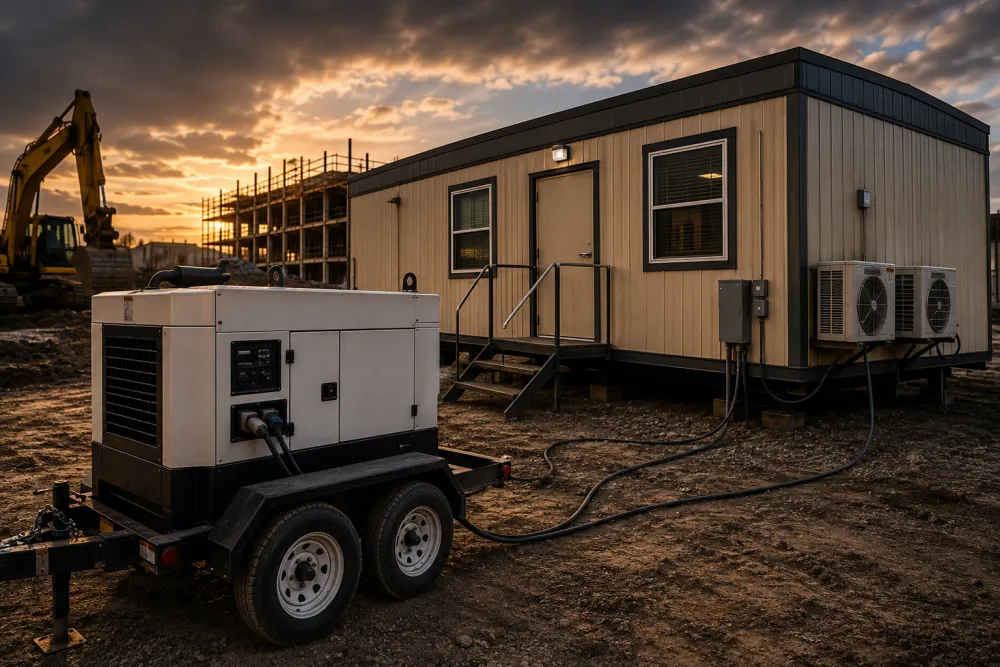
"Job site trailer generator sizing made simple: why startup surge kills undersized units and how to pick the right kW so your AC never quits."
Related reading: Choosing Between a Scissor Lift and a Boom Lift for Your 2026 Project, How to Rent the Right Lift for Warehouse Security Camera Installation, and How to Streamline Equipment Procurement for Multiple Job Sites Without Managing Separate Rental Agreements.


Get the latest GoDizel content delivered straight to your inbox
Struggling to choose between a scissor lift and a boom lift? Learn the key differences to pick the perfect aerial lift for your 2026 construction project.
Learn how to rent the right lift for warehouse security camera installation in 2026. Compare scissor and boom lifts to meet OSHA safety requirements.
A superintendent once told me his office trailer generator "kept dying every afternoon like clockwork." The mystery wasn't much of a mystery. Every day around 2 p.m., the Texas heat kicked both AC units on at the same time, the startup surge doubled the load, and the undersized generator tripped out. He'd rented on price instead of on load, and it cost him a week of frustration.
Sizing a generator for a job site trailer is simple once you understand one thing: it's not about what the trailer uses while running. It's about what it demands at startup.
For a typical single office trailer with one AC unit, lights, computers, a printer, and a coffee maker, a 20 kW generator is the common safe choice. For a larger trailer or a double-wide with two AC units, look at 25 to 30 kW. If you're powering multiple trailers or adding equipment charging stations, size up from there or ask the rental company to run a load calculation.
Could a smaller unit technically work? Sometimes. But here's why cutting it close backfires.
Air conditioners, refrigerators, and anything with a compressor or motor draw two to three times their running wattage for the first few seconds after they kick on. A 5-ton trailer AC unit might run at 6 kW but demand 15 kW at startup. If two units start at once on a hot afternoon, exactly what happened to that superintendent, the surge stacks.
When the generator can't cover the surge, it trips or stalls. Your trailer goes dark, your crew's paperwork stops, and in a Florida or Texas summer, your trailer becomes an oven in about ten minutes.
Here's the method I walk people through. List everything in the trailer that draws power: AC units, heaters, lights, computers, monitors, printers, microwave, coffee maker, water cooler, security cameras, and phone chargers. Find the running watts for each, then use three times the rating for anything with a compressor or motor as its surge number.
Your generator needs to handle your total running load plus the largest surge that could hit at one time. Then add 20 to 25 percent headroom on top.
That headroom isn't waste. Generators run best at 50 to 80 percent load. Running one flat out at 100 percent all day shortens its life, burns more fuel per useful kilowatt, and leaves you zero margin when someone plugs in a space heater you didn't plan for. And someone always plugs in a space heater you didn't plan for.
Runtime and refueling matter as much as size. A towable diesel generator with a large tank can run through a full workday or longer without refueling, and most rental companies in Texas and Florida can set up scheduled fuel service so you never think about it.
Noise matters if your trailer sits near occupied buildings or a residential edge of the site. Ask for a sound-attenuated unit.
And voltage matters. Confirm whether your trailer needs 120/240V single phase, which is typical, or three phase power before you book. It's a thirty-second question that prevents a very bad delivery day.
Count your loads, respect the startup surge, add 25 percent headroom, and for most single job site trailers you'll land at a 20 kW towable diesel generator. Bigger trailer or two AC units? Go 25 to 30 kW. When it's 98 degrees in August, nobody ever regrets the extra capacity.
Ready to line up power for your site? Dizel makes it simple to compare generator rentals, check availability, and get the right unit delivered before the trailer arrives.

