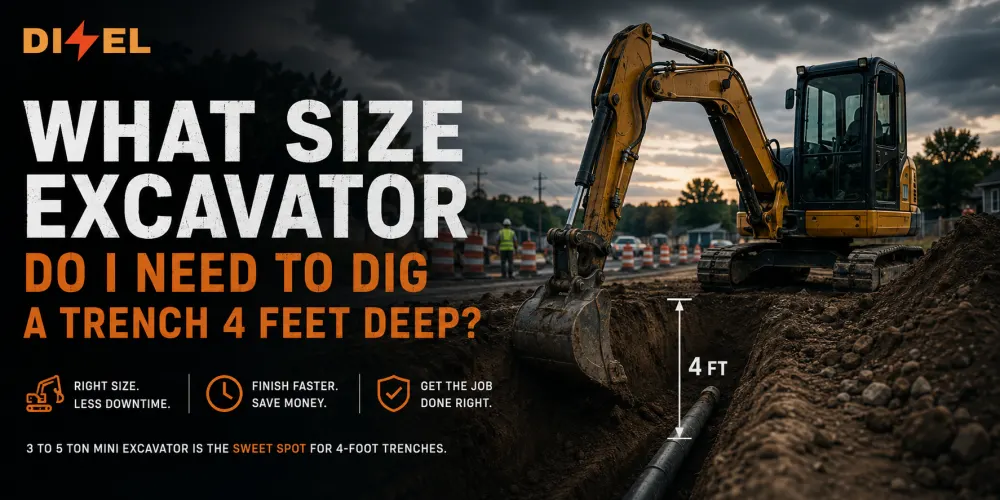
"Digging a 4-foot trench? Here's the excavator size that actually works, why max dig depth misleads, and how to avoid a wasted rental day."
Related reading: Choosing Between a Scissor Lift and a Boom Lift for Your 2026 Project, How to Rent the Right Lift for Warehouse Security Camera Installation, and How to Streamline Equipment Procurement for Multiple Job Sites Without Managing Separate Rental Agreements.


Get the latest GoDizel content delivered straight to your inbox
Struggling to choose between a scissor lift and a boom lift? Learn the key differences to pick the perfect aerial lift for your 2026 construction project.
Learn how to rent the right lift for warehouse security camera installation in 2026. Compare scissor and boom lifts to meet OSHA safety requirements.
The first trench I ever watched go wrong had nothing to do with the operator. The crew rented a 1.7-ton mini excavator to dig a 4-foot utility trench, and the machine simply ran out of reach. They spent the afternoon repositioning every few feet, burned a full extra rental day, and the foreman swore he'd never size a machine off a rental brochure again.
Here's the short answer: for a trench 4 feet deep, you want a mini excavator in the 3 to 5 ton range. That gives you the dig depth, the reach, and enough bucket to actually move dirt instead of scratching at it.
Now let me explain why, because the "why" is what keeps you from repeating that foreman's mistake.
Every excavator spec sheet lists a maximum dig depth. A 1.7-ton mini might claim 7 or 8 feet, which sounds like plenty for a 4-foot trench. But maximum dig depth is measured with the boom fully extended straight down in a perfect position. In the real world, you lose depth the moment you need reach, and you need reach constantly when trenching.
The rule I give people: your machine's max dig depth should be roughly double your trench depth. For a 4-foot trench, that means a machine that digs 8 feet or more comfortably. That lands you at 3 tons and up.
A 3.5-ton mini excavator typically digs about 10 feet deep, reaches 17 feet or so, and still fits through a 6-foot gate opening on most models. For utility trenches, drainage lines, and irrigation runs, this class of machine hits the balance of power and footprint.
Go up to a 5-ton machine if your trench is long, your soil is heavy clay, or you're loading spoil into a truck. The extra bucket capacity and lift height pay for themselves in time saved. In my experience, the daily rate difference between a 3-ton and 5-ton rental is small compared to the labor cost of a slow machine.
If you're trenching in a tight backyard, between structures, or across a finished lawn you want to protect, a 1.5 to 2 ton mini with rubber tracks may be the right call even though it digs slower. You'll trade speed for access. Just plan for more repositioning and a narrower bucket.
One more tip from the field: match your bucket width to the pipe or conduit going in the trench. A 12-inch bucket is standard for most 4-foot utility trenches. Renting the machine without asking about bucket options is one of the most common mistakes I see.
Before you call a rental company or search for a mini excavator rental near you, know these four things. How deep and how long is the trench? What's the soil like, sand, loam, or clay? What's the narrowest access point on the site? And where is the spoil going, piled beside the trench or loaded into a truck?
Answer those and the right machine class almost picks itself. A good rental partner will ask you these questions anyway, and if they don't, that tells you something about the rental partner.
For a 4-foot trench, rent a 3 to 5 ton mini excavator with a 12-inch trenching bucket, and go bigger if the soil is heavy or the run is long. Size the machine to the job, not the brochure, and you'll finish in one rental period instead of two.
When you're ready to compare mini excavator rental options and availability near you, Dizel makes it easy to find the right machine for the job and get it delivered to your site.

