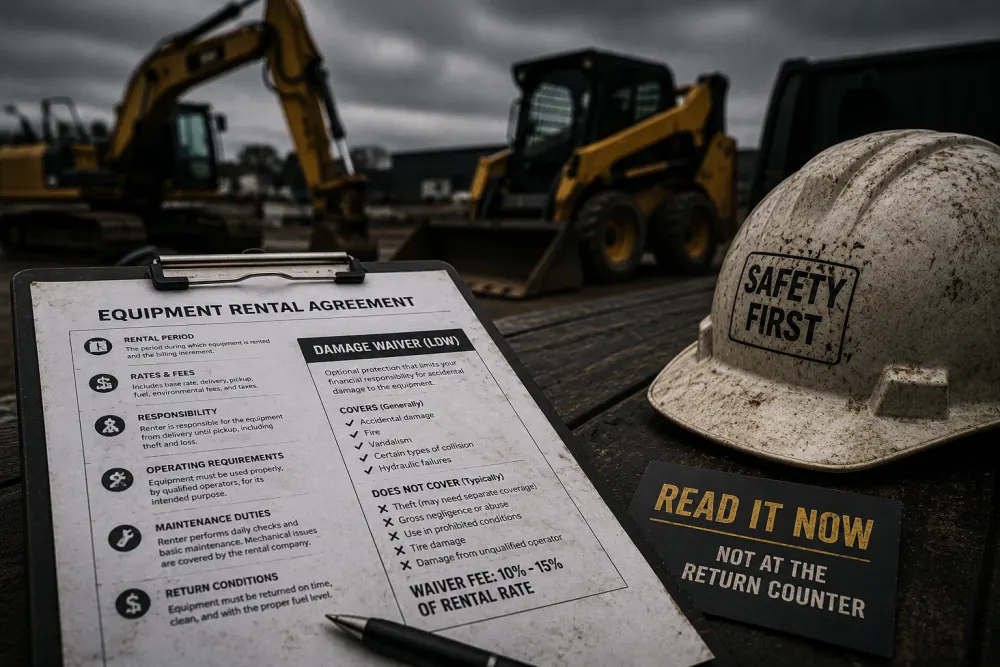
"What's really in an equipment rental agreement? The six core terms, what damage waivers cover, and the fine print that costs renters most."
Related reading: Choosing Between a Scissor Lift and a Boom Lift for Your 2026 Project, How to Rent the Right Lift for Warehouse Security Camera Installation, and How to Streamline Equipment Procurement for Multiple Job Sites Without Managing Separate Rental Agreements.


Get the latest GoDizel content delivered straight to your inbox
Struggling to choose between a scissor lift and a boom lift? Learn the key differences to pick the perfect aerial lift for your 2026 construction project.
Learn how to rent the right lift for warehouse security camera installation in 2026. Compare scissor and boom lifts to meet OSHA safety requirements.
Nobody reads the rental agreement until something goes wrong. I learned this from a contractor who returned an excavator with a cracked window and found out, at the counter, that he'd declined the damage waiver three weeks earlier. The repair bill was more than the waiver would have cost for the entire rental. He didn't remember declining anything. It was one initial on page two.
Rental agreements aren't complicated, but they're written to be skimmed, and skimming is where the expensive surprises live. Here's what's actually in one, and what that damage waiver line really means.
Strip away the legal language and every equipment rental agreement covers the same six things.
The rental period defines when the clock starts and stops, and whether you're billed by day, week, or four-week month. Watch how overtime hours work: most daily rates assume 8 hours of use per day, and heavy meter hours can trigger extra charges.
Rates and fees list the base rate plus delivery, pickup, fuel, environmental fees, and taxes. The responsibility clause makes you liable for the equipment from delivery until pickup, and that includes theft from your job site overnight. Operating requirements state the equipment must be used properly, by qualified operators, for its intended purpose. Maintenance duties split between you and the supplier: you typically handle daily checks like fluids and grease points on longer rentals, while the rental company handles mechanical failures that aren't your fault. And return conditions cover fuel level, cleanliness, and where and when the machine gets picked up.
None of this is unusual or unfair. It's the same framework everywhere from national chains to independent yards in Texas and Florida.
The damage waiver, sometimes called LDW or rental protection, is the most misunderstood line on the contract. Here's the plain-English version.
It is not insurance. It's the rental company agreeing to waive its right to charge you for accidental damage to the machine, in exchange for a fee, usually 10 to 15 percent of the rental rate. Kick up a rock and crack a windshield, back into a dumpster, hydraulic hose bursts and burns a panel? Covered, generally with a small deductible.
What it usually does not cover matters just as much: theft (sometimes a separate theft protection line), gross negligence, operating in prohibited conditions like saltwater or deep mud, tire damage on many contracts, and damage from an unqualified operator.
Should you take it? If you carry a contractor's equipment policy or an inland marine rider that covers rented equipment, you can usually decline the waiver and provide a certificate of insurance instead. That's the cheaper path for businesses renting often. If you're a homeowner or an occasional renter with no such policy, take the waiver. A 12 percent fee on a $1,500 rental is $180. A drivetrain repair is thousands.
First, the meter-hour allowance. Know how many hours per day or week are included and what overage costs. Second, the fuel policy, because returning a machine three-quarters full at the rental company's refueling rate is an expensive convenience. Third, the call-off procedure: when your job ends early, the rental keeps billing until you formally call the machine off rent, and "the job ended Tuesday" is not the same as "I called it off Tuesday." That one line of awareness saves more money than any negotiation tactic I know.
A rental agreement is six ideas in a long coat: period, price, responsibility, proper use, maintenance, and return. Read the damage waiver line like it matters, because it's the one you'll think about when something cracks. And it's always cheaper to ask questions at booking than at the return counter.
Dizel helps you rent with fewer surprises, making it easy to compare equipment, rates, and terms from rental suppliers near you before you commit.

