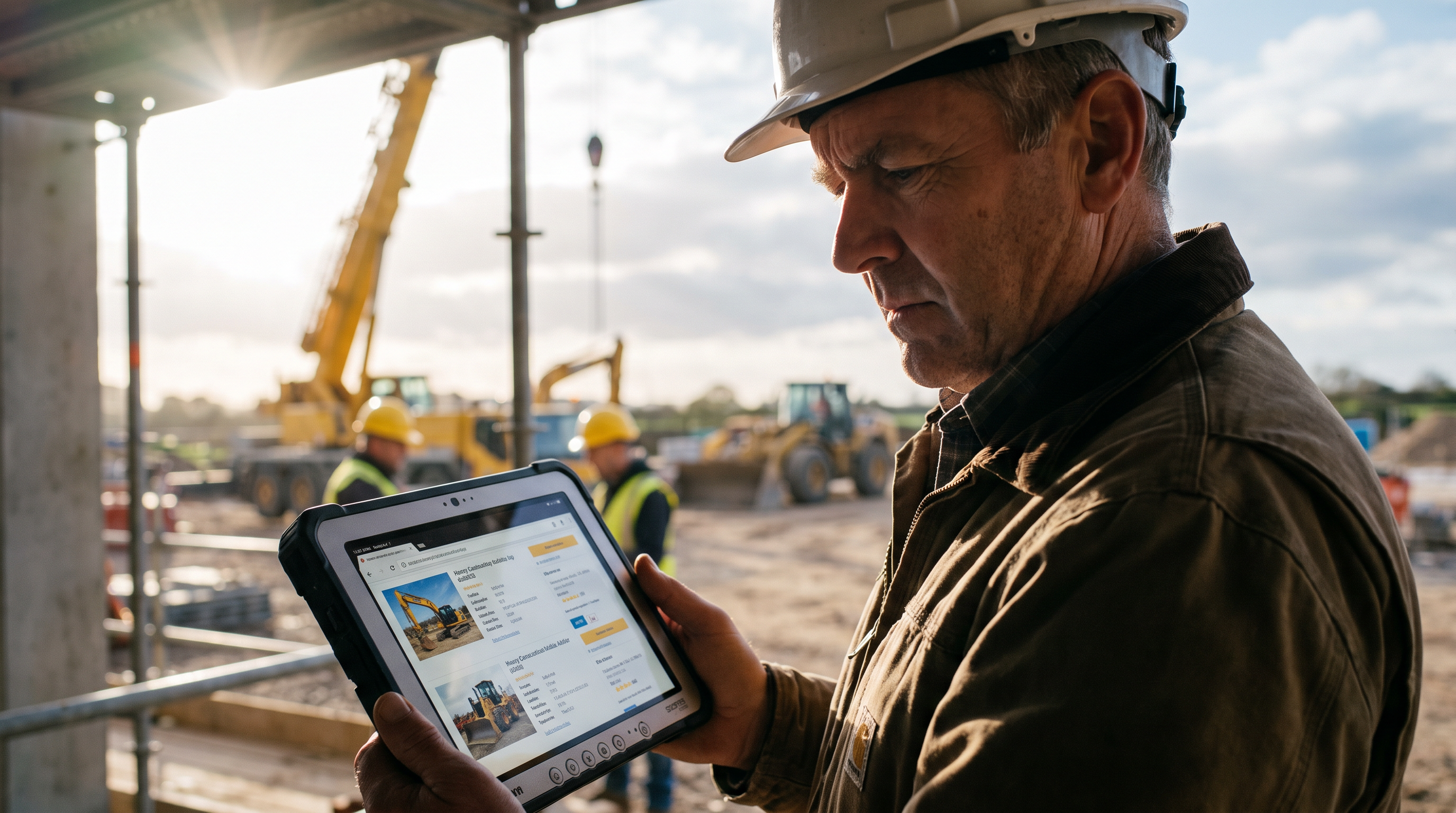
"Looking for top United Rentals alternatives in 2026? Compare Sunbelt, Herc, and EquipmentShare to find the best construction equipment for your jobsite needs."
Related reading: 8 Best Heavy Equipment Rental Platforms of 2026 Compared, Get Found When Buyers Ask AI for Rental Equipment, and The Machine That Built America: A Brief History of the Bulldozer.


Get the latest GoDizel content delivered straight to your inbox
Stop wasting hours on procurement. Discover the 8 best heavy equipment rental platforms of 2026 featuring AI-assisted booking and transparent all-in pricing.
Contractors now ask AI where to rent equipment. Here's how rental companies can show up in those answers and turn that visibility into qualified leads.
United Rentals dominates the North American equipment rental market — there's no disputing that. But size doesn't always mean speed, and for contractors working against tight jobsite schedules, the friction of calling branches, waiting on quotes, and negotiating rates manually is a real operational cost.
The construction equipment rental industry has grown into an $83.7 billion market in North America, and with that scale has come a clear shift in how contractors want to source equipment — online, with transparent pricing and without spending half a morning on the phone. The old process was built around the rental company's workflow. The new one has to be built around yours.
That's why United Rentals alternatives are getting serious attention in 2026. Contractors evaluating their options are applying three straightforward criteria:
Transparency — Can you see pricing without calling?
Speed — Can you book same-day or next-day?
Availability — Does the platform show real, confirmed inventory?
Platforms like GoDizel have entered this space precisely to close those gaps. But the market offers several options, each with different strengths depending on your project size, location, and how much hand-holding you want from a vendor.
The right alternative to a big national rental company isn't always another big national rental company — it's often a smarter way to access the same equipment.
Sunbelt Rentals is the most direct of the alternatives to United Rentals — a national giant in its own right, holding the second-largest equipment rental fleet in North America. If you've been frustrated by one big player's process, it's worth asking whether there are alternatives that simply trade one set of branch-level headaches for another.
Positioning: Sunbelt competes with United on nearly every front — branch count, fleet depth, and geographic coverage. They carry a genuinely diverse inventory, including climate control units, flooring equipment, and specialized tools that smaller regional yards rarely stock.
Pricing: Rates are competitive with United and shift based on regional market demand. Don't expect a published rate card — in practice, you're still calling a branch or submitting a quote request.
Best for: Large-scale commercial or infrastructure projects that need national reach and specialized equipment categories.
Pro: Extensive branch network across the U.S. means equipment is rarely far from your jobsite
Pro: Wide inventory depth, including climate control, power generation, and floor care equipment
Con: Opaque pricing and branch-level negotiation mirror the same friction contractors face with United
Con: Response times and availability visibility depend heavily on your local branch
Sunbelt is a legitimate option when project scale demands it — but if transparent, confirmed pricing is the goal, you'll want to keep evaluating. And that's exactly where technology-forward platforms start to pull ahead.
If Sunbelt's branch network solves your coverage problem but not your pricing transparency problem, the next category of alternatives may be what you're actually looking for.
EquipmentShare occupies a distinct lane among United Rentals competitors — it's less a traditional rental house and more a construction technology company that happens to maintain a sizeable rental fleet. That distinction matters if you're a contractor who wants more than just a machine delivered to your gate.
Positioning: EquipmentShare built its business around its proprietary T3 telematics platform, which tracks machine hours, fuel consumption, fault codes, and jobsite utilization in real time. For contractors managing multiple pieces of iron across several sites, that kind of visibility can directly reduce idle time and catch maintenance issues before they become downtime.
Pricing: Tiered based on fleet utilization and telematics integration level — not the flat-rate negotiation you'd expect from a branch-based provider. Rates vary by market, so confirm local availability before planning around it.
Best for: Data-driven contractors who want jobsite efficiency metrics alongside their rental agreement, not just a key and a fuel receipt.
Pro: T3 telematics platform gives contractors real-time machine data that most rental companies simply don't offer
Pro: Fleet tends to skew newer, which reduces mechanical risk on longer-duration rentals
Con: Physical branch footprint is smaller than the national giants — rural jobsites may find limited local availability
When evaluating alternatives to United Rentals contractors often overlook the telematics angle entirely, focusing only on rate and machine availability. EquipmentShare is worth a hard look if operational data matters to how you run jobs. But if your project sits in a specialized industrial environment — refineries, chemical plants, large-scale restoration — you may need a provider built specifically for that tier of complexity.
If you're renting construction equipment and want the data to prove your fleet is working as hard as you are, EquipmentShare puts that capability on the table.
Herc Rentals targets a different tier of contractor than most national providers — one where safety certification, machine condition, and specialized industrial equipment matter more than day rate alone. If you're running operations at refineries, chemical plants, or large-scale restoration sites, Herc's ProSolutions team is built specifically for that environment.
Positioning: A premium national provider with deep expertise in industrial and specialty equipment — a meaningful step beyond what you'd typically find through United Rentals or Sunbelt Rentals for complex plant environments.
Pricing: Expect a premium price point, particularly for specialized aerial, power, and industrial gear. General-purpose equipment categories trend toward the higher end of market rates.
Best for: Industrial plant operators, refinery contractors, and project managers running large-scale restoration work where equipment certification and maintenance documentation aren't optional.
Pro: High-quality maintenance standards with documented inspection records — important for OSHA-compliance-sensitive environments
Pro: Dedicated ProSolutions team that understands industrial project requirements, not just equipment SKUs
Con: General earthmoving and dirt-work inventory is more limited compared to larger national fleets — less competitive for standard construction needs
Con: Premium pricing can be hard to justify when your project doesn't require the specialized service tier
Herc earns its place on this list for a specific contractor — but if your project is more marketplace than industrial plant, you may be paying for a service tier you don't actually need.
The next question contractors often ask is whether there's a way to compare all of these providers — Herc, the national giants, and local yards — in one place, with real pricing, without making a single call.
GoDizel takes a fundamentally different approach than Herc Rentals, Sunbelt, or any other single-fleet provider — it's not a rental yard at all. It's a B2B digital marketplace that aggregates machines from local and national yards, putting the entire market in front of you in one place.
Positioning: Where rentals renting decisions used to mean calling five yards and waiting for callbacks, GoDizel surfaces real-time availability and all-in pricing — including delivery and protection fees — without a single phone call. No invoice drama. No surprise line items after the fact.
Best for: GCs and project managers who need to compare the full market fast. You can search, filter, and evaluate options across 4,000+ machines in under a minute.
Pro: Real-time availability across local and national partner yards — what you see is what's actually bookable
Pro: AI-assisted booking and centralized vendor management across multiple active jobs
Pro: Upfront, all-in pricing — delivery, protection, and fees shown before you commit
Con: GoDizel doesn't own physical equipment; fulfillment depends on partner yard execution
Finding equipment shouldn't be harder than using it — and a marketplace model is built around that idea.
If you've already evaluated the national giants and specialty providers, GoDizel is where you compare all of them at once — then book the one that actually fits your job.
The comparison picture isn't complete, though, until you factor in regional players who compete on local logistics and personal service — which is exactly what's worth looking at next.
Regional providers don't try to out-scale the nationals — they compete where scale actually hurts: local logistics, same-day delivery windows, and account reps who answer the phone. For contractors renting construction equipment in specific geographic markets, that trade-off is often worth more than a national brand name.
Sunstate Equipment is built around high-touch service across the Southwest and West — Arizona, California, Nevada, and surrounding states. If your jobsite sits in that footprint, Sunstate's branch density and local relationships can outperform what a national provider delivers in practice. You're not a line item in a regional contract; you're an account they recognize.
Pro: Strong local logistics and service responsiveness in the Southwest
Pro: Account-level relationships that national providers rarely replicate at the local branch
Con: Limited geographic reach — outside the West, Sunstate isn't an option
BigRentz takes the opposite approach: it's a large-scale aggregator that pulls inventory from rental yards across the country, which makes it useful when you're sourcing equipment across multiple project locations. In that sense, it shares some DNA with platforms like GoDizel and EquipmentShare — aggregation over ownership.
Pro: Wide national coverage for multi-location project sourcing
Pro: Simplifies vendor management when you're running equipment across several states
Con: Pricing and availability still depend on partner yard execution, so local service quality varies
The broader point is that neither category — regional specialists nor aggregators — wins across every scenario. What they share is a willingness to solve problems that national fleet size alone can't fix: coverage gaps, service responsiveness, and transparent pricing before you commit.
Understanding where each provider fits is the foundation for making a confident rental decision — and that's exactly what the next section maps out.
Every provider covered in this guide earns its place — but only for the right project type. Matching the vendor to the job is what keeps your construction equipment budget predictable and your timeline intact.
Here's how to map the decision:
National footprint projects: Choose United Rentals or Sunbelt when your work spans multiple states and you need a single-source vendor to manage the logistics.
Telematics-driven jobsites: Choose EquipmentShare if machine uptime data and fleet utilization reporting matter as much as the equipment itself.
Price comparison without the phone tag: Choose GoDizel when you need to see real rates instantly and skip the bottleneck of calling yards one by one.
Regional coverage with local service: Consider Sunstate Equipment or BigRentz when you're working in specific markets where logistics responsiveness beats national scale.
Regulated or industrial environments: Herc Rentals is the right tier for projects where safety certification and machine condition documentation aren't optional.
One caveat applies across every option: regardless of which vendor you book through, verify that all equipment meets OSHA construction safety standards before it goes to work on your site. No platform or provider relationship substitutes for that check.
The right rental partner isn't the biggest one — it's the one that fits your project's actual requirements without making you work to find out what it costs.
The shift is already underway. Contractors who once spent hours calling yards, waiting on callbacks, and reconciling surprise fees are moving toward renting construction equipment online — comparing available machines, delivery windows, and all-in pricing before committing to anything. That's not a trend; it's a correction.
All-in pricing matters more than most contractors account for upfront. Fuel surcharges, delivery fees, and damage waivers added after the fact are the fastest way to blow a line item. See the Real Rental Price Before You Make a Single Call — that capability alone changes how you budget a short-term rental.
The practical recommendation is a hybrid approach: lean on national fleets for long-term, complex, or multi-state jobs where established contracts and broad coverage justify the relationship. But for speed, transparency, and short-term needs, a marketplace model for equipment online comparison removes the friction that slows projects down before they start.
If you haven't tested that model yet, your next short-term rental is the right moment. The vendors, pricing, and availability are already there — you just need one place to see all of it at once.
Stop calling around. Start comparing.

