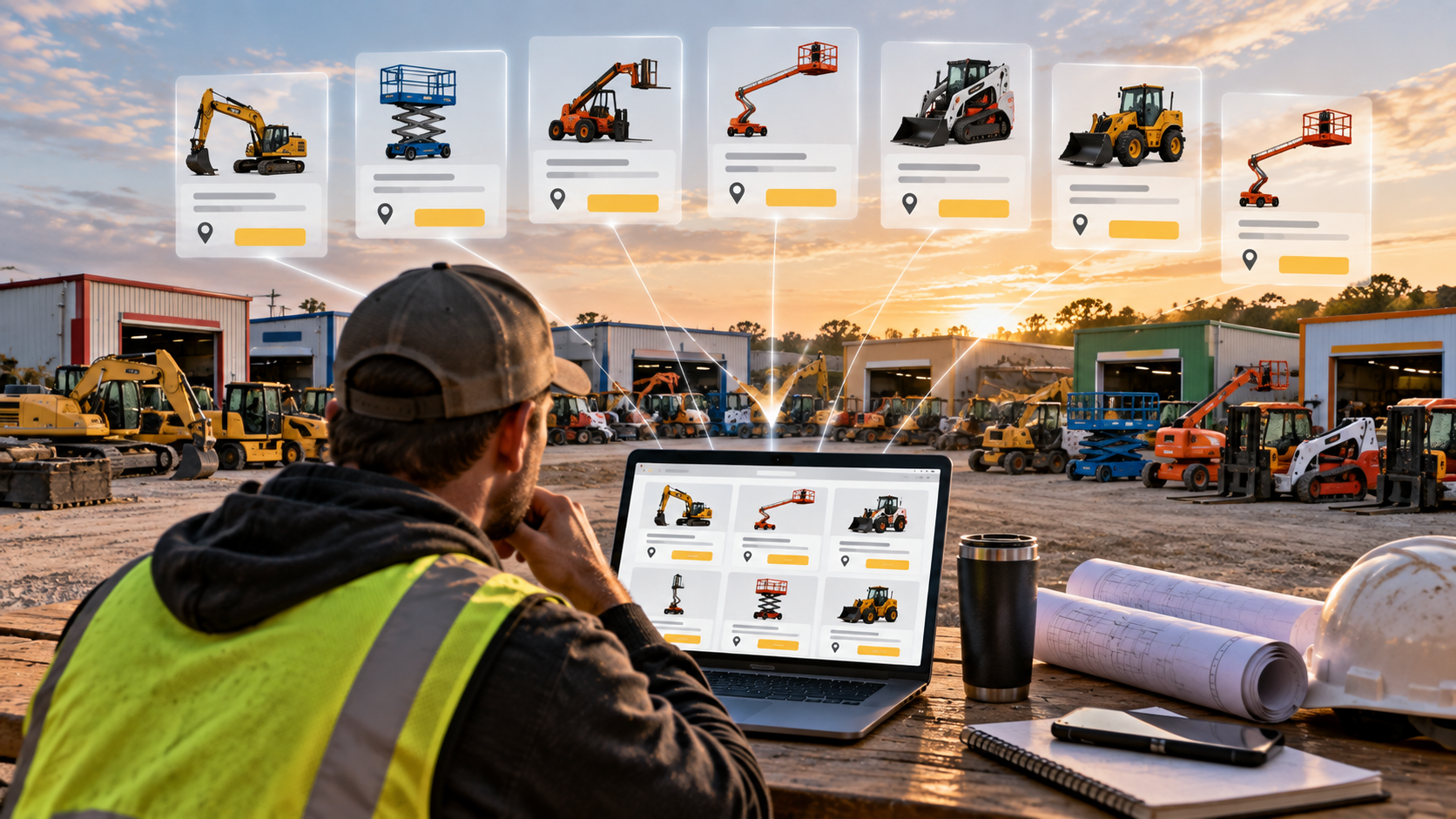
"Stop wasting hours on procurement. Discover the 8 best heavy equipment rental platforms of 2026 featuring AI-assisted booking and transparent all-in pricing."
Related reading: United Rentals vs. Competitors: Best Rental Options 2026, Get Found When Buyers Ask AI for Rental Equipment, and The Machine That Built America: A Brief History of the Bulldozer.


Get the latest GoDizel content delivered straight to your inbox
Looking for top United Rentals alternatives in 2026? Compare Sunbelt, Herc, and EquipmentShare to find the best construction equipment for your jobsite needs.
Contractors now ask AI where to rent equipment. Here's how rental companies can show up in those answers and turn that visibility into qualified leads.
Five calls, two voicemails, and a text to a guy who might have a mini excavator by Thursday. That's how a $1,800 rental still gets sourced at a lot of firms — and it's why procurement quietly eats hours that should belong to the schedule. Finding the machine is the hard part.
The old model hides its costs in two places: the hours your team spends on the phone, and the unexpected line items on the invoice. This traditional approach results in inefficiencies and unexpected expenses that disrupt project timelines and budgets.
I learned this problem from the contractor side long before we started building Dizel. I spent more than a decade running a construction company, eventually growing it to dozens of employees before selling it to a national operator. Equipment rental was just part of getting jobs done, but I watched our team burn hours calling rental companies, chasing availability, comparing rates that were rarely apples to apples, and then trying to figure out why the final invoice did not match the number we thought we agreed to. After the acquisition, I saw the same problem from inside a much larger national organization. More buying power did not necessarily make equipment procurement simpler. That experience is a big part of why we built Dizel. The industry does not need another place to request a quote. It needs a faster way to search the market, understand the real delivered cost, and book the right machine without spending half the morning working the phones.
Delivery, pickup, environmental fees, damage protection — none of it appears in the verbal rate a dispatcher gives you, and all of it lands on the invoice. Contractors have started calling that gap what it is: invoice drama. It's a margin issue disguised as an accounting problem.
Digital marketplaces close the gap by matching live yard inventory to a jobsite address and date, then quoting the whole number instead of the rate. That matching is where AI actually earns its place in construction procurement — not as a chatbot, but as the layer deciding which yard can serve your site at the lowest delivered cost.
Dizel was built around a single premise: the price you see should be the price you pay. Search by equipment type, jobsite location, and rental window, and the platform returns available machines from local and regional suppliers with delivery, pickup, and protection already folded into the quote. No callback. No "let me check with dispatch." No revised total after the fact.
The booking side is where the time savings compound. AI-assisted heavy equipment booking runs through either the web interface or a voice agent, so a superintendent standing in the mud can confirm a machine without opening a laptop or waiting on a rep. Recurring renters get member pricing, which matters for firms cycling the same skid steer or boom lift across multiple jobs a month. Rental partners keep control of their own rates through private pricing, so supply stays healthy instead of getting squeezed into a race to the bottom.
Best for:
General contractors who need a firm delivered number for an estimate today
Restoration and service crews booking under emergency timelines
Project managers standardizing equipment costs across multiple jobsites
Firms replacing manual yard calls with a single procurement workflow
BigRentz operates as a broker rather than a fleet owner, drawing on a large national network of rental yards to fill orders in markets where a single supplier can't. Its differentiator is explicitly named: AI-driven geo-matching logistics that route each request to the yard positioned to serve the site at the lowest hauling cost. Because transport is one of the largest hidden variables in any rental, that matching has real dollar consequences on longer hauls.
The tradeoff is common to every broker model. You're buying coverage, and coverage means the fulfilling yard may be one you've never dealt with. For national accounts running repeat volume across scattered geographies, that's an acceptable trade.
Callout: In brokered models, the value isn't the machine — it's the routing decision behind it.
How to work it effectively:
Enter the exact jobsite address, not the office address, so geo-matching prices the real haul.
Confirm which yard is fulfilling before you commit crew to a delivery window.
Request the delivered total in writing rather than the daily rate.
Consolidate repeat orders under one account to get consistent handling.
DOZR gained popularity with dirt-moving equipment — excavators, dozers, wheel loaders, the machines where a single spec mismatch costs a day of production. The platform leans into comparison shopping: instead of accepting the first rate a yard quotes, you see competing options for the same class of machine across a given market and pick on price, availability, or delivery timing.
Its second strength is administrative. DOZR integrates with contractor accounting and ERP systems, which matters more than it sounds. Once rental data flows into the same system tracking job costs, estimators stop reconciling paper tickets against invoices by hand. That's where a digital marketplace for construction machinery starts to function like real infrastructure rather than a website.
How it compares:
Equipment depth: strongest in earthmoving and heavy iron; lighter on specialty industrial gear
Price discovery: genuine cross-supplier comparison, not a single-vendor rate card
Back office: ERP integration reduces manual reconciliation on high-volume accounts
Best fit: mid-market contractors running consistent dirt work across a defined region
Watch for: confirm whether transport is quoted as a guarantee or an estimate
EquipmentShare runs a hybrid model — it owns and rents its own fleet while building software around it. That vertical integration is the point. Because the company controls the machines, it can instrument them, and the resulting telematics data feeds back into both the rental experience and the customer's own fleet visibility.
The platform, T3, is an operating system tracking machine location, runtime, fuel burn, and utilization in real time. For a project manager, that turns a rented excavator from a line item into a monitored asset: you can see whether the machine you're paying for by the week is actually running, and catch the idle unit sitting behind a stockpile before the invoice arrives. Maintenance alerts and utilization signals also inform booking decisions, flagging when a unit should be swapped rather than extended.
Key tech feature — T3 telematics: live location, runtime, and utilization data on rented machines, viewable alongside owned fleet in one interface. Useful for contractors who already run equipment rental management software and want rentals visible in the same system as their own iron, not tracked separately on a spreadsheet.
United Rentals brings inventory depth no marketplace can replicate from a standing start — specialty industrial, power and HVAC, trench safety, aerial work platforms, and branch coverage across most metros. When a project needs an unusual machine on a defined date, the depth is the argument.
The digital transition is a pivot rather than a starting point. TotalControl gives large accounts a portal for managing active rentals, tracking spend across sites, and reducing off-rent delays, and online booking has expanded considerably. What it doesn't fully replicate is marketplace price discovery: you're seeing one supplier's rates, and the delivered total often still arrives as an estimate subject to confirmation.
Pros
Deepest specialized and industrial inventory of any single supplier
Strong national account management for multi-site programs
TotalControl portal consolidates rental spend visibility
Cons
Single-supplier pricing means no cross-market comparison
All-in delivered totals are less consistently guaranteed than on pure marketplaces
Branch-level variation in booking experience still requires phone follow-up
If you strip these platforms down to what actually protects a project budget, four things matter.
Demand all-in pricing, not rates. A daily rate without hauling, pickup, and protection isn't a price — it's the opening figure in a negotiation you'll lose at invoicing. Transport is frequently the largest uncontrolled variable in a short-term rental.
Judge platforms by booking speed, not feature lists. The measurable win from assisted booking is procurement time collapsing from an afternoon of calls to a confirmation while you're still standing on site.
Marketplaces beat single-supplier portals on price discovery. One vendor shows you one rate card. A marketplace shows you what the market will actually charge to put that machine on your dirt this week.
Instrument your rentals. Telematics and utilization data are how you catch idle machines before they show up as margin loss rather than after.
The standard for 2026 is simple: See the Real Rental Price Before You Make a Single Call.
Match the platform to how your firm actually buys. If you're running dirt work in a defined region and need cross-supplier comparison with clean accounting handoff, a comparison marketplace fits. If you manage scattered national sites, brokered coverage matters more than shopping the market. If you already run owned iron and want rentals in the same telematics view, the integrated fleet-plus-software model earns the premium. If you need specialty industrial gear on a hard date, the legacy giant still wins on depth.
Then apply three filters, in this order: How fast can you get from search to confirmed booking? Is the delivered total a guarantee or an estimate? And is there real inventory in your specific market, not just national coverage on a map?
For general contractors whose primary problem is price certainty, the shortest path is the platform that shows the full number first. Search your next machine on Dizel, compare the delivered totals, and see the full procurement picture before anyone picks up a phone.

