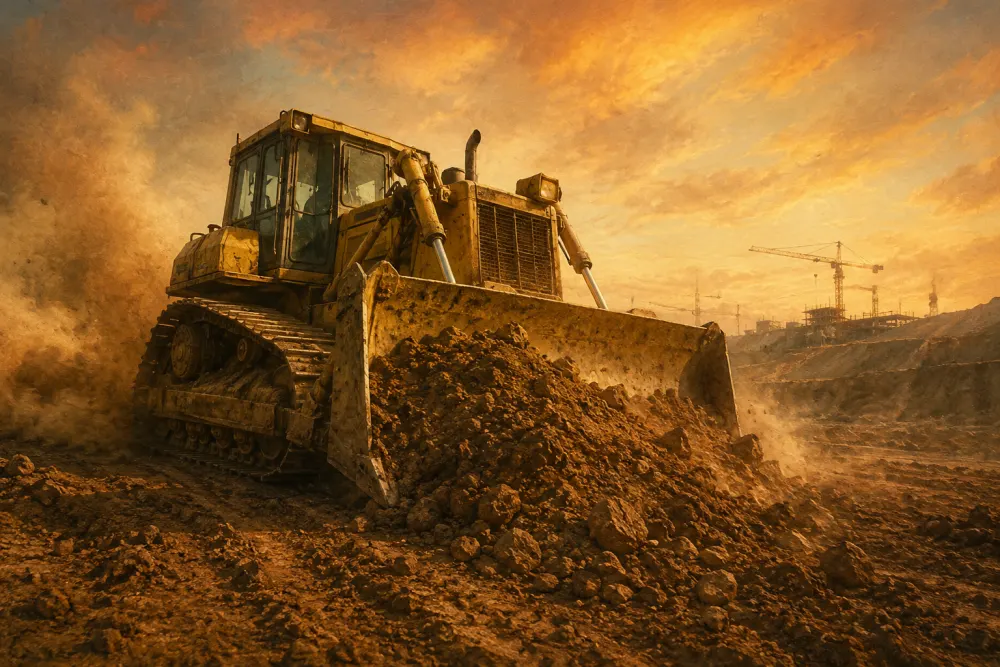
"Before highways, suburbs, or the interstate system, somebody had to move the dirt. Here's the machine that did it."
Related reading: Beyond the Search Bar: Why Agentic Shopping is the New Foundation for Equipment Rental in 2026, 8 Best Heavy Equipment Rental Platforms of 2026 Compared, and United Rentals vs. Competitors: Best Rental Options 2026.


Get the latest GoDizel content delivered straight to your inbox
Discover how agentic shopping is transforming construction equipment rental in 2026 by automating procurement and streamlining complex booking workflows.
Stop wasting hours on procurement. Discover the 8 best heavy equipment rental platforms of 2026 featuring AI-assisted booking and transparent all-in pricing.
Before highways. Before suburbs. Before the interstate system stitched this country together, somebody had to move the dirt.
That somebody was a bulldozer.
For most of human history, moving earth meant men with shovels and animals with harnesses. Slow. Brutal. Expensive. A crew could spend a full week clearing ground that a modern dozer handles before lunch.
Here's how we got there.
It Started with a Bad Idea That Worked
The first bulldozers weren't designed. They were improvised.
In the 1920s, farmers started welding makeshift blades onto crawler tractors, the same machines pulling their plows. The goal was simple: push stumps out of the way without killing the tractor. It worked well enough that people kept doing it.
The name came from the work. "Bull-dozing" was already slang for forcing something through sheer strength. The machines borrowed it about 50 years after the word first appeared in print, originally referring to people, not equipment.
In 1923, James Cummings and J. Earl McLeod drafted the first patent for a blade built specifically for earthmoving. That drawing is considered the official birth of the bulldozer. By the 1930s, manufacturers were building dedicated systems. Hydraulic controls, which let operators tilt and angle the blade mid-push, didn't become standard until the 1940s. Before that, operators could only drop the blade, not steer it.
World War II Made It a Legend
The Depression-era construction boom put the bulldozer to work. The war turned it into something else.
The U.S. military needed airstrips, roads, and bases built fast in terrain that had never seen heavy equipment. The Pacific theater, with its dense jungle and coral rock, became the proving ground for what a dozer could actually do under pressure.
The Navy's Seabees became famous for building functional airstrips in days. The bulldozer was their primary tool. By the end of the war, the U.S. military had used approximately 26,000 Caterpillar D7s across multiple theaters. Caterpillar's production lines ran around the clock for years.
Most historians who study WWII logistics credit the bulldozer as one of the machines that actually won the war. Not a weapon. A tool that built the runways, roads, and forward bases that kept the whole operation moving.
When it was over, the same equipment and the same operators came home and built the country they'd been fighting for.
The Interstate Era
The Federal Aid Highway Act of 1956 authorized 41,000 miles of interstate. Someone had to move the dirt for all of it, cut through mountains, filled across valleys, graded across every terrain this country has.
Estimates on the total earth moved during construction run into the billions of cubic yards. It is often called the largest public works project in human history.
It wasn't a political achievement first. It was a construction achievement first. And equipment made it possible.
The Machine Keeps Evolving
Modern bulldozers look familiar compared to their 1930s ancestors. The technology underneath is a different conversation.
GPS-guided blade control. 3D machine control systems that read a digital jobsite model in real time and adjust the blade automatically. Telematics that report engine hours, fuel consumption, and fault codes before the operator climbs off.
Komatsu's Intelligent Machine Control series can stop the blade automatically at finish grade without operator input. The system reads the design model and handles the precision while the operator focuses on production. The largest bulldozer currently in production, the Komatsu D575A, weighs 336 tons, runs a 1,150-horsepower engine, and pushes roughly 90 cubic yards in a single pass.
What used to take a skilled operator hours of passes, a modern machine with 3D control can do in a fraction of the time with less rework.
Why This Still Matters
The bulldozer is not a relic. It's still the first machine on nearly every major earthmoving project. Before the excavators, the compactors, the scrapers, someone fires up a dozer and starts clearing.
Good contractors know their equipment. How blade geometry affects push distance. Why track width matters on soft ground. When a dozer is the right call versus a scraper for large-area grading. That knowledge is what keeps a job on schedule when conditions change and the plan has to adjust fast.
And when it's time to put one to work, you shouldn't have to spend the morning on the phone finding it.
Search bulldozers and heavy equipment at GoDizel.com. Every rental yard near you, all-in pricing, one search. No phone tag.
The machine built this country. Go put it to work.

