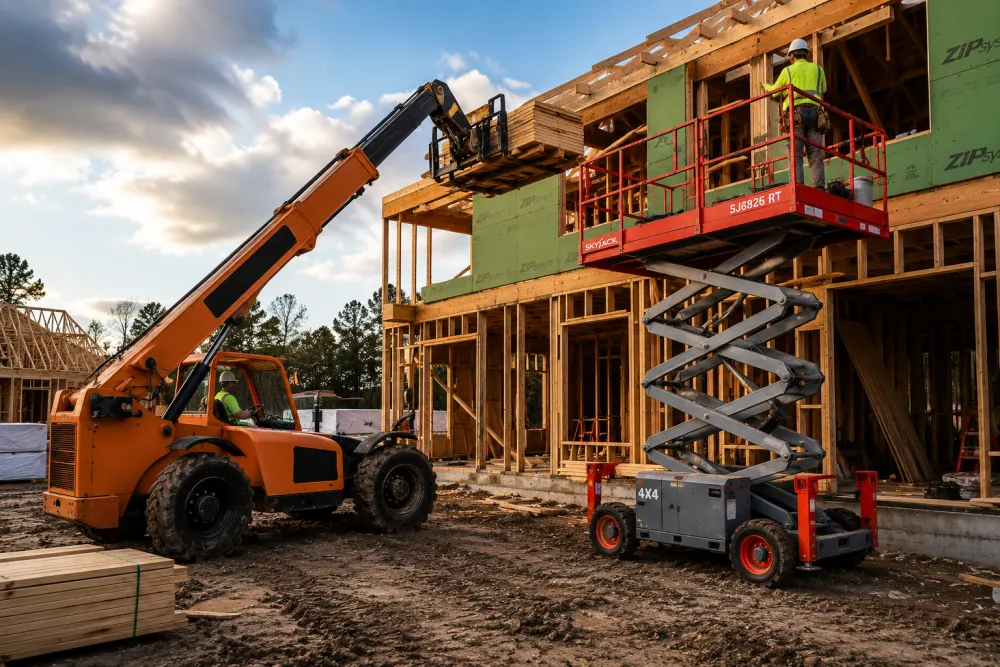
"Telehandler or scissor lift for second-story work? Wrong choice wastes a rental. The answer comes down to one question: materials or people?"
Related reading: Choosing Between a Scissor Lift and a Boom Lift for Your 2026 Project, How to Rent the Right Lift for Warehouse Security Camera Installation, and How to Streamline Equipment Procurement for Multiple Job Sites Without Managing Separate Rental Agreements.


Get the latest GoDizel content delivered straight to your inbox
Struggling to choose between a scissor lift and a boom lift? Learn the key differences to pick the perfect aerial lift for your 2026 construction project.
Learn how to rent the right lift for warehouse security camera installation in 2026. Compare scissor and boom lifts to meet OSHA safety requirements.
A framing contractor once asked me why his scissor lift rental was "useless" on his job. Turns out he was trying to land trusses on a second-story deck with a machine built to lift people straight up. Wrong tool, right height. It's one of the most common mix-ups in equipment rental, and it usually comes from thinking about height first and the actual task second.
So let's settle it. The question is not how high you need to go. It's what needs to get up there.
If you're lifting materials to a second story, rent a telehandler. If you're lifting people to work at a second-story height, rent a scissor lift. When the job needs both, and a lot of second-story work does, plenty of crews rent both and keep each machine doing what it's built for.
A telehandler is a rough-terrain forklift with a telescoping boom. It picks up loads, trusses, lumber packages, shingle pallets, block, drywall stacks, and places them up and out, over walls and onto decks. A mid-size unit handles 6,000 to 10,000 pounds and reaches 30 to 40 feet or more, which is far beyond anything a second story demands.
The boom is the key. Because it extends forward as well as up, a telehandler can stand off from the building and still land a load in the middle of a deck. On muddy or unfinished sites, which is most framing-stage sites, its big tires and rough-terrain design keep it moving where other machines can't.
What a telehandler is not: a work platform. Nobody should be riding the forks, and if you need people elevated alongside materials, that's a different machine and a different conversation.
A scissor lift raises a platform of workers and their tools straight up. For second-story exterior work like siding, soffit, windows, or painting, a 19 to 26 foot scissor lift covers the height with room to spare. The platform is roomy and stable, which makes it ideal for tasks where crews work in one zone for a while before moving.
The catch is the phrase "straight up." A scissor lift has no outreach. It has to park directly beside where the work happens. Electric slab scissors need firm, level surfaces, so for outdoor second-story work on dirt, make sure you rent a rough-terrain scissor lift, not the smooth-tire warehouse version. I've seen that mistake eat a rental day more than once, especially on sandy Florida sites.
If your work requires reaching up and over something, a porch roof, a ledge, landscaping, then neither machine fits and you should look at a boom lift instead.
Here's the mental checklist I give people. Loading trusses or material onto a second floor? Telehandler. Crew installing siding or trim at second-story height? Scissor lift, rough-terrain if you're on dirt. Reaching over an obstruction to the work area? Boom lift. Full framing package where materials go up all day and crews work the exterior? Telehandler plus a lift, and your schedule will thank you.
The cost difference is real but manageable. Scissor lifts are generally the cheapest aerial rental, telehandlers cost more, and doubling up is still cheaper than the labor hours lost hand-carrying material up ladders. One crew hauling shingles by hand versus one telehandler cycle tells you everything.
Height is the last question, not the first. Decide whether you're moving materials or people, check your ground conditions, and the right machine picks itself. Materials go up on a telehandler. People go up on a lift.
When you're ready to book, Dizel makes it easy to compare telehandler and scissor lift rentals, check real availability, and get the right machine delivered to your site on schedule.

