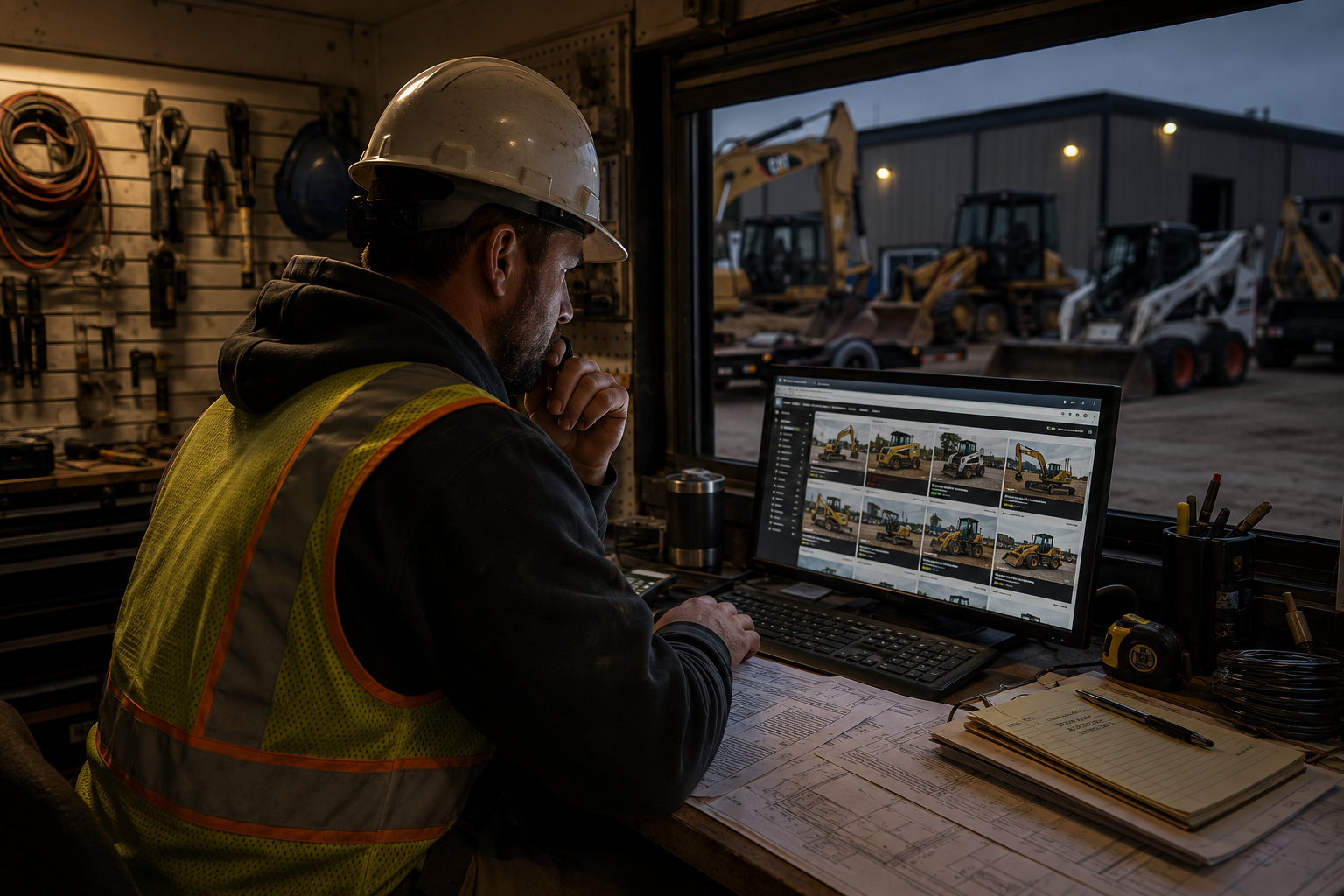
"Maximize your project efficiency and capital with our strategic guide to construction equipment rental. Learn how to source the right machinery for your job sit"
Related reading: How to Streamline Equipment Procurement for Multiple Job Sites Without Managing Separate Rental Agreements, How to Rent Storm Cleanup Equipment After a Hurricane in 2026, and How to Rent and Set a Commercial Generator in 5 Steps.


Get the latest GoDizel content delivered straight to your inbox
Learn how to consolidate equipment procurement across multiple job sites. Stop managing separate rental agreements and optimize your fleet management today.
Learn how to rent storm cleanup equipment effectively in 2026. Follow our guide to secure essential restoration tools and prevent long-term property damage.
Construction equipment rental has moved from a stopgap measure to a deliberate capital-preservation strategy for contractors who want to grow without overextending their balance sheets.
The ownership mindset treats every machine as an asset. But on a balance sheet, owned equipment is also a liability — one that depreciates, demands maintenance, and ties up capital that could fund the next contract. Rental shifts that equation. Instead of a depreciating asset, you carry an operating expense that's fully tax-deductible in the period it's incurred. That's a meaningful difference when you're managing cash flow across multiple active projects.
The concept worth understanding here is fleet elasticity — the ability to right-size your equipment mix based on what's actually under contract right now. One month you need a skid steer loader rental and bulldozer rental; the next, you need 10 ton excavator rental or crawler dozer rental. With owned equipment, you're locked into what you bought. With rental, your fleet scales with your workload. Whether you're sourcing a mini excavator rental with operator, earthmoving equipment rental near me, or a helical pile driver rental for a specialized foundation job, availability determines what you can bid — not what's sitting in your yard.
Ownership also carries costs that rarely appear in the purchase decision: storage, insurance, scheduled servicing, operator certification, and steady depreciation. A skid steer backhoe attachment rental, a construction light rental, or even a construction cone rental eliminates all of that overhead for the duration of the project. The economics of the rental-vs-own decision are worth examining closely — and that's exactly where we'll go next.
When it comes to construction machine rental versus ownership, the real question isn't which option costs less — it's which option costs less for your actual utilization rate.
The utilization threshold is where this decision gets concrete. Industry data consistently points to 60–70% utilization as the break-even zone: below that, owning a machine means you're carrying depreciation, insurance, storage, and maintenance costs on equipment that's sitting idle. Above it, a purchase starts to pencil out. A wheel loader rental at $3,500–$5,000 per month looks expensive until you compare it against a $180,000 purchase that depreciates 20–30% in year one alone. The same math applies to motor grader rental, bulldozer rental prices, and grading equipment rental — the ownership premium is front-loaded and unforgiving.
Machine lifecycle compounds the calculation. Specialty attachments — an excavator mulcher rental, a vibratory roller for skid steer, or an asphalt milling attachment for skid steer rental — are rarely used enough to justify ownership. Even workhorse units like a tractor backhoe rental or backhoe tractor for rent often serve contractors better as rental for construction equipment, simply because the machine's peak demand rarely aligns with a single contractor's schedule. The same logic applies to jumping jack compactor on a single grading job, skidloaders for rent during a short foundation phase, or trench excavator rental for a one-off utility project.
Availability directly affects your bottom line in ways that don't show up in ownership calculations. When a project timeline slips because a machine is down or unavailable, liquidated damages can run $5,000–$25,000 per day on commercial contracts. Construction machinery rental services that guarantee quick deployment — whether it's Caterpillar skid steer rental, JCB excavator rental, or a construction lull rental — protect your schedule in ways a single owned asset simply can't. Heavy equipment contractors who treat rental as a scheduling buffer, not a fallback, consistently close out projects on time. The next section examines which equipment categories have the most reliable availability — and where you're most likely to hit waitlists.
When contractors decide to rent construction equipment, the category they choose — and when they book it — often matters as much as the machine itself.
Earthmoving is the highest-volume segment, covering everything from a mini backhoe and wheeled excavator rental to a full 160 excavator rental for deep utility work. Aerial work platforms and lift crane rental options serve commercial and vertical construction, while material handling units — telehandlers, construction conveyor rental equipment, and materials hoist hire — keep job sites moving efficiently. Compaction is another dense category: a vibratory roller compactor rental, compaction roller rental near me searches, or a basic vibratory plate compactor 14 in rental can all be sourced through regional heavy construction equipment rentals providers.
Availability pressure is real in high-demand categories. Skid steer loaders, mini excavators, and compact equipment rental units book out fast in peak season — especially in growth markets. A kubota backhoe rental or rent tractor loader backhoe request submitted Monday morning may not be available until the following week. Specialty units like asphalt paver rental, road grader rental, soil grader rental, and pneumatic pile driver rental carry even tighter availability windows. Front loader rental near me, compactor machine for rent near me, and dirt compactor for rent near me searches often reflect last-minute site needs where timing is everything.
Example scenario: A mid-sized residential developer managing three subdivisions simultaneously uses commercial construction equipment rental to bridge phase gaps. Between site prep and framing, they rotate a skid steer concrete mixer rental, yard grading equipment rental units, and a vibratory plate compactor rather than carrying idle owned assets between lots. They also pull in a self loading concrete mixer rental during foundation pours and a backhoe attachment for skid steer rental for tight-access grading — keeping overhead lean without sacrificing productivity. Understanding which categories to prioritize, and how fleet age and provider support affect uptime, shapes every sourcing decision — which is exactly where equipment selection criteria come in.
Choosing the right machine for a specific site condition is the single decision that separates a smooth project from a costly overrun — and it starts well before you call a rental yard.
When you're sourcing earthmover equipment rental or evaluating a provider for heavy machinery rental, the specs that matter most depend on what the ground is actually doing. Soil density, slope grade, and confined-space constraints all dictate machine class. Need a long reach excavator for rent on a waterway project? Dig depth and boom extension are non-negotiable specs. Looking at a mini dozer for rent for grading in tight quarters? Track width and blade capacity tell the real story. For paving work, an asphalt machine rental means matching screed width to lane requirements — not just grabbing whatever's available.
Evaluating a rental provider goes beyond price. Fleet age is a reliable proxy for reliability: newer machines mean fewer mid-project breakdowns. Ask about maintenance intervals and whether the provider offers on-site support. Whether you're sourcing a portable backhoe rental, a truck mounted crane rental, or a rent construction crane for vertical work, service response time should factor into your decision as heavily as the daily rate.
The "equipment rental near me" instinct makes sense — transport costs for rent heavy construction equipment are real — but proximity alone isn't enough. A provider 20 miles further out that offers telemetry-enabled machines, digital rental agreements, and proactive maintenance alerts is often worth the extra haul cost. Modern construction equipment business operators are increasingly using GPS and telematics to monitor hours, fuel, and fault codes remotely. That data protects both sides.
The category spread in a solid rental fleet runs wide: from a backhoe digger rental or jcb 1cxt rental for utility trenching, to mini dumper rental for restricted-access material handling, to a cat bulldozer rental for mass clearing, to a construction light tower rental or construction light rental near me for night operations. Specialty items — a brokk demolition robot rental, excavator rock drill rental, or construction dehumidifier rental — signal that a provider is serious about serving complex jobsites, not just renting commodity iron. The next section drills into the specific earthmoving and material handling machines where these selection decisions get most consequential.
Choosing between a skid steer loader and a compact track loader (CTL) is one of the most consequential decisions you'll make when sourcing rental heavy construction equipment for a site.
Terrain drives that call. Skid steers are faster and more maneuverable on hard, flat surfaces — they're the go-to for small construction equipment rental on concrete pads or asphalt lots. CTLs distribute weight across rubber tracks, making them the right choice for soft, muddy, or uneven ground where a wheeled machine would sink or spin. Compact earth moving equipment decisions that ignore surface conditions routinely turn a one-week rental into a two-week headache.
Excavator selection goes deeper than machine size. When you rent construction equipment for dig work, three specs matter most:
Reach — how far the boom extends horizontally from the undercarriage
Dig depth — whether the machine can hit your grade without repositioning constantly
Bucket breakout force — the torque available to fracture compacted soil or clay
A 4,000 pound excavator handles utility trenching and landscaping grading efficiently, while a crawler excavator rental becomes necessary once you're cutting footings deeper than 10 feet or working on slopes. Matching spec to task — not just grabbing whatever's available — is what separates productive contractor rental equipment decisions from expensive mistakes.
Lift capacity on tight urban jobsites is where telehandlers and forklifts split into very different tools. Telehandlers extend their reach forward and upward simultaneously, which makes them valuable for large equipment rental scenarios involving multi-story staging. Standard forklifts are more stable at ground level but can't place material above the first floor safely. When you're evaluating construction equipment hire options for confined sites, confirm the manufacturer's rated capacity at full extension — not just the headline lift number.
And once you've locked down your earthmoving and material handling lineup, vertical access introduces a different set of tradeoffs entirely — which is exactly where aerial and specialty solutions come into play.
The decision to rent scaffold versus a self-propelled aerial lift isn't just a budget call — it's a safety and productivity call that shapes your entire vertical-access workflow.
Scaffolding vs. Aerial Lifts. When you rent scaffold for multi-day, multi-trade work at a fixed elevation, you're paying for stability and platform area. But for tasks that require repositioning — painting, mechanical rough-in, exterior inspections — a scissor or boom lift pays back its daily rate in labor hours saved. Boom lifts extend that logic further, reaching over obstacles that would require scaffolding teardown and rebuild. Match the tool to the movement pattern, not the sticker price.
Specialty One-Off Rentals. Specialty construction equipment rental fills the gap between what's worth owning and what a job demands right now. Stump grinders, trenchers, pile driving equipment rental, and even a towable roller compactor fall into this category — tools that would sit idle 48 weeks a year if purchased. The same logic applies to earth moving equipment rental for single-phase site prep: a mini backhoe rental or towable backhoe rental gets the work done without locking capital into a depreciating asset. Contractors sourcing forestry equipment rental, a construction hoist for rent, or excavating rental equipment on a per-project basis are, in effect, practicing smart construction equipment leasing without the long-term liability.
Operator Certification Requirements. Aerial equipment carries real risk. OSHA requires documented operator training for boom and scissor lifts — and rental agreements increasingly mirror that requirement. Before your crew climbs, verify certifications are current. Ignoring this step doesn't just expose workers; it voids the damage waiver on your rental contract, which is exactly the kind of detail the next section will walk through in depth.
Rental agreements contain more hidden risk than most contractors realize — and the machinery rental company you choose won't always flag those risks before you sign.
Rental limitations are real. You can't customize a rented machine the way you'd spec a purchase, and scheduling conflicts are common — especially for high-demand units like a small backhoe rental or a soil compactor for rent during peak season. When your project window is tight, a one-day delay in equipment delivery cascades fast.
Damage waivers are where many contractors get burned. Vague language around "fair wear and tear" can expose you to charges for pre-existing hydraulic leaks or cosmetic damage. Whether you're arranging a tractor loader backhoe rental, skid steer leasing, or excavation equipment hire, read every waiver clause before you sign — not after the machine arrives.
Dry vs. wet rentals carry different financial profiles. A dry rental (equipment only) keeps your costs lower but puts full operational liability on your crew. A wet rental includes an operator, which adds daily cost but reduces your exposure on complex tasks like grading or demolition equipment rental near me searches typically surface. For heavy duty equipment rental involving cranes or specialty lifts, wet arrangements often make more financial sense.
Delivery inspection is your first and best line of defense. Before your crew touches the controls — whether it's a loader rental near me pickup or a long stick excavator delivered to a remote site — document everything with timestamped photos and a written condition report co-signed by the delivery driver. That documentation will matter when it's time to go off-rent. Speaking of which, the contractual safeguards around off-rent notifications and insurance requirements deserve their own close look.
The rental contract is where your financial exposure lives — and most contractors sign it in a parking lot without reading past the daily rate.
Whether you're picking up a cat excavator rental, a vibratory roller rental, or concrete compaction equipment for a paving job, the insurance and inspection details buried in that agreement will determine who pays when something goes wrong.
Rental Equipment Protection (REP) is not your commercial general liability policy. CGL covers third-party bodily injury and property damage — it doesn't cover physical damage to rented equipment itself. REP, offered by the rental yard, fills that gap. Without it, a hydraulic failure on a kobelco excavator rental or a tipped piling rig rental becomes a five-figure invoice against your company directly. Check whether your inland marine policy already covers rentals equipment construction; if it does, you may not need to double-pay for REP.
Before the driver leaves the yard — whether you're taking delivery of a backhoe rental near me, a construction lift rental, a demolition robot rental, or asphalt paving equipment rental — run through this inspection checklist:
Fluid levels: engine oil, hydraulic fluid, coolant
Safety lights and backup alarms: non-negotiable on any equipment rental dozer or excavation rental unit operating on active job sites
Pre-existing hydraulic leaks: document every drip with timestamped photos before signing the delivery receipt
Wear items: track tension on a mini skid steer backhoe, blade condition on a pavement grinder rental, drum integrity on used compaction equipment
Attachments: confirm a backhoe auger rental arrives with the correct auger diameter and drive head specified in the contract
Off-rent notifications are where billing disputes are won or lost. Industrial equipment rental agreements, whether you're contractor equipment rental near me or sourcing heavy lift crane rental through a national network, typically bill to the minute of confirmed off-rent — not when equipment sits idle on your site. A digital timestamp, sent via the rental provider's app or emailed confirmation, creates an auditable record. Verbal phone calls don't. That discipline matters whether you're closing out a john deere dozer rental on a residential pad or wrapping a construction material hoist rental on a commercial tower.
Those misconceptions about rental cost and logistics — and why the cheapest rate on a backhoe rental per day rarely ends up being the cheapest project outcome — deserve a closer look next.
The cheapest rate to rent construction vehicles rarely produces the cheapest project outcome — and that gap is where most logistics failures begin.
The Long-Term Rental Math. Many contractors assume that for projects running six months or longer, buying beats renting every time. In practice, that calculation ignores maintenance reserves, storage costs, depreciation, and the carrying cost of capital tied up in owned assets. Earth moving equipment, compaction equipment, and specialty machines like an asphalt grinder rental or paving equipment rental sit idle between phases — and idle owned iron still costs you money. For multi-phase projects, a structured rental agreement through established construction rental companies often outperforms ownership on a total-cost basis, particularly when you factor in the flexibility to swap a grader machine rental or demolition excavator rental as site conditions change.
The Cheap Rate Trap. A low daily rate means nothing if the machine arrives two days late. Logistics failures — wrong machine spec, delayed transport for construction crane service or heavy lift crane services, or a vendor who can't supply construction scaffolding rental and a construction hoist hire from the same yard — cascade into idle crew costs that dwarf any rate savings. When you search for excavation equipment rental near me or compact construction equipment rental, the proximity of the yard matters as much as the price on the quote. A d5 dozer rental near me or a bulldozer rental near me from a vendor 15 miles out will almost always outperform a "better deal" three counties away when delivery windows tighten.
Local Yards vs. National Networks. The tradeoff between local mom-and-pop yards and large national rental networks is real, and neither wins universally. Local yards often carry niche building material rental and contractor tool rental inventory — a terramite backhoe rental, a 3000 lb excavator, or a kubota 8000 lb excavator that national chains don't stock — and their branch managers will answer the phone on Saturday. But national networks offer fleet depth: if you need a roller compactor 5 ton rental, light compaction equipment, a jack hammer attachment for excavator rental, or an excavator stump grinder rental simultaneously, a single vendor relationship simplifies coordination. The practical approach is to use both — local yards for specialty and short-notice needs, national accounts for volume and continuity. The key takeaways that follow will help you structure that balance efficiently.
Renting heavy equipment strategically comes down to three disciplines: knowing when to rent, inspecting what arrives, and managing the fleet digitally.
The 60% utilization rule remains the clearest filter for the rent-vs-buy decision — if a machine won't run at least 60% of available hours annually, renting beats owning on cost. That applies whether you're looking at a caterpillar excavator rental for a single site, a cat dozer rental on a grading contract, or a cat mini excavator rental for utility work. The math doesn't change based on brand. From a volvo excavator rental to a jcb teleskid rental to a 45000 lb excavator on a demolition job, idle equipment is a liability, not an asset.
The 3-step delivery inspection — document hours, verify attachments, photograph all visible damage — protects you before the machine turns a wheel. It applies equally to a bobcat compact equipment unit dropped off for landscaping prep, a compaction roller hire for a road base, or a high reach demolition excavator for rent on a structural teardown. Skip it once and you're disputing damage charges you didn't cause.
Digital rental management is now the primary differentiator for site efficiency. Contractors who track invoices, utilization windows, and return dates across every unit — from a cat skid steer rental to a road grader rental near me search to scaffolding equipment rental on a vertical build — run tighter projects. Construction tool rental and rent building tools decisions made through a centralized platform eliminate the scattered calls and missed return windows that inflate costs.
On supplier strategy, the right balance sits between national availability and local branch relationships. A national provider can fulfill a united rentals backhoe or united rentals bobcat request across regions, provide united rentals temporary fencing for a multi-site job, or source united rentals equipment near me at short notice. But local and regional suppliers — whether you're sourcing through admar rental prices, a dingo backhoe rental outfit, or a statewide provider — often deliver faster response and more flexible terms for ongoing work. The same logic applies when evaluating home depot backhoe rental or home depot mini backhoe options for smaller construction tool rental needs versus a specialist for a mini backhoe loader rental near me or a mini motor grader rental. Dozer rentals near me, skid steer equipment rental near me, vibratory roller for rent near me, road construction equipment rental, backhoe rental with operator, and large excavator rental near me searches all benefit from suppliers who know your region. For specialized needs — a temporary construction elevator rental, construction lifts for rent near me, a cat grader rental, a skid loader track tool, a stump grinder for backhoe, or an 18 500 lb mini excavator — local branch knowledge often closes the gap faster than a national catalog. Don't overlook niche searches like a tractor dozer for rent, rental excavators for sale, or a lowe's trench digger for smaller prep work. Even sunbelt rentals scaffolding options deserve comparison against local scaffolding equipment rental providers before you commit. Understanding which lever to pull — national scale or local depth — is the skill that separates reactive equipment sourcing from a repeatable system. The next step is knowing where industry standards, manufacturer documentation, and safety guidelines can sharpen those decisions further.
Smart construction equipment rental decisions don't stop at finding the lowest rate — they require grounding your process in manufacturer documentation, government safety guidelines, and recognized industry standards.
When you're sourcing rental machines for construction — whether that's a backhoe rental for a utility trench, a construction crane rental for a structural lift, or a high reach excavator rental for a tight urban site — the load charts and operational envelopes published by the original equipment manufacturer are your baseline. Always pull those documents before the machine arrives on site. A Komatsu excavator rental, a rent Kubota backhoe arrangement, or a 6 ton excavator rental each comes with manufacturer-specific capacity data that no general rental agreement replaces.
Beyond manufacturer specs, OSHA regulations and state-level safety agencies publish binding operational requirements for heavy machinery — covering everything from a construction forklift rental and pile driver rental near me scenarios to a backhoe loader rental or backhoe breaker rental application. Consult those guidelines before your crew operates any rental machines construction sites classify as high-risk. For equipment categories that sit at the boundary — a walk behind backhoe, a power grader rental, a dirt grader rental, or a motor grader for rent near me search — industry classification bodies like the Association of Equipment Manufacturers (AEM) provide the definitions that determine operator certification requirements.
For contractors managing larger fleets, academic construction management textbooks — specifically those covering fleet optimization models and construction machinery leasing frameworks — offer quantitative tools that go beyond rule-of-thumb decisions. These resources apply directly whether you're renting a compact track loader, evaluating earth moving equipment prices, or comparing a cat track loader rental against a 650 dozer rental for a grading phase. Platforms like Kirby-Smith, Ring Power, and Sunstate Equipment are starting points for regional availability — but the standards that govern how you operate that machinery construction machine rental near me searches surface are non-negotiable regardless of supplier. When you build your sourcing process on verified specs rather than assumptions, you make better decisions on every job.