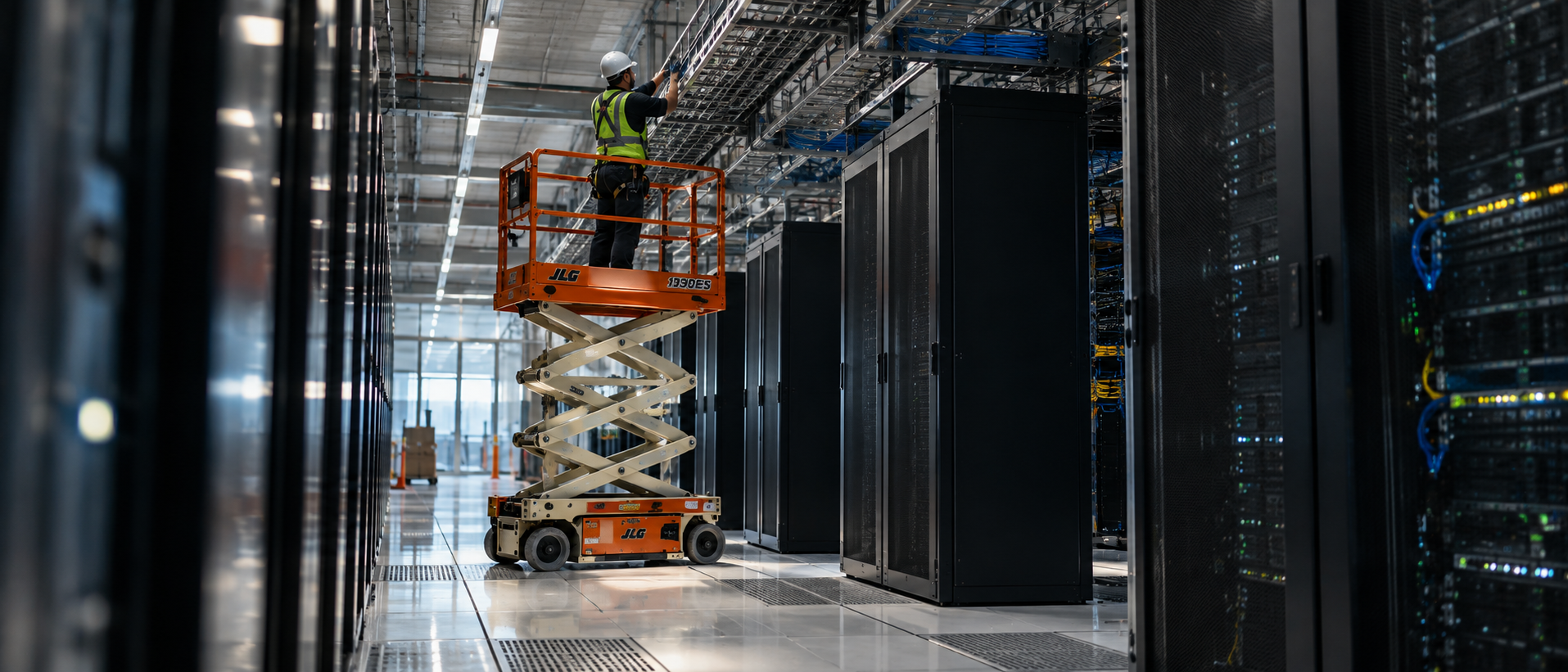
"Is the JLG 1930ES the best electric lift for data centers? Our 2026 review explores why this narrow, lightweight scissor lift is ideal for raised floors."
Related reading: How to Rent Storm Cleanup Equipment After a Hurricane in 2026, How to Rent and Set a Commercial Generator in 5 Steps, and Rent vs. Buy a Skid Steer: Is Ownership Worth It for 10 Uses a Year in 2026?.


Get the latest GoDizel content delivered straight to your inbox
Learn how to rent storm cleanup equipment effectively in 2026. Follow our guide to secure essential restoration tools and prevent long-term property damage.
Learn how to rent and set a commercial generator for your site. Follow our 5-step guide to calculating loads, choosing equipment, and ensuring safe power.
For overhead work inside an active or under-construction data hall, the JLG 1930ES is the default choice — and this JLG 1930ES review finds little reason to argue with that default.
Rating: 4.7 / 5 for data center environments ★★★★☆
The reason is balance. It's narrow enough to track down a cold aisle without clipping rack frames, and its mass is spread across a footprint that behaves predictably on a raised access floor rather than concentrating load into a single tile corner. Its battery-electric drivetrain produces no exhaust, which makes it one of the few machines a facility manager will approve for use inside a conditioned white space. Direct electric drive also means fewer hydraulic components working continuously, which translates to longer duty cycles between charges than older hydraulic-drive units of the same class.
Who it's for: General contractors running fit-outs, electricians pulling cable tray and containment overhead, fire protection subs, and facility teams performing maintenance above live racks. Anyone who needs vertical access without putting a point load through a 24-inch floor panel.
Who it isn't for: teams moving server hardware. That's a different machine entirely.
Specification
What matters in a data hall
Stowed width
Narrow-aisle class; sized to clear standard hot/cold aisle spacing
Operating weight
Distributed across four wheels rather than concentrated at one point
Platform height
Reaches typical cable tray, containment, and ceiling grid elevations
Tires
Non-marking, solid — no scuffing, no rubber dust
Power
Battery-electric drive and lift, zero emissions
Verify every figure against the manufacturer's spec sheet for the exact serial number you're renting. Battery packs, platform extensions, and optional decks all change the number on the data plate, and the data plate is what your structural engineer will ask for.
The number that actually decides the job isn't platform height — it's wheel load. Raised access floors are rated by panel, by stringer system, and by pedestal, and the governing limit is concentrated load at a single point, not the total mass of the machine. A narrow aisle electric scissor lift like the 1930ES helps because its wheels sit inboard and its weight lands across multiple panels rather than straddling one seam.
Before rolling onto the floor, pull the floor system's concentrated load rating, confirm pedestal condition, and plan the travel path. Where the math is tight, load-spreading plates or plywood sheeting redistribute wheel load across additional panels.
Rental rates for this class of machine move with region, season, and how much data center construction is competing for the same fleet. Rather than quote a number that'll be wrong by the time you call, understand what actually drives the invoice:
Rate tier. Daily, weekly, and monthly rates aren't proportional. A three-week fit-out almost always belongs on a monthly rate.
Delivery and pickup. Data center loading docks have security escorts, scheduled delivery windows, and badging requirements. Confirm whether the yard charges for waiting time.
Clean-condition prep. Some yards wash and detail units bound for interior work. Others don't. Ask, because a greasy chassis is a change order waiting to happen.
Damage waiver, environmental fees, and fuel surcharges. These are where "cheap" quotes stop being cheap.
Return condition standards. Non-marking tires scuffed on exterior concrete can trigger charges.
An electric manlift for data centers and a specialized server lifter serve different line items. Budget both if your scope covers overhead infrastructure and rack population — one won't substitute for the other.
Dizel Marketplace lets you compare live availability and all-in pricing across local yards in one search, so the number you see is the number you pay.
→ Check availability near your site on Dizel
Pros
Cons
Direct electric drive — fewer hydraulic leak points over sensitive floors
Still heavy enough to exceed some older raised floor ratings
Zero emissions; approved for conditioned interior space
Not a hardware lifter; can't safely place a populated rack
Non-marking tires standard
Platform width limits how many trades can work simultaneously
Compact footprint for aisle navigation
Requires load-spreading on marginal floor systems
Strong battery duty cycle for back-to-back shifts
Charging logistics need planning on secure sites
The hydraulic leak risk deserves more attention than most rental guides give it. A few ounces of hydraulic fluid on a warehouse slab is a cleanup. The same spill on a perforated floor panel above a plenum is a contamination event — fluid migrates under the floor, into the airstream, and potentially onto equipment the facility's SLA depends on. Direct electric drive removes the drive circuit from that equation, leaving fewer pressurized lines to fail. It doesn't eliminate the hydraulic lift cylinder, so inspect hoses and fittings before the unit crosses the threshold, and stage drip containment under the chassis when the machine parks overnight.
Aerial lift operation on construction sites falls under OSHA's aerial lift standard, 1926.453. That covers operator training, fall protection at the platform, and the prohibition on moving a lift with the platform elevated unless the machine is designed for it. The standard applies the same whether the deck is over dirt or over a data hall.
Uptime Institute's Tier classifications describe redundancy and concurrent maintainability, not floor ratings — but they shape your work plan. In a Tier III or IV facility, the expectation is that work proceeds without interrupting IT load, which means any lift route must be approved against live equipment, and any floor panel you traverse must be verified before the wheels touch it.
If the floor won't carry the load, the reach specification is irrelevant.
Confirm emergency lowering procedures before elevating — aisle geometry may block a ground rescue.
Restrict travel paths with barricades; forklift traffic and open floor tiles don't mix.
Verify noise output against the facility's live-environment policy.
Charge batteries in a designated area, never above a plenum.
As a lightweight manlift for 24 inch floor tiles, the 1930ES earns its reputation honestly. It won't solve every access problem in a white space, but for overhead work it's the machine most facility engineers will sign off on without a fight — which, on a schedule-driven fit-out, is worth as much as the spec sheet.
Key takeaways
Wheel load, not total weight, determines whether a lift belongs on a raised access floor. Get the panel rating in writing.
Direct electric drive minimizes hydraulic leak exposure over plenum space.
Non-marking tires are non-negotiable, not an upgrade.
A scissor lift moves people and tools. A rack lifter moves hardware. Don't substitute one for the other.
It remains the most reliable all-rounder as an indoor low floor pressure lift for this year's data center work.
Use it for: new construction, overhead cable tray and containment, fire suppression, lighting, and facility maintenance above the rack line. Skip it for: installing, removing, or repositioning individual servers — rent a purpose-built device lifter instead.
If it's the best lift for raised computer floors on your project, source it through Dizel Marketplace to ensure a late-model, clean-condition unit is available before you commit the schedule.
Verify the following before finalizing equipment selection. Figures cited by rental yards and third-party blogs should always be checked against primary documentation for the specific unit and facility.
OSHA 29 CFR 1926.453 — Aerial Lifts (Subpart L). The governing federal standard for aerial lift operation, operator training, and fall protection on construction sites. Obtain the current text directly from the Occupational Safety and Health Administration.
Uptime Institute — Tier Standard: Topology and Tier Standard: Operational Sustainability. Defines the redundancy and concurrent maintainability classifications that shape how and when work can proceed in a live facility. Available from Uptime Institute.
JLG Industries — 1930ES Product Specification Sheet and Operator's Manual. The authoritative source for stowed dimensions, operating weight, wheel loading, platform capacity, and platform height. Match the document revision to the serial number of the unit being delivered.
Raised access floor manufacturer documentation. Concentrated load, uniform load, and rolling load ratings for the installed panel and pedestal system, supplied by the floor manufacturer or the facility's record drawings.
Dizel Marketplace. Live regional availability and all-in rental pricing for the 1930ES and comparable narrow-chassis electric units.

