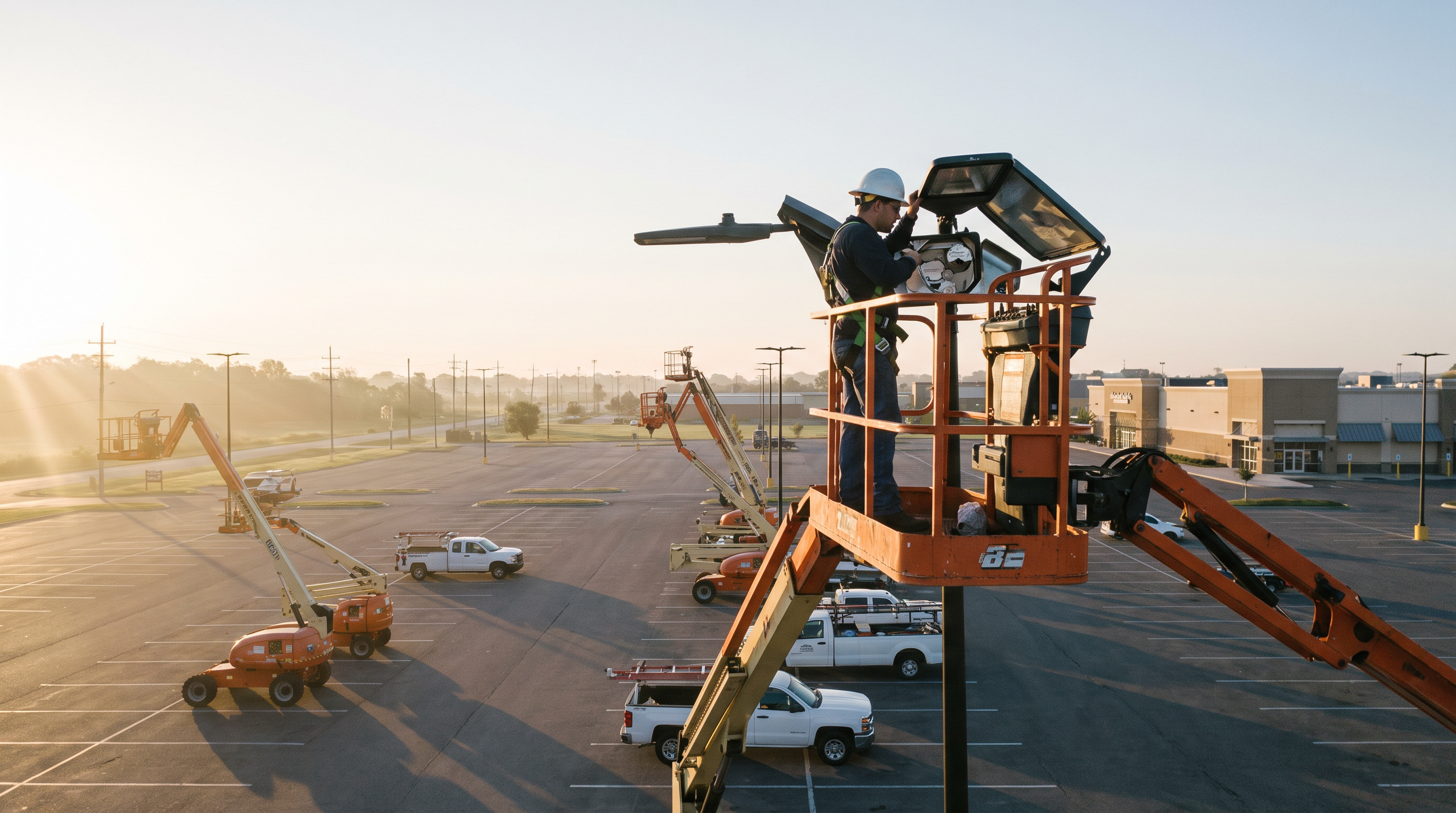
"Choosing the right lift for parking lot light maintenance? Compare articulating vs. straight boom lifts to find the best reach and efficiency for your site."
Related reading: Choosing Between a Scissor Lift and a Boom Lift for Your 2026 Project, How to Rent the Right Lift for Warehouse Security Camera Installation, and How to Streamline Equipment Procurement for Multiple Job Sites Without Managing Separate Rental Agreements.


Get the latest GoDizel content delivered straight to your inbox
Struggling to choose between a scissor lift and a boom lift? Learn the key differences to pick the perfect aerial lift for your 2026 construction project.
Learn how to rent the right lift for warehouse security camera installation in 2026. Compare scissor and boom lifts to meet OSHA safety requirements.
Choosing between an articulating boom lift vs. straight boom lift for parking lot lights isn't just a matter of picking whichever machine is available. The right call depends on your site's geometry, the height of your fixtures, and how much clearance you have around each pole. Before that decision makes sense, you need a firm grip on the core terms — because misreading a spec sheet on a job site costs time and money.
Boom lifts are projected to hold a 43.24% share of the aerial work platform market by 2025, which means there's no shortage of equipment options. But more options require sharper vocabulary. Whether you're sourcing equipment through Dizel or evaluating a quote from a local yard, the following terms will keep you grounded.
Articulating Boom Lift
Also called a "knuckle boom," this machine features multiple hinged sections that bend at joints, allowing it to reach over obstacles — a critical capability in parking lot lighting repair where canopies, signs, and existing poles block a direct path to the fixture.
Straight Boom Lift
Also called a telescopic boom, this machine extends in a straight line from its base, delivering maximum working height and horizontal reach on open, unobstructed sites.
Working Height
Platform height plus six feet — the standard calculation that accounts for an operator's upward reach, and the number you should match against your fixture elevation, not platform height alone.
Jib
A secondary articulating joint at the end of the boom that allows fine-tuned positioning of the platform, useful when the primary boom sections can't get you to the exact angle a light fixture demands.
Up-and-Over Clearance
The maximum height at which an articulating boom can extend its arm horizontally over an obstacle — the defining advantage of the knuckle boom design when navigating light pole bases and parking canopies.
If you're working on a standard lot with 30- to 45-foot fixtures and a clear path to each pole, an IC-powered unit in that height range may be all you need. Taller fixtures or denser obstacles push you toward larger articulating equipment. Either way, locking in these definitions first makes the head-to-head comparison between machine types — and the tradeoffs in reach, footprint, and maneuverability — far easier to evaluate.
Know the spec before you sign the rental agreement.
Deciding on the best lift for parking lot light maintenance comes down to three practical factors: where you need to reach, how much room you have to work with, and how quickly you need to move between poles. Now that the core terminology is clear, it's worth comparing these two machine types side by side on the specs that actually matter in a parking lot environment.
Reach profile is the starting point. Most standard lot poles sit between 30 and 40 feet — well within the working range of both machine types. However, the machines get there very differently. A straight boom extends on a single, direct axis, meaning horizontal outreach is traditionally about 9 feet less than platform height. An articulating boom uses multiple jointed sections, which lets the platform snake up and over obstacles rather than driving straight at the pole base.
Tailswing and footprint matter more than most crews expect. Straight booms typically carry a wider swing arc at the rear during rotation, which becomes a real hazard near traffic lanes or rows of parked cars. Articulating boom lifts tend to offer tighter footprints, and compact models like a diesel-powered 45-foot unit can position more precisely without endangering nearby vehicles or pedestrians.
Option
Best Use Case
Reach Profile
Maneuverability
Articulating Boom Lift
Poles near medians, landscaping, or parked cars; obstacle-heavy lift parking environments
Up to ~150 ft vertical; multi-joint horizontal flexibility; ideal for 30–40 ft poles with offset positioning
High — tight tailswing, compact footprint, can reach over and around obstructions
Straight (Telescopic) Boom Lift
Open lots, wide-lane access, or high-mast poles above 60 ft
Up to ~210 ft vertical; horizontal reach roughly 9 ft less than platform height; best for direct, unobstructed access
Moderate — faster extension speed, but wider tailswing limits use near traffic or parked vehicles
Extension speed is where the straight boom has a genuine edge. When you're running a crew through a large, open lot with clear access to every pole, a telescopic boom gets the platform up faster and lets operators move efficiently between fixtures. But that speed advantage disappears the moment there's a car, a median, or a tree between the machine and the pole.
Pick the articulating boom if your lot has any obstacles, irregular pole placement, or tight traffic lanes. Pick the straight boom if you're working an open, wide-format site — or if poles exceed 60 feet. The specific layout of your lot, though, is where the real decision lives.
Match your machine to the site conditions first, and the right choice becomes obvious.
Once you've identified which lift type fits your reach requirements, the real decision comes down to your specific lot layout. A boom lift that works perfectly in an open field can become a liability in a parking lot full of obstacles, parked cars, and overhead hazards.
Obstacle Navigation is where articulating booms earn their keep. Parking lots with raised medians, light poles set behind landscaping beds, or fixtures positioned over vehicle canopies create approach angles that a straight boom lift simply can't accommodate. The knuckle joints on an articulating boom let you reach up and over obstructions rather than driving directly beneath the work point. If your lot has any of these conditions, an articulating lift is the more practical choice — and typically the safer one.
Site-check questions for obstacles: Are any light poles located behind planters, curbs, or raised medians?, Is there vehicle traffic or parked cars that can't be cleared from the work zone?, Do overhead canopies or awnings block a direct vertical approach?, and Can the lift be positioned within 20 feet of the pole base? (Relevant for straight boom reach calculations — a compact articulating option works well in tighter footprints.) High-Reach Scenarios shift the math toward a straight boom lift. Standard parking lot poles run 20–40 feet, so the common question — what size boom lift for a 30 foot light pole? — typically points to a 40–45 foot working height unit. But stadium-style or high-mast poles exceeding 60 feet demand the extended reach that only a straight boom provides efficiently. Telescopic booms reach higher with less repositioning, which matters when you're working through a long row of poles. For high-mast applications, an 80-foot articulating model can bridge the gap when obstacles are still in play.
Safety Compliance is non-negotiable regardless of lift type. OSHA standard 1926.1431 requires that aerial lifts maintain a minimum clearance distance from energized power lines — typically 10 feet for lines up to 50kV. Parking lots often run utility lines along the same pole rows you're servicing, making this a live concern on almost every job.
Power line safety site-check questions: Are overhead power lines running along or near the light pole rows?, Have you confirmed line voltage to determine the required clearance distance?, and Is a spotter designated to monitor clearance during lift travel? Towable Options deserve consideration for multi-site work. If you're replacing bulbs across several parking lots in a single day, a towable boom lift — towed behind a standard pickup truck — cuts down on delivery costs and repositioning time. They're typically limited to 40–50 foot working heights, which covers the majority of standard parking lot fixtures.
The layout of your specific lot, not the lift spec sheet, should drive your final equipment decision — measure the site before you search for equipment.
Parking lot light replacement comes down to two variables: what's in your way and how high the poles actually are. Once you've assessed both, the decision between an articulating and a straight boom lift largely makes itself.
Choose an articulating boom lift if parked cars, concrete islands, or landscaping sit between your truck and the pole base. The knuckle joints let you work over obstacles rather than around them — a practical necessity on active lots.
Choose a straight (telescopic) boom lift if you have clean, unobstructed ground access and your lot lights sit above 50 feet. A lift straight to the fixture means faster setup and more working height for the reach.
Always verify working height. Standard parking lot poles run 20–40 feet, but working height on a boom lift includes the platform and operator. A lift rated at 45 feet of working height doesn't deliver 45 feet of usable pole access — confirm the actual fixture height before you book.
Don't overlook towable boom lifts for smaller, single-pole jobs. Towable boom lifts are cost-effective for low-volume maintenance where a full-size diesel unit would be overkill.
One thing that trips up a lot of procurement decisions is invoice surprises: a quoted rate that doesn't include delivery, fuel surcharges, or Saturday fees. Those additions can quietly add hundreds of dollars to a job that looked straightforward on paper. See the real rental price before you make a single call — Dizel's marketplace shows all-in pricing upfront, so you can compare inventory, check specs against your actual pole heights, and make a confident decision without a single back-and-forth call.
Match the lift to your site constraints first, then confirm the price includes everything — that's how you keep lot lights projects on budget and on schedule.

