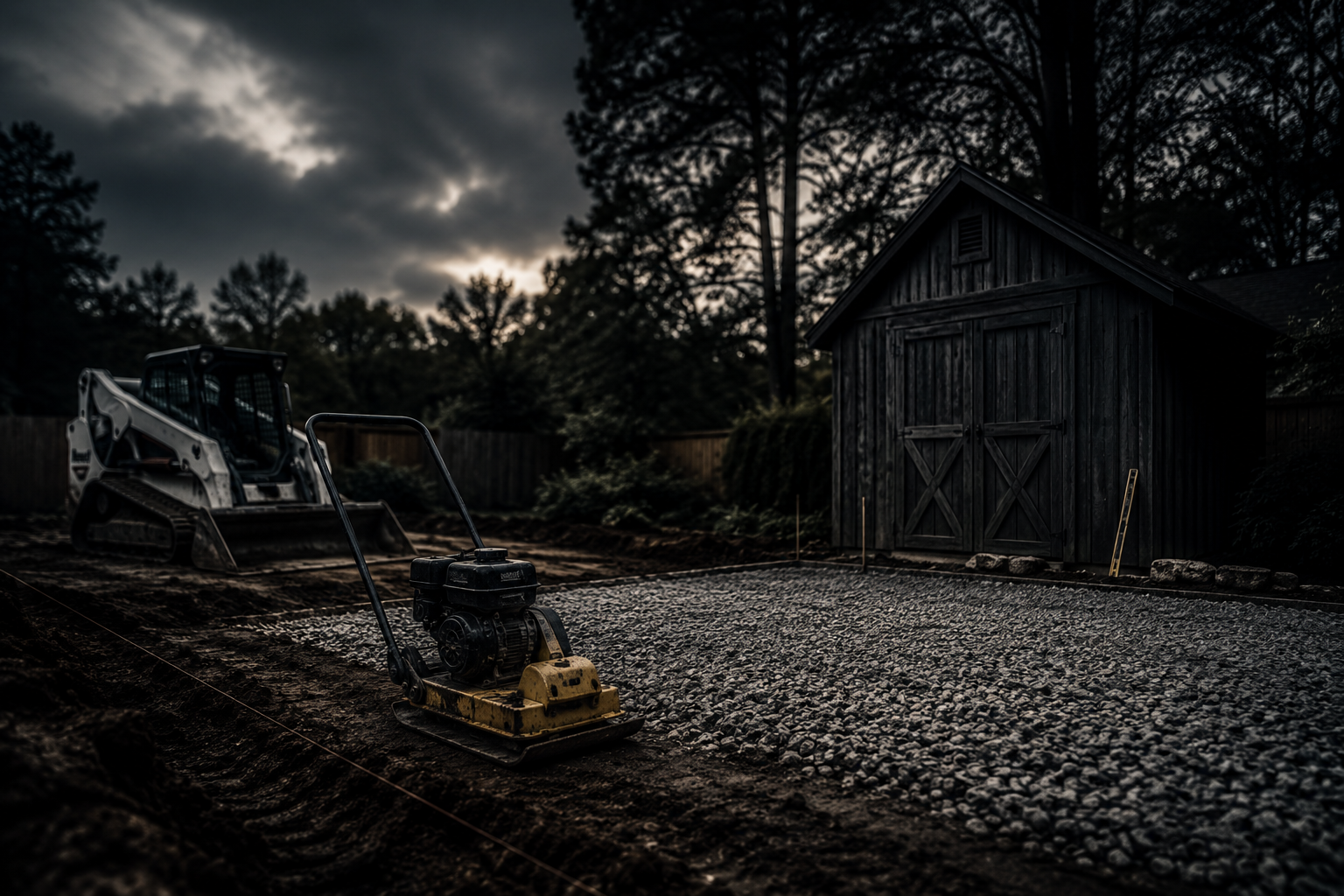
"A shed is only as good as its pad. Here's what to rent to level your backyard properly, from sod cutters to mini skid steers."
Related reading: How to Streamline Equipment Procurement for Multiple Job Sites Without Managing Separate Rental Agreements, How to Rent Storm Cleanup Equipment After a Hurricane in 2026, and How to Rent and Set a Commercial Generator in 5 Steps.


Get the latest GoDizel content delivered straight to your inbox
Learn how to consolidate equipment procurement across multiple job sites. Stop managing separate rental agreements and optimize your fleet management today.
Learn how to rent storm cleanup equipment effectively in 2026. Follow our guide to secure essential restoration tools and prevent long-term property damage.
There's a shed in my old neighborhood that everyone calls "the leaning tower." Its owner built it on ground he eyeballed as "pretty much flat." Three Florida rainy seasons later, one corner settled, the doors stopped closing, and the whole thing tilts like it's had a long day. The gap between "pretty much flat" and actually level is about four rentals and a weekend, and it's the difference between a shed that lasts decades and one that becomes a landmark.
Here's how to level a shed site properly with rented equipment.
A shed needs more than flat ground. It needs a level, compacted, drained base, usually a 4 to 6 inch bed of crushed gravel sitting on firm soil, extending a foot or two beyond the shed's footprint. The equipment list follows from that recipe: something to cut and move soil, something to compact, and a way to get gravel from the driveway to the site.
For a small shed, 8x10 or so, with mild slope, you can go old-school: a sod cutter to strip the grass ($80 to $120 a day and it beats a shovel by a mile), then rakes, a wheelbarrow, and a plate compactor. The plate compactor is the non-negotiable rental here, roughly $80 to $150 a day, because un-compacted gravel is how leaning towers are born.
For a mid-size shed or a yard with real slope, add a mini skid steer or compact track loader, the machine that changes everything. It cuts the high side, fills the low side, carries every load of gravel through your gate, and finishes with a smooth back-drag that gets you 90 percent level before you touch a rake. Mini skid steers fit through 36-inch gates and rent for roughly $250 to $400 a day in most Florida and Texas markets.
For big sheds, garages, or badly sloped yards, step up to a full compact track loader with a grading bucket, and consider a vibratory roller instead of the plate compactor if the pad is large.
Mark the pad a foot or two larger than the shed, and call 811 before any digging. Strip the sod and topsoil, since organic material rots and settles and everything soft has to go. Cut and fill to rough level, but here's the pro secret: always dig the high side down rather than just piling fill on the low side, because compacted native soil barely settles while deep loose fill settles for years. Compact the soil, spread your gravel in 2-inch layers, and compact each layer before adding the next. Check level constantly with a long straightedge, or rent a laser level for larger pads; it's a few dollars more and removes all guesswork.
Two regional notes. In Florida, drainage is the whole game, so crown the pad slightly or slope it an inch so water sheds, and never build in the spot where the yard puddles, no matter how convenient it looks in the dry season. In Texas clay, moisture swings make soils heave and shrink, so a slightly thicker gravel base buys stability through the wet-dry cycles.
A small shed pad is a one-day project with a sod cutter and plate compactor, maybe $200 in rentals plus gravel. A sloped-yard pad with a mini skid steer is a weekend and $400 to $700 in rentals. Compare that to what settling damage does to a shed, or what a contractor charges for a prepared pad, and it's some of the best-paying DIY work there is.
Strip the organics, cut the high side, compact everything in layers, and let a mini skid steer carry the gravel so your back doesn't. Level today is level in ten years if the base is right.
Dizel makes the equipment part easy: compare mini skid steers, compactors, and sod cutters from rental suppliers near you, delivered to your driveway with the price clear up front.