"Stop wasting hours calling for excavator rental prices. Learn how to find the best heavy equipment rates in 2026 without the hidden fees and manual labor."
Related reading: Stop Calling Yards: The Faster Way to Rent a Generator Near You, How Much Does a Stump Grinder Cost in 2026? Buying vs. Professional Service Guide, and Choosing Construction Equipment Suppliers: Expert Analysis of Procurement and Dealer Reliability in 2026.


Get the latest GoDizel content delivered straight to your inbox
Stop wasting time calling local yards. Discover a faster, more efficient way to secure a portable power generator for rent near you in 2026.
Planning stump removal in 2026? Compare the cost of buying a stump grinder versus hiring a professional service to find the best option for your yard.
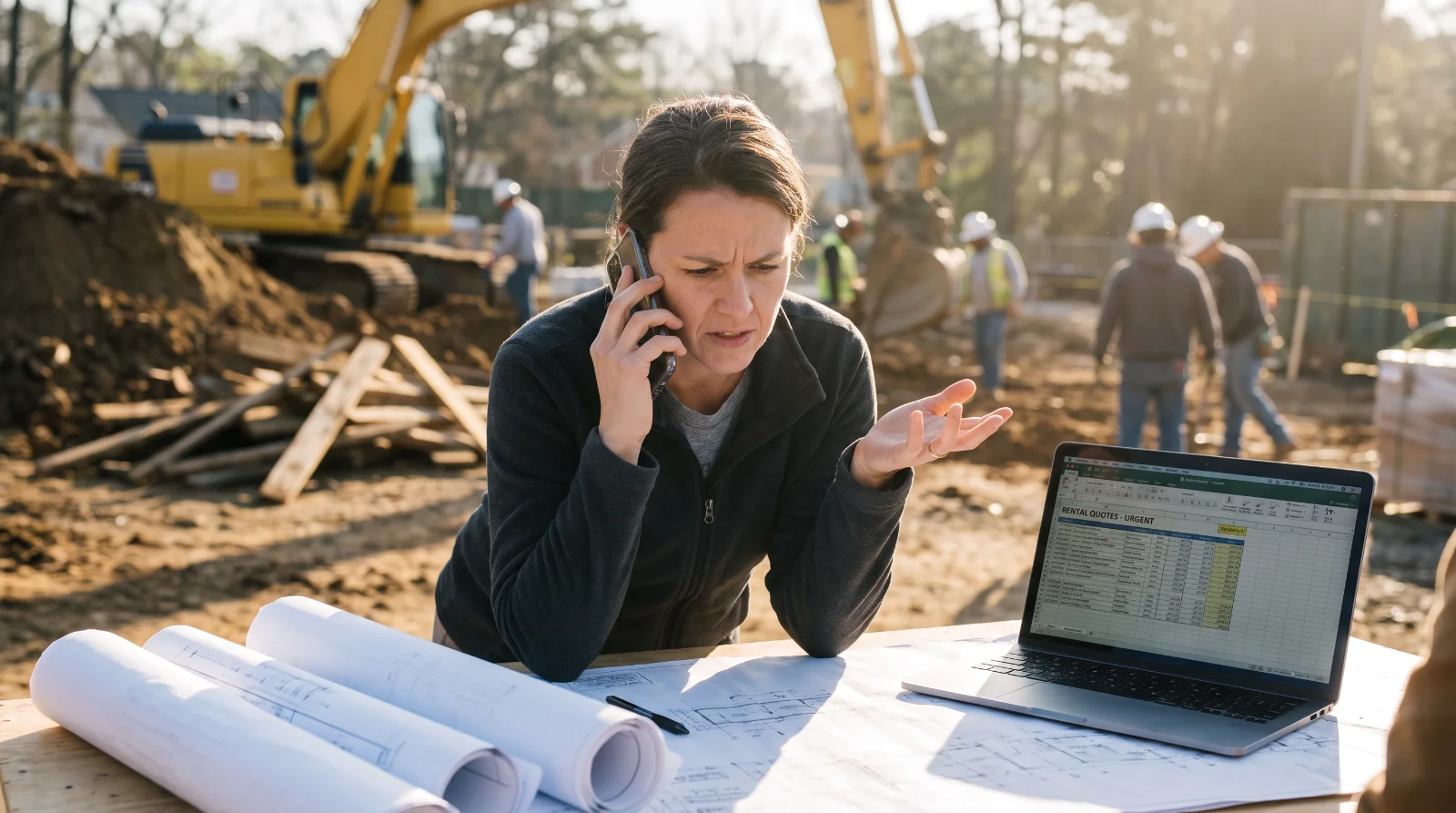
Every hour a project manager spends calling yards to find mini excavator rental prices is an hour not spent moving dirt, managing crews, or closing the next bid.
The process hasn't changed in decades: call a yard, get put on hold, receive a base rate that excludes delivery, insurance waivers, and fuel surcharges, then repeat the cycle with the next yard down the list. By the time you've assembled a real comparison, half the morning is gone. That's not procurement—that's overhead with no return.
And the base rate is only the beginning. What you actually pay at invoice almost never matches the number you got on the phone. Delivery fees, environmental levies, and damage waiver charges accumulate between the quote and the final bill. Contractors who've been through it have a name for it: invoice drama. It's predictable, it's frustrating, and it's costing firms real margin on every rental.
The market conditions in 2026 exacerbate this issue. The rental penetration index reached a record high of 59.5% in 2025, which means more contractors are choosing to rent rather than own—and yard inventory is under more pressure than ever. When you search "rent digger near me" on a tight timeline, availability isn't guaranteed, and no yard is going to volunteer that information over the phone before they have your name and project details.
The successful procurement model in 2026 relies on upfront, all-in pricing visible before any calls are made. The rates and variables that drive that transparency are worth understanding before you commit to any rental.
If your excavator sits idle more than 40% of the time, ownership is costing you money that renting would save.
That threshold is the core of the 60/40 rule: when utilization drops below 60%, the fixed costs of ownership — storage, insurance, financing, and scheduled maintenance — erode the margin that the machine is supposed to protect. And those fixed costs add up faster than most project managers budget for. The 250-hour service intervals alone require either a dedicated mechanic on payroll or a costly third-party service call. Neither is free.
The labor factor sharpens this calculation considerably. 92% of construction firms reported difficulty finding qualified workers in 2025, which means the technician hours needed to maintain an owned fleet are genuinely scarce. When you rent, that maintenance burden stays with the provider. The machine that shows up on your site is the provider's problem to keep in service spec — not yours.
There's also a capital flexibility argument that's hard to ignore in a market this active. Tying up six figures in a machine purchase locks working capital that could fund crew, materials, or the next bid deposit. Renting — even when you're searching for a cheap excavator rental near me on a tight timeline — keeps that capital fluid and your overhead responsive to actual project volume rather than forecasted utilization that rarely holds.
However, the machine itself is only part of the cost equation. What you attach to it can swing a project's efficiency just as dramatically as the base rate.
Skipping the right attachment often stalls the job, and renting the wrong configuration costs more in lost productivity than the upgrade fee.
Whether you're searching to rent mini excavator near me or sourcing a full-size machine for a foundation dig, the bucket spec deserves as much attention as the machine itself. A 12-inch bucket handles utility trenching cleanly — tight enough to minimize spoil and avoid disturbing adjacent lines. Step up to a 24-inch bucket for footings and mass excavation, where every pass needs to move real volume. Using the wrong width doesn't just slow you down; it forces extra passes, extra compaction, and extra labor.
Hydraulic breakers and augers solve problems that buckets can't. When you're demolishing a concrete pad or breaking through rock cap, a breaker converts the excavator's hydraulic output into controlled impact force — far faster than any hand tool. Auger attachments flip the equation for post holes, helical pier drilling, or sign footings, where a bucket would leave you chasing a clean bore. The decision isn't complicated: if you're breaking material, rent a breaker; if you're boring, rent an auger.
The thumb is the attachment contractors most often skip and most quickly regret. Without it, moving brush, managing demolition debris, or placing irregular stone requires a second machine or a hand crew. With it, one operator handles material that would otherwise stall the whole sequence.
Verify hydraulic flow compatibility before the machine leaves the yard. Not every mini excavator delivers the pressure rating a breaker or auger requires, and a mismatch surfaces on-site — not in the quote. Confirm auxiliary hydraulic specs against the attachment's requirement, and ask whether the attachment comes pre-fitted or needs field hookup. What you need ready on day one matters as much as the rate. That readiness extends beyond equipment specs — the documentation the rental yard requires before dispatch is worth understanding before you book.
Before you search for heavy equipment for rent near me, understand this: signing the rental contract and being legally qualified to operate the machine on a commercial job site are two completely different thresholds.
Rental eligibility vs. operator compliance. A rental yard will typically release a machine once you've presented a valid government-issued ID and completed their contract. That's their requirement — not yours. The moment that excavator hits a commercial job site, OSHA's operator qualification standards apply, and a driver's license doesn't satisfy them. OSHA 29 CFR 1926.1427 requires that equipment operators be trained and evaluated for the specific equipment type they're running. That responsibility sits with the employer, not the rental yard.
Insurance: COI vs. damage waiver. These are not interchangeable. A rental yard's damage waiver limits your liability for the machine itself — often with exclusions buried in the fine print. A Certificate of Insurance (COI) naming the rental provider as an additional insured is what most commercial projects actually require before dispatch. If your general liability policy doesn't extend to rented equipment, you'll want to confirm that before the truck rolls.
Pro Tip: Pull your COI before you book, not after. Waiting until dispatch to discover a coverage gap can delay mobilization by a full day — and that delay lands on your schedule, not the yard's.
Site-specific compliance adds another layer. Local municipalities, utility corridors, and certain private sites impose their own equipment restrictions — dig permits, ground disturbance notifications, or proximity rules near existing infrastructure. Confirm those requirements with your site supervisor before the first scoop. The paperwork is manageable, but surprises are not. Once your documentation is in order, the final step is knowing how to put all of this together efficiently.
When you search "rent excavator near me," the goal isn't just finding a machine — it's finding the right machine, at a confirmed all-in price, without burning a morning on hold.
The previous sections provide a complete decision framework. The question now is execution. Each step you skip in pre-booking prep compounds on-site — an unverified attachment spec, a coverage gap discovered at dispatch, a quote that looked clean until the invoice arrived with delivery stacked on top. The pattern is predictable, and it's avoidable.
Digital comparison is the starting point. Phone-based procurement means you get one yard's availability, one yard's framing of the rate, and no easy way to pressure-test either. A platform that surfaces real-time inventory across multiple suppliers flips that dynamic before you've committed to anything.
All-in pricing verification is the non-negotiable follow-through. Before you confirm any booking, the quote needs to show delivery, protection, and any fuel or cleaning conditions — itemized, not bundled into a vague "total." If those line items aren't visible, the number on screen isn't the number you'll pay.
And apply the 60/40 rule and attachment logic as a standing discipline, not a one-time exercise. Project mix shifts; a machine that hits 60% utilization this quarter may fall short next quarter. Run the check each time the scope changes. The contractors who protect their margins consistently are the ones who've made these habits automatic — and who have the right tools in place to act on them fast.
Every framework in this article — the 60/40 rule, attachment compatibility, all-in pricing, documentation prep — only delivers value when you can act on it without picking up the phone.
This is the core problem that Dizel solves. Whether you're sourcing a large excavator for a foundation dig or a small excavator for rent on a utility corridor job, the platform shows real-time availability and all-in pricing — delivery, protection conditions, and applicable fees — before you commit to anything. No quote requests. No hold music. No invoice drama two weeks later when a line item appears that wasn't in the verbal agreement.
Real-time availability is the operational differentiator. The U.S. equipment rental market's continued expansion means more machines are in circulation — but also more competition for the right spec on the right date in your zip code. Dizel's search reaches across local and national yards simultaneously, so you're not rationing calls between three yards and hoping one has your machine ready for dispatch.
And once you've confirmed the spec, the AI-assisted booking flow closes the gap between search and site fast. The documentation checklist, attachment configuration, and pricing are consolidated into a single checkout — not scattered across emails and callbacks. The contractor who books efficiently is the one who shows up on day one ready to dig, not still negotiating. That's the contractor who wins the job site. See the real rental price.