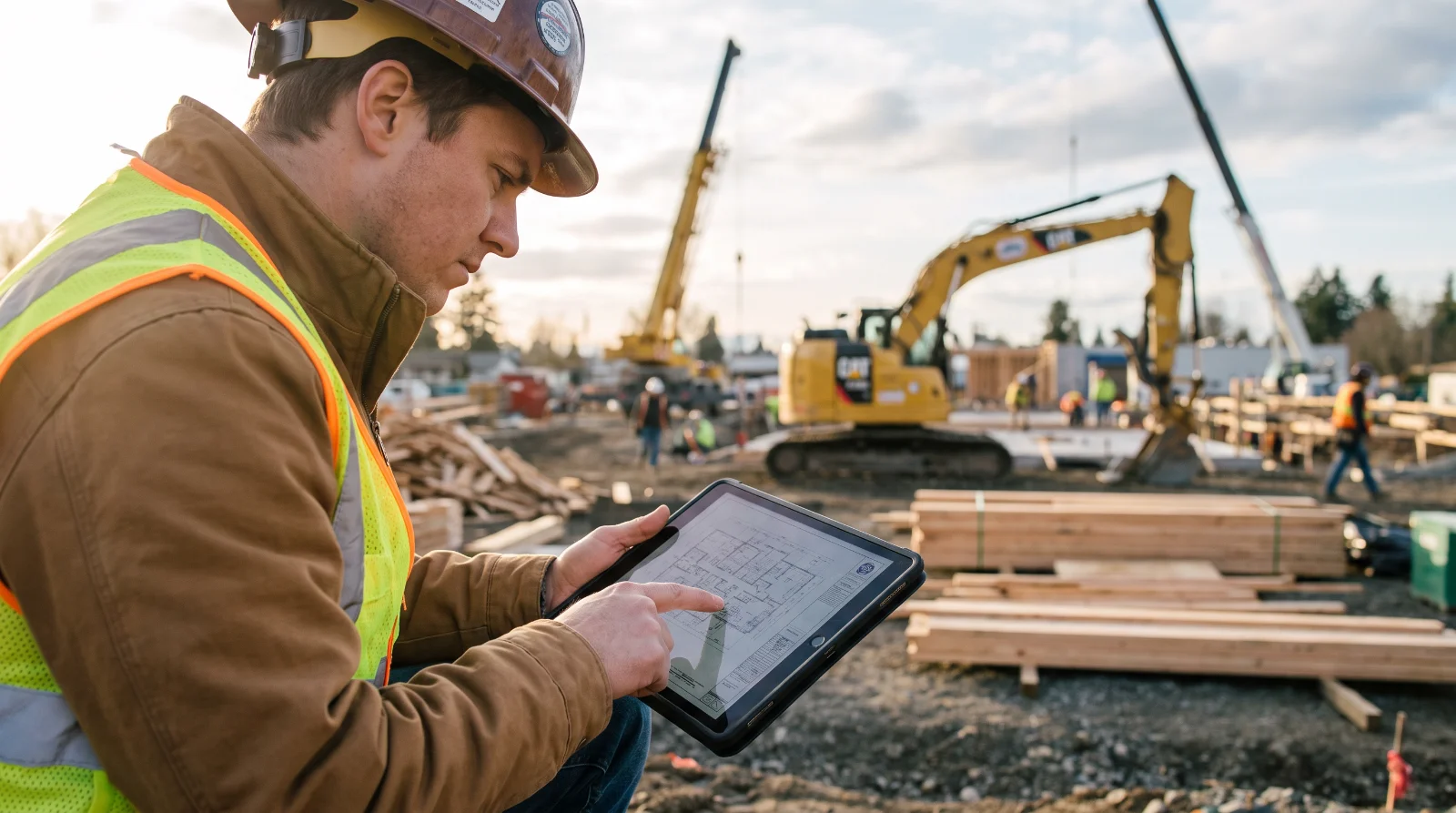
"Master construction equipment procurement in 2026. Learn how to evaluate heavy equipment dealers, compare costs, and choose the right partner for your site."
Related reading: How Much Does a Stump Grinder Cost in 2026? Buying vs. Professional Service Guide, Backhoe vs. Excavator: Which Machine Do You Need?, and How to Choose and Rent a Tree Chipper: A Contractor’s Guide to Rates and Specs (2026).


Get the latest GoDizel content delivered straight to your inbox
Planning stump removal in 2026? Compare the cost of buying a stump grinder versus hiring a professional service to find the best option for your yard.
Choosing between a backhoe and an excavator? Our 2026 pro guide breaks down the key differences in power, mobility, and versatility to help you decide.
What costs more on a job site: the machine itself, or the time spent waiting for it?
That question used to be rhetorical. Now it's a line item.
Construction equipment suppliers have always occupied the critical space between a manufacturer's production line and the dirt where work actually happens. For most of the industry's history, navigating that space meant working a contact list — calling the right heavy equipment dealer, knowing which rep picked up on the first ring, and accepting whatever inventory was available because you didn't have a clear view of anything else. Procurement was relationship-dependent by necessity, not by choice.
That's changed. Not because relationships stopped mattering, but because information stopped being scarce.
Digital marketplaces and aggregated inventory platforms have made visible what was always there: a distributed network of construction equipment suppliers, independent distributors, rental yards, and authorized dealers holding substantial fleets — often within reasonable delivery radius of a job site. Real-time availability, delivery cost, and machine specs used to require three calls and two callbacks. When that information becomes searchable, supplier selection stops being a clerical task and becomes a financial decision with a direct line to project margin.
That shift is the defining procurement story of 2026.
The gap between availability and accessibility
Supply is not the problem. Construction machinery distributors across North America and globally maintain substantial fleets of excavators, skid steers, compactors, and specialty equipment. The problem has been accessibility — the friction between a contractor who needs a Tier 4 Final excavator by Tuesday and the supplier who has three of them sitting in a yard forty miles away.
That friction has real costs. A crew waiting on equipment is a crew burning payroll without producing output. A project manager spending two hours sourcing a replacement machine is two hours not spent managing the project. And a procurement decision made under time pressure — without adequate comparison — is rarely the most cost-effective one.
The emergence of digital procurement tools hasn't eliminated the heavy equipment dealer relationship. It's made that relationship easier to initiate and easier to evaluate. A contractor can now search by equipment class, delivery geography, and pricing before making a single call. That changes the starting position of every supplier conversation.
Why transparency changes the decision
When pricing and availability were opaque, the first supplier to pick up the phone often got the job. That's not procurement strategy — that's urgency driving decisions that should be driven by data.
Transparency introduces comparison. And comparison surfaces the factors that actually determine whether a supplier relationship is worth building: parts availability, service response time, operator certification support, equipment condition, and total cost of ownership over the rental or ownership period. These aren't soft considerations — they're the variables that determine whether a machine earns money or creates problems.
Understanding equipment total cost of ownership has become a sharper discipline as a result. It's no longer sufficient to compare day rates or sticker prices. Procurement teams are now evaluating fuel consumption, expected maintenance intervals, downtime risk, and how quickly a supplier's service infrastructure can respond when something goes wrong on a job site.
That's the analysis this article is built to support. Not a directory of names, but a framework for evaluating construction equipment suppliers the way a job site actually demands — through operational reliability, service depth, and the ability to put the right machine in the right place when the schedule requires it.
What 2026 procurement actually looks like
The construction industry hasn't abandoned its preference for established supplier relationships. What's changed is how those relationships get established and stress-tested.
A decade ago, a fleet manager might work with two or three suppliers simply because those were the relationships that existed. Today, the same manager can compare inventory across a wider network, identify which heavy equipment dealer within their region has the fastest service response, and make an informed case to ownership for why one supplier's total cost of ownership outperforms another's — even if the day rate is slightly higher.
That's a more considered procurement environment. It rewards suppliers who have invested in service infrastructure, parts depth, and delivery reliability. It creates pressure on those who have competed primarily on price without supporting it with operational capability.
For contractors, the practical implications are significant. Knowing how to choose an equipment supplier now involves evaluating factors that weren't previously visible: dealer certification status, parts warehouse proximity, technician response commitments, and whether the supplier's fleet meets current emissions standards — including Tier 4 Final compliance for projects with air quality requirements.
For procurement teams managing multiple active projects, the ability to compare construction equipment financing options across suppliers has also become more actionable. Where financing terms were once negotiated almost entirely on trust and relationship history, digital platforms and standardized quoting processes have made it easier to evaluate lease structures, rent-to-own arrangements, and short-term rental pricing against each other with consistent inputs.
The argument this article makes
The question at the center of construction equipment procurement isn't who builds the best machine. Major manufacturers produce equipment that meets professional standards across categories. The question is who can get that machine to your site, keep it running, support it when it fails, and structure the financial terms in a way that fits how your projects actually work.
That's a question about suppliers — not specifications.
The sections that follow examine how construction equipment suppliers and construction machinery distributors are structured, what separates reliable dealers from unreliable ones, which aftermarket services have the greatest operational impact, how to approach the buy-versus-rent decision with real financial inputs, and what the secondary market looks like for contractors managing asset turnover.
The goal isn't comprehensiveness for its own sake. It's to give procurement professionals and site managers a usable framework — one that reflects how equipment decisions actually get made in 2026, with the information now available and the pressure that's always been there.
Finding equipment shouldn't be harder than using it. The analysis that follows is built around that standard.
Understanding how construction equipment suppliers are structured helps you make faster, smarter sourcing decisions — whether you're procuring a fleet for a highway project or tracking down a single excavator for a utility job.
OEM dealers focus on one manufacturer and go deep. That depth translates into real operational advantages: factory-trained technicians who know the machine at the component level, warranty-backed repairs that don't void coverage, and genuine parts matched to the serial number on your unit. Authorized equipment dealer benefits concentrate around uptime. The heavy equipment dealer has a commercial stake in keeping that machine running long after delivery, which means they're motivated to respond when something goes wrong on a Thursday afternoon rather than waiting until Monday. For contractors running tight schedules on highway projects or large earthmoving operations, that relationship has measurable value. The tradeoff is brand lock-in. If the OEM's spec doesn't match what your site actually needs, the dealer can't offer an alternative — you're buying what that manufacturer builds.
Independent construction machinery distributors operate differently. They carry multiple brands, which gives you more room to match equipment to job requirements without compromising on spec. If one manufacturer's excavator dimensions don't suit your trenching conditions but another's does, an independent construction machinery distributor can put both options in front of you. That flexibility often opens negotiating leverage on price as well, since the distributor isn't tied to a single-brand sales quota. The honest caveat is that service depth varies. A distributor covering a wide geography with a broad catalog may not have the same technician density or parts inventory for any given machine that a dedicated heavy equipment dealer would. When evaluating independent distributors, it's worth asking directly about technician certification levels and regional parts stocking for the specific brands and models you're considering.
Digital rental marketplaces solve a different problem altogether — one that most contractors recognize immediately but rarely talk about as a category failure. The traditional process of calling rental yards one at a time, waiting for callbacks, and manually comparing rates creates friction that costs real time on projects where schedules don't have slack. A digital marketplace surfaces availability, all-in pricing including delivery, and machine specs in a single view. For contractors weighing buy vs. rent on construction equipment, or evaluating equipment dealer vs. rental company options for a specific project phase, that transparency changes the comparison. It's not just about convenience; it's about making an informed decision quickly rather than making a good-enough decision because the clock ran out.
Each tier of construction equipment suppliers exists because it solves a different version of the same underlying problem: getting the right machine to the right site with enough support behind it to keep the project moving.
Reliability gets judged at the wrong moment. Most contractors evaluate a supplier during the quote, when everyone is responsive and every machine is available. The real test comes six weeks later when a hydraulic line fails on a Friday afternoon.
That's why the evaluation framework needs to start before anyone signs anything.
Ask what happens after the sale. Specifically: how many field technicians cover your region, what the average parts turnaround looks like for common wear items, and whether the supplier stocks locally or pulls from a central warehouse several states away. A dealer with a strong brand and a thin regional presence will cost you more in downtime than a smaller operation with a truck twenty minutes out.
Don't accept vague answers here. Press for specifics. Ask what the typical response window looks like on a Monday versus a Friday. Ask whether local parts inventory is maintained or whether the dealership relies on a regional distribution hub. A supplier confident in their infrastructure will answer these questions without hesitation. One that pivots to talking about brand reputation probably can't answer them.
Parts availability is its own question. Parts availability is the measure of whether a supplier stocks common wear items — filters, seals, cutting edges, bucket teeth — at a location close enough to reach your site the same day. If a dealer's answer to parts turnaround is "three to five business days from our regional distribution center," that tells you something important about how they view field support. Some operations stock strategically for the region they actually serve. Others are simply resellers who happen to carry a franchise name. The difference matters enormously when a machine is down and a crew is standing around.
Regional footprint is crucial for multi-site work. A supplier's regional footprint is the actual geographic area in which they can dispatch technicians and deliver parts within a standard response window — not simply the states listed on their website. A supplier serving one metro can't support a crew moving between three. When you're running concurrent projects across different corridors — or bidding work that might take you into adjacent markets — the dealer's coverage map needs to match your actual footprint, not just your current jobsite address. Reliable heavy equipment dealers tend to be the ones whose service territory actually overlaps your work zones, not just the city where their showroom happens to be located.
Before committing to a supplier relationship, ask for their service territory map. Ask which of your active or anticipated project locations fall within standard response range. If a region sits outside their normal coverage, ask how they handle it and what the response time expectation becomes. This conversation will reveal a lot about how operationally prepared they are for clients who work beyond a single job address.
Evaluate the supplier's depth, not just their catalog. A wide equipment listing is easy to produce. The harder question is whether the dealer can support what they sell at the density you need. A supplier who can deliver a machine but can't service it in the field has transferred the operational risk entirely to you. That's not a partnership — it's a transaction with a very long tail of exposure.
The evaluation framework for heavy equipment dealers should include at minimum:
Regional technician coverage — how many field technicians are deployed in your area and what their typical dispatch radius is
Local parts stocking policy — whether common wear items are held at a nearby location or pulled from a distant distribution hub
Field response time commitments — documented windows for weekday and weekend response, not verbal estimates
Coverage continuity across your project geography — confirmation that your active and anticipated job locations fall within the dealer's standard service territory
These aren't unreasonable questions. They're the ones any serious operation should be asking before signing a purchase order or a service agreement.
The supplier who makes this conversation easy is probably the one worth working with.
Preventative maintenance contracts — defined as formal service agreements with clearly specified intervals tied to machine hours — are worth evaluating as contracts, not perks. The distinction matters more than it sounds. A maintenance contract with clearly defined service intervals tied to machine hours creates a predictable cost structure and a documented service history. One tied to operator logs alone is only as reliable as whoever fills them out. Telematics, which refers to onboard systems that report machine hours, engine load, idle time, and fault codes back to the dealer or service team, changes that equation: when a machine is reporting its own data, the maintenance schedule becomes data-driven rather than self-reported. For fleet managers running multiple machines across multiple sites, that visibility is the difference between managing maintenance and reacting to it.
Emergency response windows — defined as the stated, written timeframes within which a supplier commits to dispatching service — are the harder question, and it's one worth asking directly before you need the answer. Ask for stated response windows in writing. Ask whether field repair is available or whether the machine has to be transported to a shop. That distinction is critical because transport time is downtime, and downtime has a cost that runs well beyond the repair bill itself. A crew standing idle, a subcontractor waiting on you, a schedule slipping by a day — none of that shows up on a repair invoice, but all of it affects your project margin. A supplier with on-site field repair capability and a defined response window is a meaningfully different partner than one who handles everything through shop intake.
Parts sourcing is the aftermarket question most buyers skip until it becomes urgent. For newer equipment from major OEMs, parts availability is rarely the problem. For older machines, niche models, or any equipment that has passed through a manufacturer's support window, it can become your most expensive operational problem. Discontinued models don't stop working the day dealer support ends — but sourcing becomes your responsibility the moment it does. Before committing to a supplier for equipment in those categories, confirm the supply chain directly: who they source from, what their lead times look like on non-stocked components, and whether they maintain any parts inventory in-house. A construction equipment parts supplier relationship that exists only on paper won't help you when a machine is down and the part isn't in stock anywhere nearby.
The aftermarket relationship with a heavy equipment dealer is ultimately about risk transfer. A supplier with strong telematics integration, defined emergency response windows, and a credible parts supply chain takes on a portion of the operational risk that otherwise lands entirely on you. That's worth factoring into any supplier evaluation alongside price and availability.
Construction equipment financing structures aren't complicated once you understand what each one actually does to your balance sheet and your flexibility. The right structure depends less on which machine you're buying and more on how long you'll hold it, how heavily you'll use it, and what your exit looks like when the job or the season ends.
Operating leases keep your monthly obligation low and remove residual risk entirely. You don't own the asset at the end of the term — you hand it back and walk away. That's not a weakness; it's the point. If you're cycling equipment in and out based on project type, an operating lease means you're never stuck trying to move iron you no longer need. You pay for access, not ownership.
Capital leases and installment contracts work the opposite way. You're building equity, carrying the asset on your books, and committing to the resale market when you're done with it. The monthly cost is higher, but so is the eventual return — assuming the machine holds its value and you have a plan for disposing of it. These structures make sense when utilization is predictable and long-term, not when project pipelines are uncertain.
Rental-purchase agreements occupy the middle ground. Rental payments apply toward a buyout, which gives you a decision window. If the project runs longer than expected or you realize you need the machine on a recurring basis, you can convert without starting over. That optionality has real value when you're committing to a contract before the full scope of a job is clear.
Understanding which structure fits your situation is step one. Step two is accounting for every cost that doesn't appear in the headline rate — because that's where budgets get wrecked.
Delivery and pickup fees, required insurance certificates, fuel surcharges, damage waivers, and late-return penalties all land after the fact. None of them are hidden in a deceptive sense; they're just not in the number you compared. A rate that looks competitive in isolation can look very different once logistics, documentation requirements, and return conditions are factored in. Ask for a fully itemized cost breakdown before signing anything, not after the machine is on your site.
The buy vs. rent construction equipment decision comes down to one variable more than any other: utilization. An excavator working most weeks of the year generates enough productive hours to justify ownership. The depreciation, financing cost, maintenance, and storage spread across that volume of work. An excavator working in bursts between projects does not, regardless of how attractive the purchase price looks on paper. Ownership without utilization is just expense without return.
That's the framework. Apply the financing structure that matches your hold period. Account for every cost category before committing. And let utilization, not price, drive the buy-versus-rent call.
Fuel is one of those costs that doesn't announce itself. It doesn't show up in the purchase negotiation, it doesn't appear on the sticker, and it rarely makes it into the first conversation with a supplier. But across a long equipment hold, excavator fuel consumption per hour quietly becomes one of your largest operating line items. A machine running full shifts burns continuously, and even modest differences in consumption compound across thousands of hours of use.
That's why the conversation with your supplier shouldn't stop at the purchase price or the monthly payment.
What Tier 4 Final engines actually changed
Tier 4 Final emissions standards pushed manufacturers to invest heavily in combustion efficiency. The practical result, beyond reduced particulate output, is that compliant engines run cleaner combustion cycles than older-generation equipment. When you're evaluating tier 4 final excavator suppliers, ask them to provide manufacturer consumption figures broken down by work mode — economy, standard, and high-power settings typically produce meaningfully different numbers. That breakdown matters because different applications place different demands on the machine throughout the shift.
One question worth asking directly: are those figures pulled from the spec sheet, or are they drawn from telematics data on comparable units operating in similar conditions? The answer tells you something important about how that supplier understands their own inventory.
Telematics as a procurement input, not just a maintenance tool
Modern equipment generates a continuous stream of operational data — idle time, fuel burn by mode, load factor, fault codes. Suppliers who have access to telematics data on their fleet, and who are willing to share it, give you something a brochure simply cannot: a record of how the machine actually behaves under load, not how it was designed to behave in ideal conditions.
If a supplier can tell you that a comparable unit running similar applications averaged a specific consumption rate over its last several hundred hours, that's a real input into your equipment TCO calculations. If they can only hand you a spec sheet, you're estimating — and estimates compound in the wrong direction when fuel prices shift.
Building a total cost of ownership picture that holds up
Equipment TCO (total cost of ownership) calculations depend entirely on the quality of their inputs. Purchase price, financing cost, expected maintenance intervals, parts availability, and excavator fuel consumption per hour all feed into the number. Weak assumptions in any of those inputs produce a figure that looks clean on paper but drifts from reality once the machine is in the field.
Suppliers who operate with transparency on operational data are giving you the material to build a TCO model that actually holds. Those who can only offer manufacturer estimates and purchase terms are leaving you to guess at the variables that matter most over a multi-year hold. When you're comparing options — whether new or used, whether financed or rented — push for the real numbers. The difference between a supplier who can produce them and one who can't is a meaningful signal about how that relationship will operate once the sale is closed.
Top-tier suppliers organize inventory by application. It's worth thinking the same way when you're sourcing — because a machine that's wrong for the application costs you more than a higher day rate would have.
Excavation and earthmoving: This category covers excavators, dozers, wheel loaders, backhoes, and skid steers. Application fit matters here more than raw specs. Utility trenching, for example, rarely calls for a large excavator — the best excavator for utility trenching is typically a compact or mid-size unit with a narrow bucket and enough reach for the trench depth, delivering less fuel burn and better maneuverability in tight corridors. Oversizing earthmoving equipment is one of the more common and avoidable cost leaks on a job site.
Paving and road work: Pavers, rollers, milling machines, and the support fleet that keeps them sequenced. Construction equipment for highway projects runs on tight timing, and a delayed machine can stall an entire paving train. For this category, supplier delivery reliability matters more than unit price — a slightly cheaper machine that arrives a day late costs far more than it saves.
Lifting and material handling: Telehandlers, rough-terrain cranes, and boom lifts each have different reach, load, and terrain requirements. Matching the right lift to the site conditions — ground bearing pressure, working height, outrigger footprint — prevents both underperformance and unnecessary cost.
Attachments: This is where suppliers often separate themselves from one another. A skid steer rental with attachments — breakers, augers, grapples, sweepers — turns one carrier into several different tools. But only if the supplier stocks the work tools alongside the machine, with matched couplers and hydraulic flow ratings. Attachments sourced separately introduce a separate delivery timeline and a separate failure point. Before you confirm any rental or purchase, verify that the attachments, carrier, and coupler system are available together from the same source. It's a small confirmation that prevents a large problem.
Supplier inventory organization tells you something about how they operate. A supplier whose catalog is sorted by machine type rather than application is thinking about their fleet, not your job. The better ones make it straightforward to find what works for the work you're doing.
When it's time to move aging equipment out of the fleet, you have two realistic exits: dealer trade-ins and industrial auctions. Each has a different risk profile, and the right choice depends on how much documentation you have, how quickly you need to close, and how much valuation uncertainty you can absorb.
Trade-In vs. Auction: Where the Trade-Offs Actually Live
Dealer trade-in programs are faster and simpler. The dealer absorbs the asset, applies credit toward the replacement purchase, and the transaction closes in a single step. The trade-off is valuation — dealers price trade-ins conservatively because they're taking on resale risk. That discount is the cost of speed and convenience.
Industrial auctions expose the machine to a wider competitive buyer pool, which can push realized prices higher. But that upside comes with listing timelines, seller fees, buyer premiums, and genuine price uncertainty. A machine that attracts two bidders returns very differently than one that attracts twelve. If you're working against a fleet replacement deadline or a financing cycle, that uncertainty has real operational cost.
Neither path is universally better. The honest question is whether the potential price differential from auction justifies the time, fees, and outcome risk relative to what a dealer will credit today.
Documentation Requirements and Why They Move the Number
Regardless of which exit you choose, documentation is what separates a machine priced on evidence from one priced on assumption — and buyers and appraisers always discount assumption.
Complete service records are the baseline. Hour meter logs, fluid service intervals, component replacement history, and filter records allow a buyer to evaluate wear relative to hours rather than guessing. Telematics exports add another layer: GPS history, idle time ratios, load factor data, and fault code logs give a buyer or auction house a data-backed condition picture that's harder to dispute than a visual inspection alone.
Recent third-party inspection reports carry similar weight, particularly for auction listings where the buyer can't run the machine before bidding. Machines that arrive at auction or trade-in without documentation routinely receive a blanket condition discount. That discount isn't arbitrary — it reflects the buyer's cost of absorbing unknown risk.
If you've maintained equipment under a dealer-managed service plan, those records are often already centralized and exportable. That's one of the practical advantages of using a heavy equipment dealer with a formal service infrastructure: the documentation that protects resale value is a byproduct of ongoing maintenance, not an extra step.
How Valuation Gaps Form
Valuation gap refers to the difference between what an owner expects and what the market returns. These gaps can stem from several factors worth understanding before you list or trade.
Condition relative to hours is one of them. A machine with high hours but complete service documentation can outperform a low-hour machine with no records. Buyers price risk, not just mileage.
Market timing is another. Equipment categories move in cycles tied to construction activity, project financing, and regional demand. A dozer that commands a strong price during an infrastructure surge may sit longer at auction during a slowdown. If your fleet refresh is discretionary, timing the secondary market can materially affect returns.
Regional liquidity refers to how actively a given machine category trades within a specific geography. Some machine categories trade actively in certain geographies and thinly in others. An excavator class with strong local demand will find more bidders at a regional auction than the same unit shipped to a distant yard where buyers are fewer and freight costs inflate the effective purchase price.
Understanding those factors before you list or trade gives you a realistic ceiling to work against — and helps you decide whether the trade-in offer on the table is genuinely fair given current conditions.
No supplier arrangement is immune to failure, and understanding where the cracks appear is what separates a contingency plan from a crisis.
Supply chain vulnerabilities don't announce themselves. Specialized components — final drives, electronic control modules, emissions hardware — move through longer, more fragile supply chains than standard wear parts. A backorder on a single ECM can idle a machine for weeks, regardless of how responsive your dealer is day-to-day. These aren't hypothetical risks. Procurement teams that treat parts availability as an afterthought during supplier selection often discover the gap only when a machine is already down and a crew is standing around waiting.
The practical response is to ask suppliers, before you commit, about their parts stocking depth for the specific models you're running. A dealer who carries on-hand inventory for Tier 4 Final emissions components is structurally different from one who orders on demand. That distinction won't appear on a website. You have to ask directly.
Seasonal availability patterns add another layer of pressure. Compact equipment — mini excavators, skid steers, track loaders — tightens significantly in spring as residential and utility work accelerates. Contractors who wait until March to source equipment for April starts frequently find themselves taking whatever's left rather than what they actually need. Committing earlier in the procurement cycle, even before full project scopes are finalized, is often the more reliable path. Rental options can bridge the gap when ownership timelines don't align with project starts.
The OEM versus independent mechanic trade-off is real and worth thinking through clearly. Authorized dealers protect warranty coverage and use manufacturer-approved parts and procedures. That matters during the warranty period, particularly for emissions systems where non-compliant repairs can create compliance exposure — especially on OSHA compliant construction equipment where documented service records and approved components are part of maintaining site eligibility. Independent mechanics are often faster, more geographically convenient, and less expensive for routine work on older units.
Contractors running mixed fleets — which is most of them — frequently split the difference by design: OEM dealers handle warranty-period service and anything touching emissions hardware, while trusted local shops handle routine maintenance and repair on older machines outside warranty. That's not a workaround. It's a deliberate service strategy that reflects how procurement decisions actually play out in the field.
Traditional dealerships aren't the right answer for every situation. The equipment dealer vs rental company decision comes down to duration, specificity, and geography. Short-duration needs, one-off specialty machines, and projects in regions where no dealer maintains a physical presence all point toward rental marketplaces or peer-to-peer sourcing instead. Knowing which sourcing channel fits which situation — and having those relationships established before a project starts — is what keeps a procurement problem from becoming a schedule problem.
Factor | OEM Dealer | Independent Distributor |
|---|---|---|
Warranty coverage | Factory-backed, honored network-wide | Varies; often limited or third-party |
Service depth | Factory-trained, brand-specific | Broad but less specialized |
Brand variety | Single line | Multi-brand |
Pricing flexibility | Structured, less negotiable | More room to negotiate |
Parts access | Direct OEM channel | Mixed OEM and aftermarket |
The table above maps the structural differences, but the more useful question is which supplier type fits your situation — and when you need both.
OEM dealers make the most sense when standardization and long-term serviceability are non-negotiable. If your fleet runs a single brand of excavator across multiple sites, keeping service, parts, and warranty within one factory-authorized network reduces variables. The authorized equipment dealer benefits here are tangible: technicians trained on that specific platform will diagnose problems faster. Factory-backed warranty coverage travels with the machine across the dealer's authorized network, which matters if equipment moves between regions. The tradeoff is pricing flexibility: OEM dealer structures tend to be tighter, and negotiating on a core unit purchase leaves less room than you might find elsewhere.
Independent distributors become the right call when budget pressure is real and brand loyalty is secondary to availability. For smaller contractors sourcing their first few machines, the case for affordable equipment for small contractors is clearest here — an independent can offer access to multiple brands at once, with more room to negotiate on price and terms. The limitation is depth: an independent's service team may cover a wider range of equipment, but they won't match the brand-specific diagnostic depth of a factory-trained technician on a complex machine. Parts sourcing through independents often mixes OEM and aftermarket supply, which is worth clarifying before you commit to a service agreement.
In practice, the most durable procurement strategies don't force a binary choice. Fleet managers running high-utilization core assets — primary excavators, motor graders, compactors that run daily — typically anchor those through OEM dealers where warranty integrity and parts availability are worth the structured pricing. Peripheral needs — specialty attachments, short-term capacity additions, secondary machines for specific project phases — often get filled through independents or rental, where flexibility and speed matter more than long-term serviceability continuity.
The key is matching the supplier type to the asset's role in your operation. A machine that runs five days a week and anchors a production schedule warrants the OEM relationship. A machine you need for one phase of a project and may not need again doesn't.
Reliability is an uptime metric, not a price tag. When evaluating construction equipment suppliers, the numbers that matter most are technician response time, parts availability, and guaranteed service windows — not sticker price. A supplier who can't support the machine after delivery isn't a partner; they're a transaction.
Verify availability and total delivered cost before you commit, and do it digitally. Manual yard-calling hides fees, creates information gaps, and wastes time your crew doesn't have. When you can see real-time inventory and all-in pricing in one place, you're comparing actual options — not best-case estimates from a rep who needs to close the deal.
Treat financing structure as a specification. The shape of the contract — lease versus loan, term length, residual value, early exit conditions — affects your cash position and operational flexibility just as much as the machine's bucket capacity or lift rating. Work through the numbers before you sign, not after.
Favor suppliers who offer telematics integration as a standard part of the relationship. Fuel consumption, idle time, and service intervals are only manageable when they're being measured. Equipment that runs without data is equipment you can't optimize, and in 2026, that's an avoidable competitive disadvantage.
Know how to choose an equipment supplier by what happens after delivery, not before. Pre-sale responsiveness is easy. The real signal is whether the dealer shows up when something breaks down on a Wednesday morning, two months into a project, with a crew standing around waiting.
Knowing where to find reliable information matters as much as knowing what to look for. The sources below each serve a specific purpose — treat them as tools, not interchangeable references.
Manufacturer service manuals are the starting point for anything related to maintenance intervals, fluid specifications, and component life. They're model-specific and version-controlled in ways that general guides aren't. If you're evaluating total cost of ownership for a machine you already operate or plan to acquire, the manufacturer's documentation is the floor, not the ceiling.
Standards bodies are the authoritative source for regulatory and certification requirements. For safety compliance, go directly to OSHA's published standards rather than relying on summaries or dealer representations. For ISO certified equipment supplier requirements that procurement teams increasingly include in bid specifications, the International Organization for Standardization maintains the definitive documentation. Summaries are fine for orientation; standards bodies are what you cite when it matters.
Construction fleet management textbooks cover TCO modeling with the depth that articles and blog posts can't match. If your organization is making multi-year fleet decisions — weighing new versus used, buy versus rent, Tier 4 Final engine costs against fuel savings — this category of reference provides the analytical frameworks that hold up under scrutiny.
Regional dealer associations are underused. They publish localized service benchmarks, track parts availability by market, and often document response time expectations that reflect your geography rather than a national average. When you're comparing quoted service windows from competing heavy equipment dealers, regional association data gives you a baseline grounded in your actual operating area.
None of these sources replaces the conversation with a supplier. But they give you the vocabulary and benchmarks to make that conversation more productive — and to recognize when an answer doesn't hold up.

