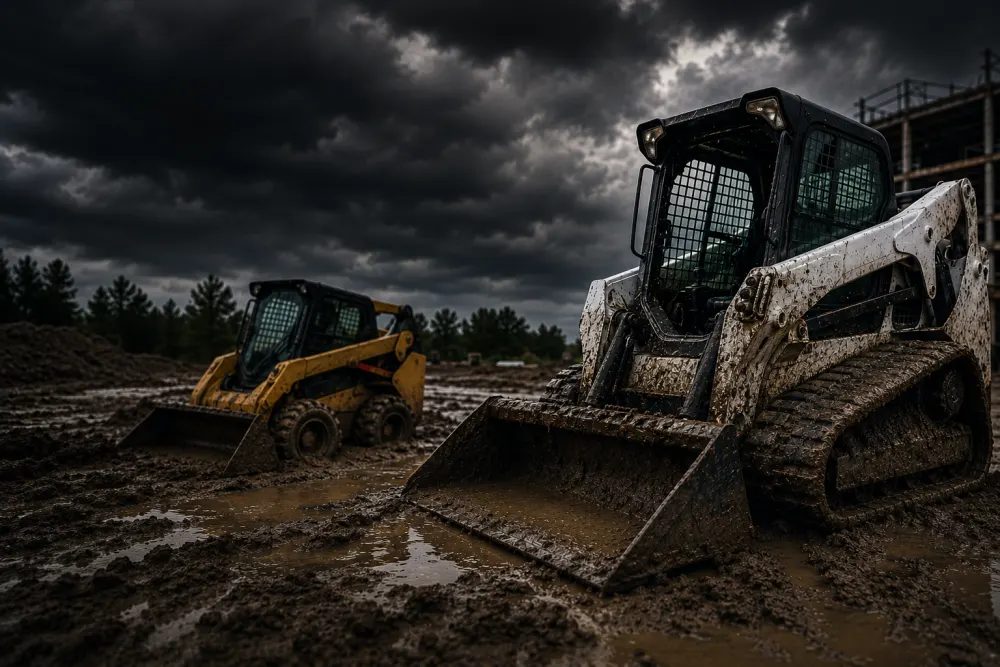
"Skid steer or compact track loader for a muddy site? One sinks, one works. Here's the ground pressure math and when each machine makes sense."
Related reading: How to Streamline Equipment Procurement for Multiple Job Sites Without Managing Separate Rental Agreements, How to Rent Storm Cleanup Equipment After a Hurricane in 2026, and How to Rent and Set a Commercial Generator in 5 Steps.


Get the latest GoDizel content delivered straight to your inbox
Learn how to consolidate equipment procurement across multiple job sites. Stop managing separate rental agreements and optimize your fleet management today.
Learn how to rent storm cleanup equipment effectively in 2026. Follow our guide to secure essential restoration tools and prevent long-term property damage.
Mud doesn't defeat equipment by being wet. It defeats equipment by exceeding a handful of measurable physical limits, and every argument about which machine belongs on a saturated site traces back to the five terms below. Get these straight and the rental decision stops being a guess.
Ground pressure is the machine's operating weight distributed across the surface area actually touching the soil, expressed in pounds per square inch. Standard wheeled skid steers typically exert 35-45 PSI of ground pressure, significantly higher than tracked counterparts, which is why a wheeled unit punches through a soft crust that a tracked unit rolls across.
Flotation is the machine's ability to stay on top of saturated soil rather than sink into it, and it's a direct function of contact area — wide rubber tracks spread the same weight over far more surface than four tires do.
Ground clearance is the vertical gap between the underside of the chassis — the belly pan — and the ground; once mud rises above that gap, the machine is resting on its frame instead of driving on its drive system.
The ledge effect describes what happens when a machine crosses an abrupt transition in a muddy site — a trench edge, a rutted haul path, a pad drop-off — and the undercarriage catches or the load shifts before the drive system regains purchase.
OTT tracks are steel or rubber track systems bolted over a wheeled unit's tires, adding contact area and bite without the cost of a dedicated tracked machine. See the Real Rental Price Before You Make a Single Call.
The skid steer vs compact track loader question has one honest answer in soft ground: tracks win on flotation, wheels win on cost and clearance. Here's the comparison that matters when the forecast turns.
Typical Ground Pressure: 35 to 45 PSI
Best Use Case: Hard pads, gravel, pavement, demolition, and high cycle loading
Mud Performance: Poor in saturated soil. Digs ruts and loses traction on slick clay
Typical Ground Pressure: Roughly 3 to 6 PSI with wide rubber tracks
Best Use Case: Soft topsoil, sensitive turf, grading, and wet conditions
Mud Performance: Strong flotation, but vulnerable when mud depth exceeds belly pan height
The PSI gap is the whole story. According to specifications published by Bobcat, standard wheeled skid steers typically exert 35-45 PSI of ground pressure, significantly higher than tracked counterparts. That difference decides whether a machine sits on the soil or in it.
Soil type matters more than rainfall totals. On greasy clay — a thin slick film over firm subgrade — a wheeled unit with aggressive tread or chains can still work, because the load-bearing layer is only inches down. In deep, soupy conditions where there's no firm layer within a foot of the surface, a compact track loader is the only machine likely to finish the shift.
Cost runs the other direction. CTL day rates sit above comparable wheeled units, and undercarriage wear — tracks, rollers, idlers, sprockets — is meaningfully more expensive to replace than a set of tires. Smooth or worn tires on a slick surface produce spin, not production, so a wheeled unit without chains or OTT tracks is rarely worth mobilizing to a wet site.
Low ground pressure solves one problem. It creates another, and the operators who learn that lesson the hard way learn it while waiting on a dozer to pull them out.
A CTL's flotation advantage disappears the moment mud depth exceeds belly pan height. The machine stops riding on its tracks and starts riding on its frame — high-centering — at which point the tracks spin freely and dig the chassis deeper. Wheeled machines generally sit higher, which is the one structural advantage they hold in genuinely deep conditions.
Probe mud depth before committing a tracked machine to an unknown area.
Compare the spec sheet ground clearance of the specific model, not the class average.
Keep the bucket low and loaded lightly when crossing suspect ground.
Grousers pack solid with clay, and a track with filled grousers becomes a flat rubber sled. On a greasy slope, that machine slides sideways with no steering authority at all. Wheels cut through the film and can sometimes hold a line where tracks won't.
Approach muddy slopes straight up or straight down, never across.
Stop and clear packed grousers before working any pitched surface.
Watch for the ledge effect at pad edges and trench crossings.
Mud left in a CTL undercarriage overnight sets hard and accelerates roller and sprocket failure. Fifteen minutes of cleanout protects thousands in components.
Pressure-wash tracks, rollers and sprockets at end of shift.
Check track tension after heavy mud work.
For wheeled units, heavy-duty tire chains deliver bite at a fraction of OTT track cost.
The CTL vs skid steer mud debate resolves differently depending on what's actually under the water.
Standard wet conditions, soft topsoil, sensitive turf: rent a CTL. Flotation and minimal site disturbance keep restoration costs off the change order.
Light mud over a firm base, tight budget: a wheeled skid steer with OTT tracks or heavy-duty chains does the same work for less money.
Deep, soupy mud with no firm layer near the surface: prioritize ground clearance. A high-centered CTL costs more in recovery time than a wheeled machine costs in traction.
Hard pads, demo, gravel, high-cycle loading: wheels remain faster, cheaper and easier to maintain. A skid steer compact enough to maneuver between forms still earns its keep year-round.
Mixed conditions across one site: rent both. The mobilization cost is usually smaller than a week of lost production.
So on a track loader vs skid steer call for a skid steer muddy site — which one is better on a muddy site comes down to mud depth relative to belly pan height, not brand preference.
Acting on that decision is where most crews lose the day. Calling six yards to find out who has a 1700-2000 lb. compact track loader available tomorrow is the friction, not the machine. GoDizel lets you compare live rental pricing and availability on both machine classes in under a minute, book directly, and lock in tracked equipment before the seasonal rush clears the regional supply. See the Real Rental Price Before You Make a Single Call.

