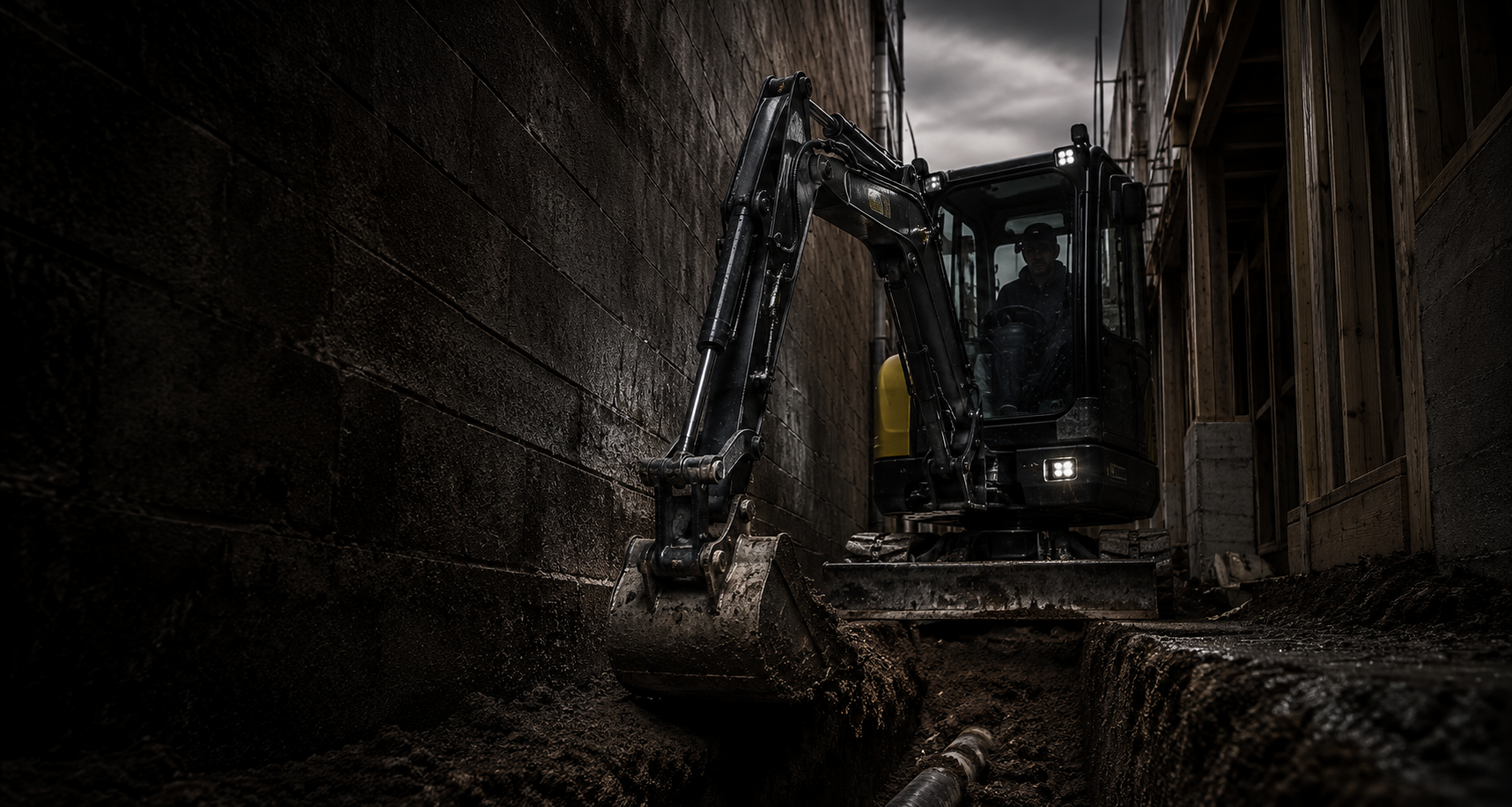
"Master tight space maneuverability with your compact excavator. Learn how to calculate clearance, compare tail swing types, and choose the right rental machine."
Related reading: How to Streamline Equipment Procurement for Multiple Job Sites Without Managing Separate Rental Agreements, How to Rent Storm Cleanup Equipment After a Hurricane in 2026, and How to Rent and Set a Commercial Generator in 5 Steps.


Get the latest GoDizel content delivered straight to your inbox
Learn how to consolidate equipment procurement across multiple job sites. Stop managing separate rental agreements and optimize your fleet management today.
Learn how to rent storm cleanup equipment effectively in 2026. Follow our guide to secure essential restoration tools and prevent long-term property damage.
Picking the wrong machine for a confined job site is one of the most expensive mistakes a contractor can make. Before you search for a micro excavator rental or commit to any specific machine class, you need hard measurements — not estimates — of every physical constraint on your site. Think of this step as building the spec sheet the machine has to match.
Accomplish this step by working through four critical measurements in sequence:
Measure the narrowest access point. Walk every entry route — gates, alleyways, side yards, or interior openings — and record the width and height of the tightest passage. Add at least 6 inches of clearance buffer on each side to account for blade or bucket overhang during entry.
Identify vertical obstructions. Scan the full work area for eaves, power lines, tree canopies, or low-clearance structures. Vertical limits directly restrict boom height during operation, not just transit.
Determine required dig depth versus machine reach. Match your target trench depth or excavation footprint against published digging depth specs before rental. A machine that cannot reach the required depth forces multiple repositions, which costs time on confined sites.
Assess ground pressure limits. Soft landscaping, pavers, or existing slabs impose load limits. Check the machine's ground pressure rating — measured in PSI — against what the surface can sustain without damage.
Right-sizing matters more than raw power. A smaller machine that fits the site outperforms a larger one that cannot maneuver without striking obstructions. Understanding how to park in tight spaces starts with knowing, precisely, how much space you actually have. Once those measurements are locked in, the next decision — zero tail swing versus conventional tail swing — becomes straightforward.
With your clearance numbers in hand, the next decision that determines your heavy equipment tight space maneuverability is choosing between a zero tail swing (ZTS) and a conventional tail swing excavator. Getting this wrong means a machine that cannot rotate freely — or worse, one that damages adjacent walls mid-dig.
Here is how to evaluate and match the right configuration to your job:
Identify your boundary conditions. Measure the distance from your dig centerline to the nearest fixed obstacle — a wall, fence, or foundation. This single number drives every decision below.
Understand ZTS geometry. On a zero tail swing machine, the housing stays within the track width during a full 360-degree rotation, meaning the counterweight never extends beyond the machine's footprint. Wall-adjacent trenching, basement work, and corridor excavation are all viable.
Weigh the stability trade-off. Conventional tail swing units carry a counterweight that extends beyond the tracks, which improves lift capacity and arm force. In open conditions, that extra stability is an advantage. Against a wall, it becomes a hard stop.
Evaluate sustained maneuver duration. For long-duration trenching runs where the machine must reposition repeatedly, ZTS tends to work better — each swing cycle stays predictable and safe without a spotter constantly watching the rear.
Match configuration to task. Wall-adjacent grading, utility trenching near structures, and indoor demolition favor ZTS. Open-field grading, heavy lifting, and deep excavation often favor conventional tail swing for the added counterbalance.
Request the right unit when booking a small digger rental. Confirm with the rental provider whether the machine is ZTS-rated and ask for the manufacturer's tail swing radius specification before the truck leaves the yard.
Once you have the correct machine confirmed, the next challenge is getting it onto the site cleanly — which is where your approach and entry technique becomes equally critical.
Navigating a compact excavator into a confined work zone demands deliberate technique, not just a capable machine. Once you have confirmed your tail swing type and clearance numbers, the approach itself determines whether entry goes smoothly or becomes a costly repositioning exercise. Doing a quick compact excavator turning radius comparison between your machine's spec sheet and your actual site measurements before you move is a habit that pays off every single time.
Follow these steps to execute a controlled, damage-free entry into any tight work zone:
Align the tracks perpendicular to the entry point before you begin moving forward. A square approach eliminates the need for corrective steering mid-entry, which is where most sidewall and gate strikes happen.
Retract the expandable undercarriage if your machine is equipped with one. Narrowing the track width can reduce your footprint by several inches — enough to clear a framed opening that would otherwise reject the machine entirely.
Station a spotter at every blind spot, particularly when the excavator has been offloaded from a semi-truck delivery trailer and the operator is still adjusting to the machine's orientation on unfamiliar ground.
Drop to the lowest usable travel speed before crossing the entry threshold. Lower speed increases torque and gives the undercarriage maximum steering authority on uneven or soft surfaces.
Pause and re-assess clearance once the front idlers have crossed the entry point. What looked clear from outside the zone may present new obstacles once you are inside the frame.
Bold safety tip: Never rush the entry. As one industry discussion on spatial awareness puts it, a skillful operator in tight spaces is defined by "the ability to maintain spatial awareness and patience over speed." That distinction between a confident entry and a reactive one often comes down to swing space management — which is exactly where the next step takes you.
With your machine positioned and your entry path established, the next priority is working efficiently without repositioning the tracks repeatedly. Every unnecessary track movement costs time and increases the risk of disturbing underground utilities or unstable trench walls.
Complete these steps to maximize your swing efficiency once the machine is in place:
Plan your dig pattern before the first bucket drop. Map out the full trench or excavation run mentally, then position the machine so the greatest number of passes are reachable from a single track position.
Activate boom swing for offset work. Most compact excavators offer independent boom swing, allowing the arm to angle left or right without rotating the cab. Use this for offset trenching along walls or footings where cab rotation is impossible.
Stage spoil piles deliberately. Place excavated material to one side only, keeping the opposite side clear as your exit path. A blocked exit in a confined zone creates a real safety hazard and wastes repositioning time.
Check overhead clearance before every cab rotation. Utility lines, low ceilings, scaffolding, and structural overhangs are common strike hazards. Maximizing vertical maneuver space can increase operational efficiency by 15% in urban demolition environments, making overhead awareness both a safety and a productivity discipline.
Match swing arc to available horizontal space. In sites where zero tail swing vs conventional tail swing was a deciding factor during machine selection, that same clearance logic applies to your horizontal swing arc during operation. Know your radius and respect it.
Reassess position every three to four bucket cycles. In practice, small drift in machine angle compounds quickly. A quick check keeps the boom centered in its most efficient range and reduces unnecessary arm extension.
Applying these steps consistently keeps your machine productive without constant repositioning — a discipline that separates efficient confined-space operators from those who fight the site all day. The next section pulls together the core principles from every step into a set of practical takeaways you can apply across any tight-space job.
Pulling together the right approach before you book a compact excavator can save hours of repositioning on-site. Use these four principles as a quick-reference checklist before your next job.
Zero Tail Swing is non-negotiable on tight sites. Any work zone with less than 5 feet of lateral clearance demands a zero tail swing machine. A conventional rear overhang will contact walls, fencing, or parked vehicles during every rotation — turning a manageable dig into a liability.
Calculate the total landed cost. Micro-unit rental rates can look reasonable until delivery fees are added. Always verify the full delivered price before committing, especially for single-day pulls where transport cost can rival the rental itself.
Compare maneuverability ratings for dirt movers before booking. Digital equipment marketplaces let you filter and compare turning radii, tail swing dimensions, and transport weight side by side. Use that data to match machine geometry to your site constraints, not the other way around.
Precision beats power in residential utility work. Tight trenching, root pruning near foundations, and proximity grading reward control over bucket force every time.
Compact excavator work in confined environments is ultimately a planning problem as much as an equipment problem. Get the machine geometry right, confirm your all-in cost, and trust that a well-matched tool — operated with deliberate technique — will outperform a more powerful unit every time. When you are ready to compare specs and find available units near your job site, a platform built around equipment search takes the friction out of that final step.