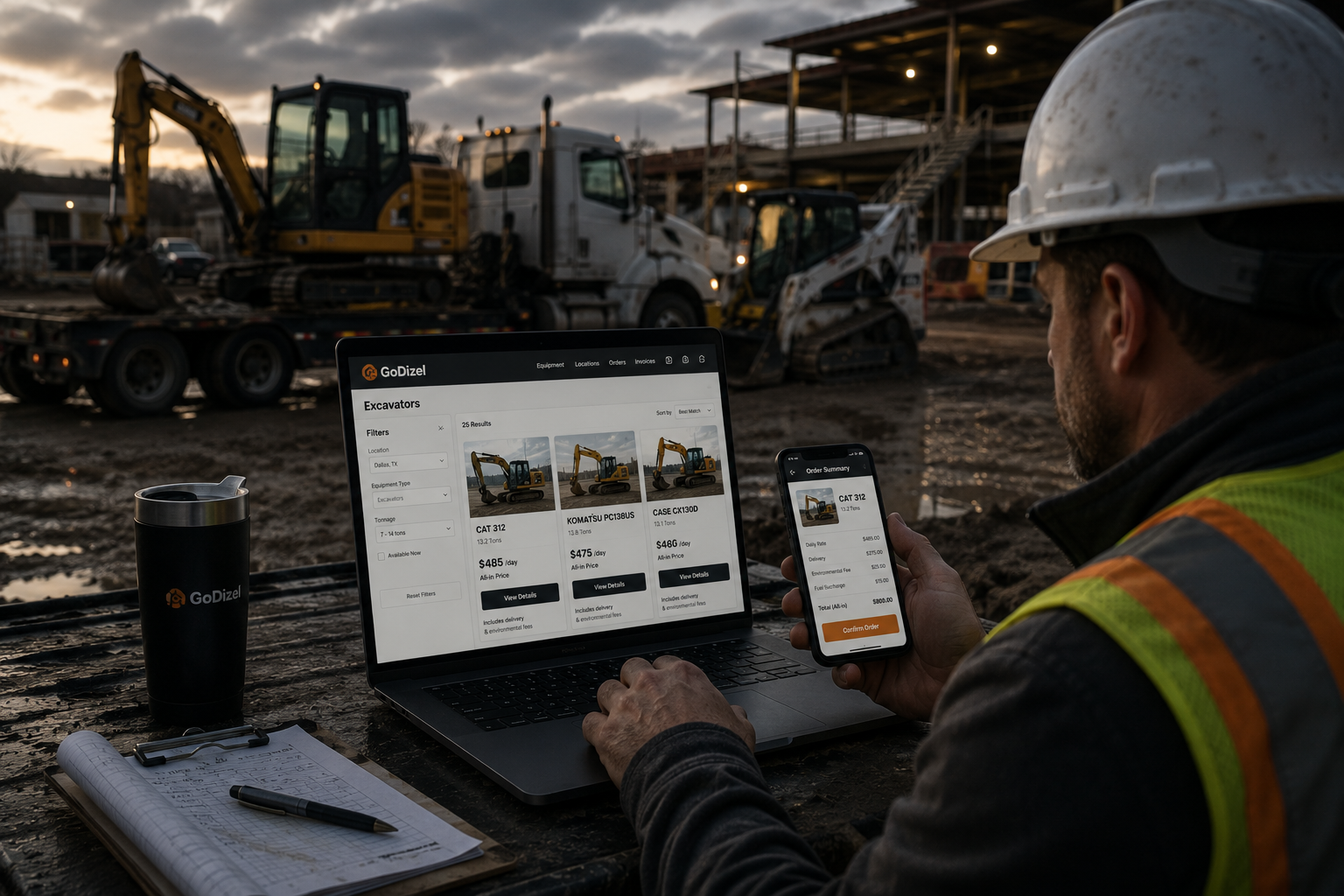
"Renting heavy equipment online rewards discipline. A five-step system for 2026: spec it, compare all-in pricing, and close out clean."
Related reading: Dizel One Rate, How it works., EVERYTHING CONTRACTORS NEED TO KNOW ABOUT DIZEL, and FAQ FOR RENTAL COMPANIES AND EQUIPMENT PROVIDERS.


Get the latest GoDizel content delivered straight to your inbox
The price you see is the price you pay. No delivery fees, fuel surcharges, or mystery line items. One Rate. One search. Book and get back to work.
Stop calling around for equipment. Dizel lets you compare rates, check availability, and book rentals in minutes—all from one trusted platform.
Great procurement is not a matter of luck or circumstance. It is a matter of discipline. The contractors who consistently get the right machine, at the right price, on the right day are not smarter than everyone else. They simply follow a system, and they follow it every single time.
The heavy equipment rental market is projected to reach approximately $135.7 billion by 2030, propelled by an industry-wide shift from ownership to rental. Growth of that magnitude means more suppliers, more rate tiers, and more variables. The undisciplined renter experiences this as chaos. The disciplined renter experiences it as opportunity. The difference is the system below.
Renting heavy equipment online starts well before you open a browser tab. Lock your specifications early and you prevent costly mid-project swaps; skip this step and every price you see reflects a generic estimate rather than your actual scope.
Build a complete equipment brief with four data points:
Determine ton-class or reach height. Excavators are categorized by operating weight: mini (1 to 6 tons), mid (7 to 14 tons), and large (15 to 90 tons). Aerial platforms filter by working height, commonly 20, 40, or 60-plus feet. Match the machine to your dig depth or lift requirement, never to your budget.
Identify site constraints. Narrow access, indoor air-quality rules, and weight-restricted surfaces all shrink your options. A diesel excavator disqualifies itself on an indoor pour slab. Know this before you search, not after.
Calculate exact duration. A typical weekly rate runs roughly 3 to 4 times the daily rate, so overestimating by even two days inflates cost without adding value.
Prepare precise delivery coordinates. Logistics pricing is distance-dependent. Exact coordinates produce an accurate freight number instead of a placeholder.
Four data points. That is the entire price of admission, and most contractors never pay it.
Here is where the process traditionally breaks down. Calling yards one by one is slow, inconsistent, and riddled with availability gaps. According to McKinsey & Company, digital marketplaces compress the procurement cycle from days to minutes by consolidating fragmented supplier data into one interface. That is not an incremental improvement. It is a different way of operating.
Configure the marketplace deliberately:
Navigate to a platform that aggregates regional and national suppliers, giving you one unified view of excavators, dirt movers, and earthmoving inventory.
Create a contractor profile with your business license and tax ID to unlock member pricing and tax-exempt status where applicable.
Enter your job site address, since location drives both delivery cost and lead time.
Select your equipment category, Earthmoving, Power Generation, or Aerial, to match the machine class from your brief.
Comparing prices is not about finding the lowest number. It is about understanding what each number contains. According to Trackunit research, roughly 92 percent of construction professionals say real-time visibility into availability is critical to project planning. That single fact explains why phone-and-fax procurement is losing ground so quickly.
Filter by equipment class and toggle between daily and hourly views. Hourly rates tend to win for tasks under four hours.
Identify all-in pricing that bundles delivery, pickup, and environmental fees. A base rate without them can understate true cost by 15 to 30 percent.
Verify availability refreshes in real time, not on a 24-hour lag, because double-booking is what manually managed inventory produces.
Cross-reference quotes against published heavy equipment rental cost guides to confirm they fall within regional benchmarks.
As the Association of Equipment Management Professionals observes, AI in construction procurement is no longer a luxury. It is a necessity for managing complex logistics. Use it with discipline:
Engage the platform's AI agent to verify attachments, confirming buckets, augers, or compaction wheels are paired correctly before the order finalizes.
Review the automated delivery schedule against your crew's actual site-access windows.
Upload your Certificate of Insurance once; the platform applies it to every future rental automatically.
Confirm the all-in total, delivery, fuel surcharges, and environmental levies included, so the end-of-month invoice contains no ambiguity.
Booking the machine is half the equation. The disciplined hand-off is the other half:
Track the delivery vehicle in real time so your supervisor coordinates crew and access routes before the machine arrives.
Perform a digital walk-around the moment equipment unloads. Photograph all four sides, log pre-existing damage, and require the driver's countersignature.
Log the hour-meter reading immediately. According to Holt CAT's heavy equipment rental guide, undocumented meter readings are a leading cause of billing discrepancies on extended rentals.
Set automated alerts for extensions and pickups. Accidental over-rental is among the most avoidable cost overruns in the industry.
Closeout is where contractors quietly lose money. With GoDizel, the off-rent process is built to eliminate what the industry calls Invoice Drama, the gap between the real-time quote and the final bill:
Click Off-Rent the moment equipment leaves your site. This stops the billing clock during pickup coordination.
Download the consolidated invoice in formats compatible with Procore or Sage, removing manual re-entry errors.
Review the final cost line by line against your original quote, and flag any variance through the dispute tool immediately.
Rate the supplier. Ratings feed the recommendation engine that refines your future matches.
None of these steps is remarkable on its own. Their power is cumulative. The GoDizel platform lets contractors search over 4,000 machines across local and national yards in under a minute, but the platform is only as good as the process you bring to it. Prioritize all-in pricing. Filter by real-time availability. Let AI handle the paperwork. Inspect digitally at delivery, and close out the same way every time.
Run this cycle on every rental and each turn gets easier, faster, and cheaper than the last. That is the point. Procurement stops being a liability you manage and becomes an advantage you compound.
Listing your equipment on Dizel is designed to be straightforward, whether you want full control or prefer a completely hands-off approach.

